Psychology Roots
Table of Contents
Comprehensive Frameworks in Lifespan Psychology: An Integrative Academic Review
The establishment of psychology as a formal scientific discipline is a relatively recent historical development. Until the 19th century, psychology was not recognized as a separate field of study. The formal inception of the science is widely traced to 1879, founded by Wilhelm Wundt in Leipzig, Germany. Since that foundational moment, the discipline has expanded exponentially to encompass lifespan psychology. Lifespan psychology is the specific field of study that examines the complex patterns of growth, change, and stability in behavior occurring throughout the entire human life span.
To conceptualize these developmental trajectories, researchers divide the lifespan into systematic age groups, including the prenatal period, infancy (ages 0 to 2), early childhood (ages 3 to 6), and middle childhood (ages 6 to 11), extending continuously through late adulthood. A rigorous psychological theory must provide a framework for managing vast collections of observational data, offer coherent explanatory models, and generate testable predictions. These predictions drive further empirical research that refines or extends our theoretical understanding. This article critically evaluates the primary theoretical paradigms that currently define lifespan developmental psychology.
Foundational Debates in Developmental Theory
Before analyzing specific schools of thought, it is necessary to establish the core conceptual debates that govern developmental modeling. Two central issues remain paramount in the literature: the dichotomy of active versus passive development, and the debate between stage-based versus continuous development.
Organismic theorists emphasize active development. They argue that individuals are active participants in their own developmental trajectories. Conversely, mechanistic theorists emphasize passive development. This paradigm posits that humans are driven primarily by internal drives and biological motivations in conjunction with external pressures produced by the environment. Contemporary empirical consensus dictates an interactionist resolution: our active human minds interact continuously with the forces of society and nature, and this dynamic interaction determines our behavior and identity formation.
The Psychodynamic Perspectives
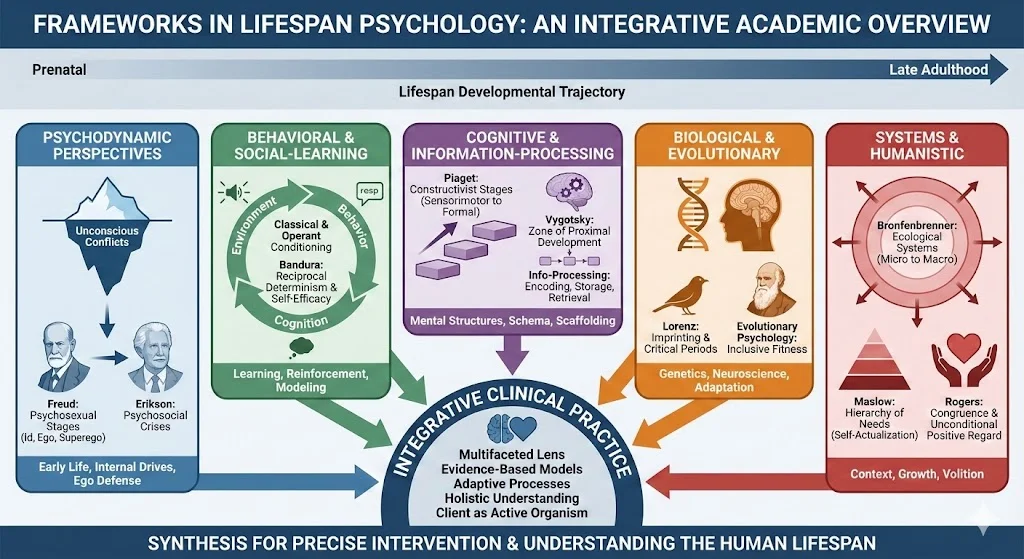
The psychodynamic approach asserts that fundamental psychological structures are forged through the resolution of unconscious conflicts, primarily during early life.
Freudian Psychoanalysis
Sigmund Freud revolutionized the understanding of internal psychological conflict by proposing a tripartite structure of personality. The id operates on the pleasure principle, seeking immediate gratification of fundamental life and death instincts. The ego functions according to the reality principle, mediating between internal desires and external constraints. Finally, the superego represents the conscience and the internalized moral and social standards of the ego ideal.
Freud theorized that development proceeds through specific psychosexual stages: Oral (ages 0 to 2), Anal (ages 2 to 3), Phallic (ages 3 to 6), Latency (ages 6 to 12), and Genital (ages 12 to 18). When the ego faces unmanageable anxiety resulting from these stages, it deploys defense mechanisms. These mechanisms include repression, projection, displacement, regression, denial, sublimation, and reaction formation.
Eriksonian Psychosocial Theory
Erik Erikson advanced psychodynamic theory by shifting the focus from psychosexual to psychological and social motivation. Erikson framed development as an ongoing, lifelong process characterized by eight distinct developmental stages. At each stage, the individual faces a specific psychosocial crisis that must be resolved. These stages span from Trust vs. Mistrust in infancy to Ego Integrity vs. Despair in older adulthood.
Behavioral and Social-Learning Paradigms
Behaviorism emerged as a rigorous empirical counterpoint to the unobservable constructs of psychoanalysis. This framework studies the direct environmental impact on behavior.
Ivan Pavlov established the principles of classical conditioning, demonstrating how learning occurs through the systematic association between environmental stimuli and reflexive responses. B.F. Skinner developed operant conditioning, highlighting the mechanisms of reinforcement and punishment in shaping voluntary behavior. Edward Thorndike contributed the foundational Law of Effect, which dictates that behaviors followed by satisfying consequences are more likely to be repeated.
The Social-Learning school subsequently introduced cognitive variables into the behaviorist equation. Albert Bandura conceptualized self-efficacy, which is derived from mastery experiences, vicarious experiences provided by successful peers, verbal persuasion, and physiological states. Bandura championed reciprocal determinism, illustrating that a belief in your abilities affects your behavior and environment, which subsequently feeds back to alter your beliefs. Julian Rotter introduced the locus of control. Individuals with an internal locus of control believe they are responsible for what happens to them, while those with an external locus believe they are victims of luck, fate, or the actions of others. Furthermore, Edward Tolman’s work on latent learning demonstrated that cognitive maps form even in the absence of immediate reinforcement.
Cognitive and Information-Processing Frameworks
Cognitive theories investigate the structural evolution of human thought and its influence on behavior.
Piagetian Constructivism
Jean Piaget argued that cognitive development involves universal stages occurring in a fixed order, leading to both qualitative and quantitative acquisitions of knowledge. Piaget equated knowledge with motor behavior in early life and proposed that humans organize knowledge into mental structures or schemes. Adaptation occurs via two principles. Assimilation involves fitting new information into your present system of knowledge or mental schemas. Accommodation involves changing and modifying your existing schemas to process novel information. This mental functioning progresses through four stages: Sensorimotor, Preoperational, Concrete Operations, and Formal Operations.
Vygotsky and Information Processing
Lev Vygotsky’s Social-Cognitive Theory localized development within interpersonal contexts. He defined the Zone of Proximal Development as the critical distance between what a child can do alone and what a child can do with the help of others. According to Vygotsky, children develop through participation in activities slightly beyond their competence, facilitated by adults or older peers.
Concurrently, Information-Processing Theory utilizes a computer analogy to map how the human mind receives, analyzes, and stores information. This continuous model examines the mechanisms of encoding data, storing it in memory, and retrieving it into conscious awareness.
Biological and Evolutionary Approaches
Biological approaches ground psychological development in phylogenetic history and neurology. Ethological theories emphasize that behavior is fundamentally influenced by biology. Konrad Lorenz identified imprinting as a rapid, innate learning process occurring within a limited period of time, involving attachment to the first moving object encountered. This research solidified the concept of the critical period, defined as a very early phase in development during which certain behaviors optimally occur.
Evolutionary psychology traces its roots back to Charles Darwin. Theorists like E. O. Wilson utilize concepts of inclusive fitness to explain adaptation. Survival of the fittest manifests in two ways: direct fitness (survival long enough to pass adaptive characteristics to the next generation) and indirect fitness (supporting biological relatedness). Modern developmental neuroscience integrates these perspectives by studying the development of brain structures and their direct relations to behavioral functions.
Systems and Humanistic Frameworks
Ecological Systems
Systems approaches investigate how interconnected environments evolve and change. A core tenet is contextualism, the view that environmental, social, psychological, and historical factors interact systematically to determine development. Urie Bronfenbrenner’s ecological approach originally identified four levels of environment that simultaneously influence individuals: the microsystem, mesosystem, exosystem, and macrosystem. Modern theoretical advancements (e.g., the Bioecological Model) have further refined this by emphasizing the Process-Person-Context-Time parameters (Bronfenbrenner & Morris, 2006).
Humanistic and Existential Theories
Humanistic psychology prioritizes volition, subjective meaning, and the intrinsic drive toward growth. Abraham Maslow proposed a Hierarchy of Needs, progressing from fundamental safety and physiological requirements to emotional needs, ultimately culminating in self-actualization. Carl Rogers stressed the importance of congruence, which is the functional relationship between the “self” (your conscious view of yourself) and the “organism” (the sum of all your experiences, or who you really are). Rogers argued that achieving self-fulfillment requires unconditional positive regard. Complementing this, existentialist theorists like Rollo May confronted the difficult and tragic aspects of the human condition, emphasizing the weight of the freedom of choice and the absence of any obvious predetermined meaning to life.
Critical Analysis: Bridging Theory to Clinical Practice
In clinical practice and advanced academic supervision, we consistently observe that no single theoretical framework can adequately account for the complexities of human psychological distress or resilience. For example, when conceptualizing the etiology of a substance use disorder, a clinician must resist reductionism. A rigorous formulation requires assessing biological predispositions, cultural variables, familial systems, cognitive schemas, and emotional regulation.
Relying exclusively on a mechanistic behavioral view neglects the client’s cognitive agency and existential search for meaning. Conversely, purely humanistic approaches may severely underestimate the neurobiological constraints and systemic barriers facing the client. Recent advancements in lifespan developmental psychology underscore that adaptive processes require a multifaceted lens. We must conceptualize clients not as static clinical entities, but as active organisms continuously negotiating a matrix of biological, systemic, and cognitive variables over time.
Conclusion
Understanding human development mandates a rigorous synthesis of psychodynamic, behavioral, cognitive, biological, systemic, and humanistic paradigms. Each theoretical school offers specific academic utility and distinct clinical tools. By moving beyond rigid ideological demarcations and adopting integrative, evidence-based models, researchers and clinical psychologists can formulate more precise interventions. The ongoing evolution of psychological science ensures a progressively clearer understanding of the profound intricacies inherent in the human lifespan.