 Psychology Roots
Table of Contents
The Unexpected Advantages of Choosing a Pre-Licensed Professional for Your Therapy Journey
You have finally decided to seek therapy. You spend hours scrolling through directories, reading profiles, and looking for someone who feels right. You find a therapist whose bio resonates deeply with you. They specialize in exactly what you are struggling with, and their warm smile puts you at ease. But then, right at the bottom of their profile, you spot a title that makes you pause: Pre-Licensed Professional.
Suddenly, a wave of hesitation washes over you. Are they qualified? Am I going to be a guinea pig? Should I hold out for someone with decades of experience? As a clinical psychologist who has spent nearly two decades in the field, both treating clients and supervising the next generation of therapists, I hear these concerns frequently. It is entirely normal to want the best possible care for your mental health. However, the assumption that a pre-licensed therapist is somehow “less than” a fully licensed one is one of the biggest misconceptions in modern psychology. In reality, choosing to work with a pre-licensed professional offers a wealth of hidden benefits that can profoundly enhance your therapeutic journey.
Let’s demystify what it actually means to be pre-licensed and explore why these dedicated clinicians might be exactly what you need to heal and grow.
What Exactly is a Pre-Licensed Professional?
To appreciate the value of a pre-licensed therapist, we first need to clear up the terminology. The term “pre-licensed” does not mean “uneducated” or “untrained.”
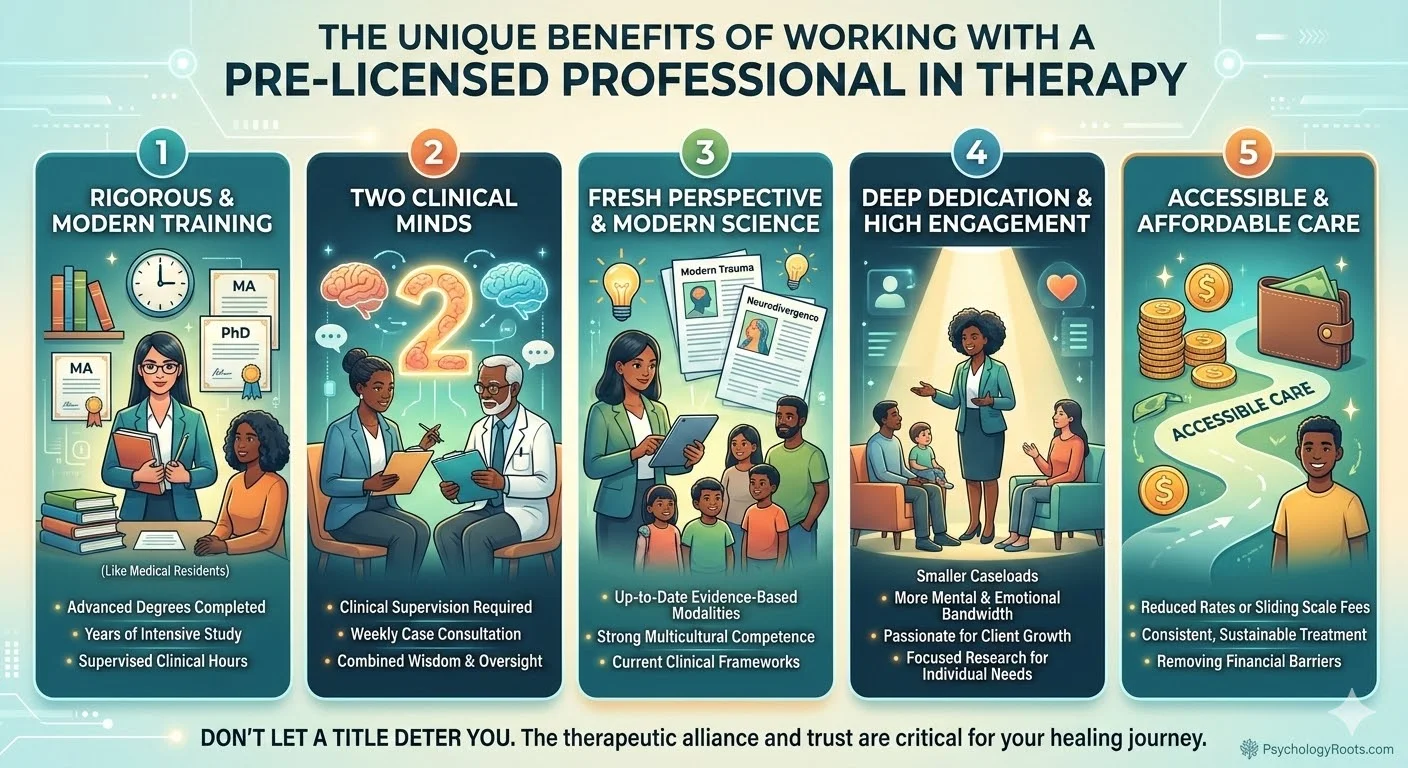
By the time a mental health professional reaches the pre-licensed stage (often holding titles like Associate Marriage and Family Therapist, Clinical Social Work Candidate, or Psychology Postdoctoral Fellow), they have already completed a rigorous Master’s or Doctoral degree program. They have spent years studying human behavior, psychological testing, and therapeutic interventions. They have also completed extensive practicum hours, working directly with clients under observation.
The pre-licensure phase is simply a mandatory, post-graduate period, often requiring 2,000 to 3,000 hours of direct clinical contact, before the state grants them an independent license. Think of them like medical residents: they are highly educated, fully capable doctors who are simply fulfilling their final structural requirements under the wing of an attending physician.
The Hidden Strengths of a Pre-Licensed Therapist
When you sit across from an associate or trainee, you are tapping into a unique set of clinical advantages that are sometimes harder to find in veteran practitioners.
The Power of Collaborative Care (Two for the Price of One)
One of the most significant, yet overlooked, benefits of working with a pre-licensed professional is clinical supervision. Pre-licensed therapists are required to meet weekly with a seasoned, fully licensed supervisor to review their cases.
From a client’s perspective, this is an incredible advantage. You are essentially getting two clinical minds for the price of one. You benefit from the warm, highly engaged relationship with your immediate therapist, while simultaneously receiving the behind-the-scenes wisdom, clinical oversight, and strategic insight of an expert with years of experience. When you face complex challenges, your therapist isn’t sitting in a silo; they are actively consulting with a veteran to ensure your treatment plan is robust and effective.
Up-to-Date Clinical Training and Cultural Competence
Psychology is a constantly evolving science. What we knew about trauma, neurodivergence, and the brain twenty years ago has shifted dramatically. Pre-licensed therapists have just stepped out of modern academic environments.
Because their education is fresh, they are often deeply trained in the latest, evidence-based modalities, such as third-wave Cognitive Behavioral Therapies, modern trauma processing, and somatic interventions. Furthermore, recent graduate programs place a massive emphasis on multicultural competence. Pre-licensed clinicians are intensely trained to understand how systemic issues, race, gender, and societal structures impact your mental health, bringing a highly nuanced and modern perspective to the therapy room.
High Enthusiasm and Unwavering Dedication
Let me speak candidly from my years in the field: burnout is a real threat in the helping professions. A therapist who has been seeing 30 clients a week for 20 years can sometimes, despite their best efforts, fall into clinical routine.
Pre-licensed professionals, on the other hand, are remarkably eager, passionate, and deeply invested in their clients. Because they typically carry smaller caseloads, they have more mental and emotional bandwidth. If you mention a specific, niche struggle during your session, it is highly likely that a pre-licensed therapist will spend their evening researching peer-reviewed articles to bring a specialized intervention to your next appointment. Their dedication to “getting it right” translates to highly personalized, attentive care.
The Financial Benefit: Accessible Mental Health Care
We cannot talk about therapy without addressing the elephant in the room: cost. Mental health care can be prohibitively expensive, creating a massive barrier for individuals desperately seeking support.
Pre-licensed professionals are frequently the bridge to accessible care. Because they cannot yet bill all insurances independently or charge premium out-of-pocket rates, clinics and private practices often offer their services at a significantly reduced rate or on a sliding scale. This allows you to receive top-tier, closely monitored, evidence-based psychological care without enduring crippling financial strain. Consistency is key in therapy, and affordability ensures you can attend sessions regularly enough to see real change.
Therapist Insight: It Is Always Okay to Ask
If you are considering a pre-licensed professional, I encourage you to be an active participant in your care. A strong therapeutic alliance is built on transparency and trust. It is absolutely appropriate to ask questions during your initial consultation.
Feel free to ask:
- “Can you tell me a little bit about your supervisor’s specialty?”
- “What evidence-based approaches are you currently training in?”
- “How do you handle cases that feel stuck?”
A well-trained pre-licensed clinician will not be offended by these questions; they will welcome your self-advocacy and use it to build a stronger foundation for your work together.
Moving Forward with Confidence
The ultimate predictor of success in psychotherapy is not the age or the exact license level of the provider. Decades of clinical research consistently show that the therapeutic alliance, the bond, trust, and collaboration between you and your therapist, is the most critical factor in healing.
If you find a pre-licensed professional who makes you feel seen, heard, and deeply understood, do not let their title deter you. You are stepping into a dynamic environment where passion meets veteran oversight. Give the process a chance, lean into the relationship, and you may find that the exact person you were hesitant to book with becomes the catalyst for your deepest psychological growth.
Key Takeaways
- Pre-licensed does not mean uneducated: These clinicians hold advanced master’s or doctoral degrees and have completed rigorous clinical training.
- You get a clinical team: Working with a pre-licensed therapist means their work is overseen by a veteran supervisor, giving you the benefit of multiple expert perspectives.
- Modern, evidence-based care: Trainees possess fresh academic knowledge, bringing the latest research and strong cultural competence into your sessions.
- Affordability: Pre-licensed professionals often offer high-quality therapy at sliding scale or reduced rates, making consistent care financially sustainable.
References
American Psychological Association. (2019). Clinical supervision in health service psychology. https://www.apa.org/about/policy/clinical-supervision
National Institute of Mental Health. (2021). Caring for your mental health. U.S. Department of Health and Human Services. https://www.nimh.nih.gov/health/topics/caring-for-your-mental-health
Owen, J., Tao, K. W., Drinane, J. M., Hook, J., Davis, D. E., & Kune, N. F. (2016). Client perceptions of multicultural orientation and psychotherapy outcomes. Psychotherapy, 53(1), 24-30. https://doi.org/10.1037/pst0000046
Wampold, B. E., & Imel, Z. E. (2015). The great psychotherapy debate: The evidence for what makes psychotherapy work (2nd ed.). Routledge.
