 Psychology Roots
Table of Contents
The Sixteen Personality Factor Questionnaire (16PF): Structure, Validation, and Clinical Application
The assessment of personality stands as a cornerstone of psychological science. Among the myriad of instruments available to the clinician and researcher, the Sixteen Personality Factor Questionnaire (16PF) distinguishes itself through its rigorous empirical origins and hierarchical structure. Developed by Raymond Cattell, the 16PF was not merely designed to measure preconceived notions of character; rather, it emerged from a scientific quest to map the fundamental building blocks of human personality, akin to the periodic table in chemistry.
This article examines the structural integrity, psychometric properties, and diverse applications of the 16PF in clinical and industrial-organizational settings.
Historical Context and Development
The genesis of the 16PF lies in the lexical hypothesis, which posits that all significant aspects of human personality have been encoded into language. Raymond Cattell, leveraging his background in the physical sciences, sought to identify these basic elements through factor analysis. Unlike contemporaries who developed tests based on intuitive theory, Cattell and his colleagues analyzed vast datasets of “L-data” (life records), “Q-data” (questionnaires), and “T-data” (objective tests) to distill the complexity of human behavior into unitary traits.
This decades-long research program culminated in the identification of sixteen primary personality factors. These primary traits represent the fine-grained nuances of an individual’s character, offering a level of specificity that broader measures often obscure.
The Hierarchical Structure of Personality
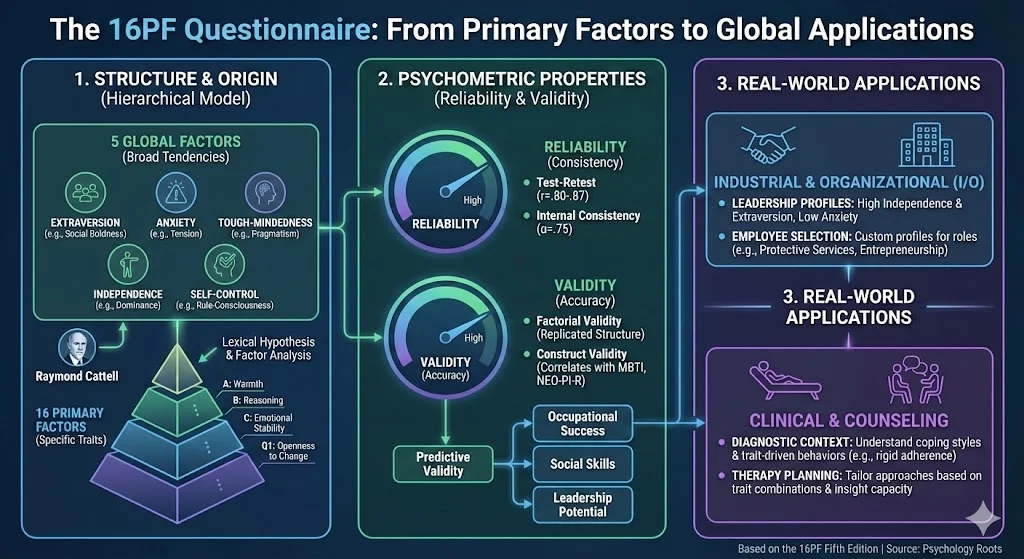
One of the defining features of the 16PF is its multi-level, hierarchical organization. This structure allows the practitioner to view personality through lenses of varying magnification, from broad global tendencies to specific behavioral inclinations.
The Primary Factors
At the base of the hierarchy lie the sixteen primary scales. These factors, such as Warmth (A), Reasoning (B), and Emotional Stability (C), provide the most basic definition of individual differences. Research indicates that these specific primary traits are often more predictive of actual behavior than broader global measures because they capture the unique texture of an individual’s personality.
The Global Factors (The Original Big Five)
Through the factor analysis of the sixteen primary traits, Cattell identified five broader, second-order dimensions. These “Global Factors” serve as an organizing framework and align closely with the widely recognized Big Five model of personality.
- Extraversion: Derived from traits like Warmth (A+) and Social Boldness (H+).
- Anxiety: A composite of traits including Apprehension (O+) and Tension (Q4+).
- Tough-Mindedness: Contrasting openness to feelings and new ideas with pragmatism.
- Independence: Focusing on assertiveness and influence.
- Self-Control: Related to conscientiousness and rule-adherence.
Third-Order Factors
Recent analyses using large-scale samples have identified a third stratum of personality organization. Two consistent third-order factors have emerged:
- Active Outward Engagement: Encompassing Extraversion and Independence, this factor describes the tendency to move assertively into the world.
- Self-Disciplined Practicality vs. Unrestrained Creativity: This factor contrasts internal impulse control and objective focus with sensitivity and openness.
The 16PF and the Big Five: A Methodological Divergence
While the 16PF contains the Big Five factors, there is a distinct methodological difference between Cattell’s model and later Five-Factor Models (FFM) like the NEO-PI-R. The developers of the NEO-PI-R imposed “orthogonality” on their factors, forcing them to be statistically uncorrelated for theoretical simplicity.
In contrast, the 16PF global factors are “oblique,” meaning they are allowed to correlate if the data supports a relationship. For instance, intelligence and anxiety are distinct concepts yet may correlate in the real world; forcing them to be orthogonal distorts this reality. Critics of the forced orthogonal approach argue that it sacrifices the natural interconnectedness of personality traits for statistical convenience. Consequently, the 16PF’s oblique structure often yields factors that are more reflective of the complex, overlapping nature of human psychology.
Psychometric Properties
The scientific utility of any psychometric instrument rests on its reliability and validity. The 16PF Fifth Edition demonstrates robust properties in both domains.
Reliability
Test-retest reliability is strong, with primary scales averaging 0.80 and global scales averaging 0.87 over a two-week interval. Internal consistency (Cronbach’s alpha) for the primary scales averages 0.75. It is important to note that maximizing internal consistency can sometimes narrow the scope of a construct excessively; the 16PF balances homogeneity with the breadth required to measure comprehensive traits.
Validity
- Factorial Validity: Extensive factor-analytic studies across diverse international populations (including German, French, and Japanese samples) have consistently replicated the 16PF’s factor structure.
- Construct Validity: The scales show expected correlations with other established measures such as the Myers-Briggs Type Indicator (MBTI), the California Psychological Inventory (CPI), and the NEO-PI-R.
- Predictive Validity: The instrument has successfully predicted outcomes in areas ranging from leadership potential and creativity to social skills and marital compatibility.
Applications in Practice
Industrial and Organizational Psychology
The 16PF is a staple in employee selection and development due to its ability to predict occupational profiles.
- Leadership: Effective leaders typically score higher on Independence and Extraversion, while scoring lower on Anxiety.
- Entrepreneurship: Entrepreneurs differ from general managers by displaying higher Openness-to-Change (Q1+) and Self-Reliance (Q2+), often combined with lower Sensitivity (I-).
- Protective Services: Police and security personnel consistently demonstrate high Emotional Stability (C+), Rule-Consciousness (G+), and Social Boldness (H+).
Clinical and Counseling Use
Although a measure of normal personality, the 16PF provides vital context in clinical settings. It facilitates rapport and helps clinicians understand a client’s coping style. For example, knowing whether a client’s self-control is driven by rigid adherence to rules (G+) or temperament (Q3+) can dictate different therapeutic approaches. Furthermore, specific trait combinations have been linked to therapy outcomes, such as insight capacity and termination success.
Conclusion
The Sixteen Personality Factor Questionnaire remains a premier instrument in the psychologist’s toolkit. Its endurance is not accidental but is a result of its deep empirical roots and its capacity to capture the complexity of the human psyche. By offering a hierarchical view that spans from broad global factors to precise primary traits, the 16PF provides the depth of analysis required for sophisticated clinical diagnosis, career counseling, and organizational development. For the practitioner seeking an objective, comprehensive, and validated map of personality, the 16PF serves as an essential guide.
References
- Cattell, H. E. P., & Mead, A. D. (2008). The Sixteen Personality Factor Questionnaire (16PF). In G. J. Boyle, G. Matthews, & D. H. Saklofske (Eds.), The SAGE Handbook of Personality Theory and Assessment: Vol. 2 Personality Measurement and Testing (pp. 135–159). SAGE Publications.
- Cattell, R. B. (1946). The Description and Measurement of Personality. Harcourt, Brace and World.
- Cattell, R. B. (1957). Personality and Motivation Structure and Measurement. World Book.
- Conn, S. R., & Rieke, M. L. (1994). 16PF Fifth Edition Technical Manual. Institute for Personality and Ability Testing.
- Costa, P. T., & McCrae, R. R. (1992). Revised NEO-PI-R Personality Inventory (NEO-PI-R) and NEO-PI-R Five-Factor Inventory (NEO-PI-R-FFI) Professional Manual. Psychological Assessment Resources.
