 Psychology Roots
Table of Contents
The Evolution of Cognitive Behavioral Therapy: Integrating Islamic Psychology and Historical Paradigms
Clinical psychology has long relied on foundational paradigms developed within Western secular frameworks. However, the universal application of these models often fails to account for the spiritual and cultural dimensions of diverse patient populations. The uncritical acceptance of early psychoanalytic theories or strictly non-directive therapies frequently yields suboptimal clinical outcomes for individuals who require a centralized, spiritually congruent focus in their therapeutic journey.
Professor Malik Badri, an authoritative figure in clinical psychology, systematically challenged the hegemony of Freudian psychoanalysis by advocating for evidence-based behavioral interventions adapted for cultural relevance. This article examines the methodological innovations in cognitive systematic desensitization, historical precedents set by early Muslim scholars, and the current trajectory of third-wave cognitive behavioral therapies.
Deconstructing Secular Frameworks in Early Psychotherapy
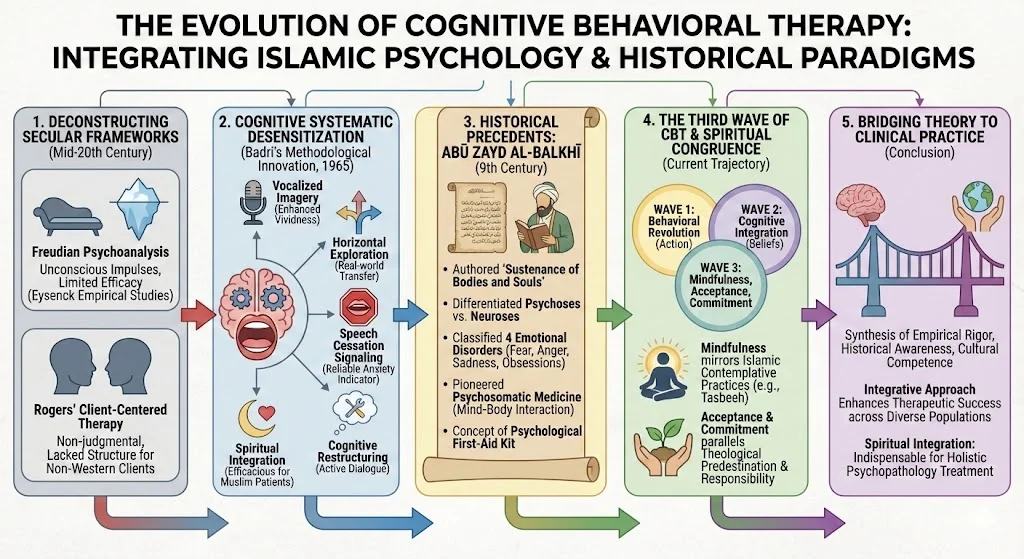
In the mid-twentieth century, Freudian psychoanalysis dominated psychological practice, attributing complex behaviors to unconscious sexual impulses. Concurrently, Rogers client-centered therapy gained traction as a dominant alternative. Clinical observation, however, revealed that extreme non-judgmental and non-interfering approaches often lacked efficacy for non-Western clients. These patients typically seek direct guidance and a structured therapeutic focus rather than entirely self-directed solutions.
The Transition to Empirical Modalities
The paradigm shifted significantly with the empirical evaluations conducted by Hans Eysenck. Eysenck demonstrated severe statistical limitations in psychoanalytic efficacy. His epidemiological research on 7000 patients revealed that 72 percent of individuals with emotional disorders improved without any therapy, whereas only 44 percent improved under psychoanalysis. This empirical validation catalyzed the adoption of learning theory and behavior modification, pioneered by Joseph Wolpe through his technique of systematic desensitization.
Cognitive Systematic Desensitization: A Methodological Innovation
While classical behaviorism offered rigorous stimulus-response paradigms, its mechanistic application treated human subjects akin to Pavlovian models, entirely omitting subjective cognitive and spiritual dimensions. Recognizing these limitations, clinical applications required a transition from rigid behavioral conditioning to cognitive integration.
In 1965, Malik Badri introduced critical methodological alterations to Wolpe systematic desensitization, fundamentally humanizing the process. These evidence-based modifications included:
- Vocalized Imagery: Patients articulated their imagined scenes aloud, significantly enhancing cognitive involvement and vividness compared to silent imagination.
- Horizontal Exploration: Therapists encouraged patients to discuss parallel anxiety-provoking scenarios outside the rigid hierarchy, facilitating superior transfer of coping skills to real-world environments.
- Speech Cessation Signaling: Patients ceased talking when experiencing severe anxiety, providing a highly reliable indicator compared to the classical motor instruction of raising an index finger. Research demonstrated that patients often fail to raise a finger despite exhibiting visible facial anxiety.
- Cognitive Restructuring: Therapists actively engaged in dialogue to alter negative thoughts during anxiety peaks, essentially employing early cognitive therapy techniques.
- Spiritual Integration: The combination of desensitization, cognitive restructuring, and spiritual therapy proved exceptionally efficacious for Muslim patients.
Historical Precedents: The Contributions of Abū Zayd al-Balkhī
Modern cognitive behavioral therapy (CBT) asserts that beliefs and thoughts generate emotional responses. This premise is frequently attributed to ancient Greek Stoicism. Nevertheless, rigorous historical analysis reveals that early Muslim scholars developed sophisticated cognitive therapies centuries before the European Enlightenment.
Abū Zayd al-Balkhī, a ninth-century encyclopedic scholar, authored a seminal manuscript titled Sustenance of Bodies and Souls. His clinical contributions were foundational:
- Al-Balkhī successfully differentiated between psychoses and neuroses.
- He classified emotional disorders into four distinct categories: fear and panic, anger and aggression, sadness and depression, and obsessions.
- He distinguished between normal sadness, reactive depression caused by environmental stressors, and endogenous depression driven by biological factors.
- He instructed mentally healthy individuals to store rational thoughts in their consciousness to counteract future emotional pathologies, conceptualizing a psychological first-aid kit.
- He pioneered psychosomatic medicine by demonstrating the reciprocal interaction between physiological and psychological disorders.
The Third Wave of CBT and Spiritual Congruence
Cognitive behavior therapy continues to evolve through a third wave. The first wave initiated the behavioral revolution against psychodynamic models. The second wave integrated cognitive psychology to focus on beliefs and thought patterns. The current third wave emphasizes mindfulness, acceptance, and commitment. This modern psychological trajectory aligns inherently with Islamic spiritual practices. Mindfulness techniques demand present-moment focus and the external observation of personal emotions, directly mirroring the contemplative focus found in Islamic practices such as tasbeeh. Furthermore, the therapeutic goal of accepting uncontrollable variables while committing to actionable life improvements strongly parallels the theological acceptance of predestination alongside personal responsibility.
Critical Analysis: Bridging Theory to Clinical Practice
In clinical practice, we observe that the deliberate avoidance of a patient worldview undermines therapeutic efficacy. The notion of an entirely non-judgmental, value-free therapy is increasingly obsolete. Effective cognitive interventions depend intrinsically on the core beliefs of the patient. If religion constitutes a central pillar of an individual cognitive framework, therapists must integrate these variables to achieve optimal outcomes.
This integrative approach possesses universal clinical utility, applicable across diverse religious demographics. For instance, psychogenic physiological symptoms rooted in religious guilt require direct spiritual reframing. Collaborating with culturally relevant spiritual authorities can induce profound emotional catharsis and rapid symptom resolution. Modern CBT training curricula must, therefore, systematically incorporate spiritual integration to address the holistic reality of human psychopathology.
Conclusion
The advancement of clinical psychology demands a synthesis of empirical rigor, historical awareness, and cultural competence. The pioneering adaptations of cognitive systematic desensitization by Malik Badri, coupled with the foundational discoveries of Abū Zayd al-Balkhī, demonstrate that indigenous and spiritual frameworks enhance, rather than impede, therapeutic success. As cognitive behavioral therapy enters its third wave, the deliberate integration of spiritual paradigms will remain an indispensable tool for clinicians treating complex, culturally diverse populations.
References
- Badri, M. B. (1966). A new technique for the systematic desensitization of pervasive anxiety and phobic reactions. American Journal of Psychology, 65, 201-208.
- Badri, M. B. (1970). Vivid imagination in relation to the speed and outcome of systematic desensitization therapy. Sudan Medical Journal, 8(3), 145-152.
- Badri, M. B. (2013). Abū Zayd al-Balkhi’s sustenance of the soul: The cognitive behaviour therapy of a ninth century physician. International Institute of Islamic Thought.
- Badri, M. B. (2014). Cognitive systematic desensitization: An innovative therapeutic technique with special reference to Muslim patients. American Journal of Islamic Social Sciences, 31(4), 1-12.
- Eysenck, H. J. (1954). Uses and abuses of psychology. Pelican Books.
- Eysenck, H. J. (1957). Sense and nonsense in psychology. Penguin Books.
- Eysenck, H. J. (1972). Fact and fiction in psychology. Penguin Books.
- Meyer, V., & Chesser, S. (1971). Behaviour therapy in clinical psychiatry. Penguin Books Ltd.
- Vitz, P. C. (1977). Psychology as a religion: The cult of self-worship. Eerdmans Publishing Co.
