Psychology Roots
Table of Contents
Evidence-Based Protocols for Physiological Regulation: A Clinical Review of Relaxation Techniques
In clinical practice, the management of stress is often reduced to colloquial advice regarding “relaxing,” yet the physiological mechanisms underlying relaxation are profound and complex. Stress dysregulation involves the chronic activation of the sympathetic nervous system. This leads to a cascade of neuroendocrine responses that can be deleterious to long-term health.
The induction of the “relaxation response,” the hypometabolic state of parasympathetic dominance, is a critical clinical intervention. This article delineates six empirically supported techniques for stress reduction. It analyzes their mechanisms and provides structured protocols for implementation.
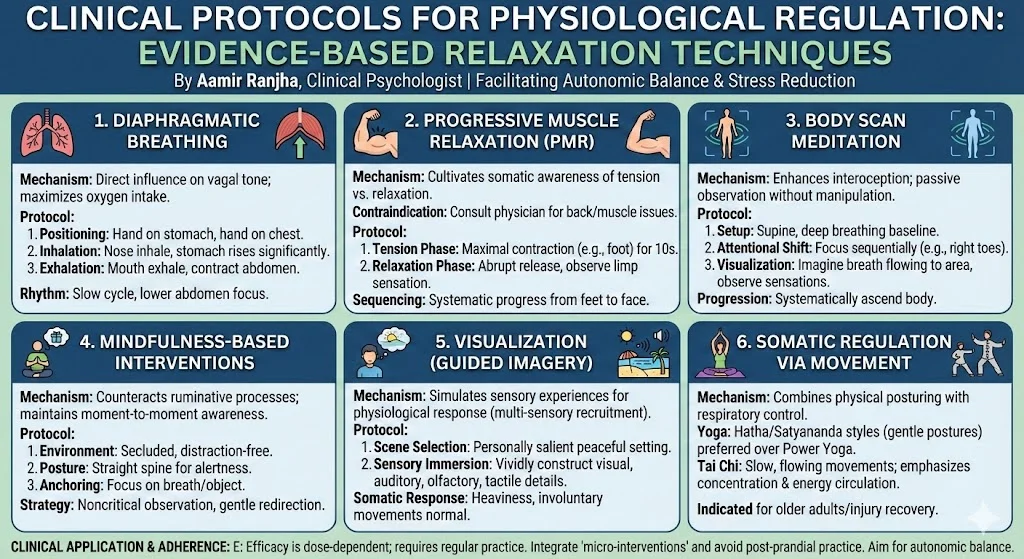
1. Diaphragmatic Breathing: The Foundation of Autonomic Regulation
Breathing exercises serve as the cornerstone for many other relaxation practices due to their direct influence on physiological regulation. Unlike shallow thoracic breathing, which is associated with anxiety, deep breathing is a simple yet powerful technique centered on full, cleansing breaths. By prioritizing abdominal expansion, individuals can maximize oxygen intake. Increased oxygen saturation correlates with reduced feelings of tension, shortness of breath, and anxiety.
Clinical Protocol: The objective is to transition from upper-chest respiration to deep abdominal expansion.
- Positioning: The client should sit comfortably with a straight back or lie on the floor if sitting is difficult. Placing one hand on the chest and the other on the stomach provides biofeedback regarding respiratory mechanics.
- Inhalation: Inhale through the nose; the hand on the stomach must rise significantly while the hand on the chest moves very little.
- Exhalation: Exhale through the mouth, pushing out as much air as possible while contracting the abdominal muscles.
- Rhythm: Establish a slow cycle where the lower abdomen rises and falls with each breath.
- Tactile Aid: For clients struggling with proprioception, placing a small book on the stomach while supine can enhance feedback.
2. Progressive Muscle Relaxation (PMR): Somatic Awareness Training
Progressive Muscle Relaxation (PMR) is a systematic technique that involves a two-step process of tensing and relaxing different muscle groups. This method cultivates an intimate familiarity with the distinct sensations of muscular tension versus complete relaxation. This awareness allows individuals to identify and counteract the early physiological signs of stress.
Contraindications: Prior to initiation, clients with a history of back problems, muscle spasms, or serious injuries must consult a doctor, as the tensing phase may aggravate these conditions.
Clinical Protocol: The standard sequence typically progresses from the feet up to the face.
- Preparation: Loosen clothing and remove shoes to ensure comfort. Initiate the session with deep breathing.
- Tension Phase: Focus attention on a specific muscle group, such as the right foot. Induce maximal contraction by squeezing tightly for a count of ten.
- Relaxation Phase: Relax the foot and focus on the tension flowing away. The client should observe the sensation of the limb becoming limp and loose.
- Sequencing: Proceed systematically through the contralateral foot, calves, thighs, hips, abdomen, back, upper extremities, neck, and finally the face.
3. Body Scan Meditation: Interoceptive Attunement
Distinct from PMR, the body scan technique does not involve tensing muscles. Instead, it emphasizes passive observation of sensations in each body part. The goal is to enhance interoception, the sensing of internal bodily states, without active manipulation.
Clinical Protocol:
- Setup: The subject lies supine with legs uncrossed and arms relaxed at the sides. Deep breathing establishes a baseline of calm.
- Attentional Shift: Attention is directed sequentially, typically beginning with the toes of the right foot.
- Visualization: The client imagines breath flowing to the toes and observes any sensations for one to two minutes.
- Systematic Progression: The focus moves to the sole of the foot, ankle, calf, knee, and thigh before repeating the sequence on the left leg. Attention then ascends through the torso, lower back, and shoulders.
- Cranial Focus: Special attention is paid to the jaw, chin, lips, eyes, and scalp. The session concludes with a visualization of hovering above the body.
4. Mindfulness-Based Interventions: Cultivating Present-Moment Awareness
Mindfulness is operationally defined as the ability to remain aware of moment-to-moment experiences, both internal and external. Clinically, this counteracts the ruminative processes regarding the past or worries about the future that drive sympathetic arousal.
Clinical Protocol:
- Environment: Select a secluded environment free from distractions or interruptions.
- Posture: A straight spine is essential to maintain alertness; lying down is generally discouraged to prevent sleep onset.
- Anchoring: Attention is anchored to a specific focal point. This can be internal, such as a feeling, or external, such as a flame or a meaningful word.
- Cognitive Strategy: Maintain an observant, noncritical attitude. When distracting thoughts intrude, do not fight them; instead, gently return attention to the point of focus.
5. Visualization: Guided Imagery for Sensory Regulation
Visualization, or guided imagery, utilizes the brain’s capacity to simulate sensory experiences to induce a physiological relaxation response. Effective visualization requires “multi-sensory recruitment.” It engages not only the visual cortex but also olfactory, auditory, tactile, and gustatory modalities.
Clinical Protocol:
- Scene Selection: The client selects a personally salient setting associated with peace, such as a tropical beach or a wooded glen.
- Sensory Immersion: The client must construct the scene vividly. For example, in a lake setting, they should visualize the sunset, hear birdsong, smell pine trees, and feel cool water on their feet.
- Somatic Response: It is normal for clients to experience heaviness in limbs, stiffness, or involuntary muscle movements during this deep state of relaxation.
6. Somatic Regulation via Movement: Yoga and Tai Chi
Movement-based therapies such as Yoga and Tai Chi combine physical posturing with respiratory control to strengthen the relaxation response.
Yoga: Not all yoga modalities are suitable for stress reduction. “Power yoga” focuses on stimulation and fitness. Conversely, Hatha and Satyananda styles emphasize gentle postures and deep relaxation, making them preferable for anxiety management.
Tai Chi: Rooted in martial arts, Tai Chi is a non-competitive series of slow, flowing movements. These movements emphasize concentration and the conscious circulation of energy. It is particularly indicated for older adults or those recovering from injury due to its low-impact nature.
Clinical Application and Adherence
The efficacy of these techniques is dose-dependent. Regular practice is required to condition the nervous system. Integrating “micro-interventions” into daily routines improves adherence.
Integration Strategies:
- Rhythmic Exercise: Repetitive physical activities like running or rowing can function as mindfulness practices if the focus remains on the rhythm of breath and movement.
- Situational Practice: Deep breathing can be utilized during mundane tasks such as housework or commuting.
- Hygiene Factors: Practice should be avoided post-prandially (after heavy meals) or while using substances. Furthermore, due to the soporific effects of deep relaxation, practice should be timed when alertness is required unless used specifically for sleep induction.
Conclusion
Stress management is not a passive luxury but an active physiological necessity. By systematically applying these evidence-based techniques, ranging from the mechanical regulation of breath to the cognitive restructuring of mindfulness, individuals can regain autonomic balance.