 Psychology Roots
Table of Contents
The Jungian Psyche: Archetypes, Libido, and Individuation
Carl Gustav Jung remains one of the most influential figures in modern psychology. His divergence from classical psychoanalysis birthed analytical psychology, a framework that conceptualizes the human mind as a complex, self-regulating system. Jung proposed that the ultimate goal of psychological development is individuation, a process of integrating conscious and unconscious elements into a cohesive whole (Jung, 1968). By examining the structure of the psyche, the function of archetypes, and the broader definition of libido, clinicians and researchers can better understand the underlying mechanisms of human behavior and psychopathology.
The Tripartite Structure of the Psyche
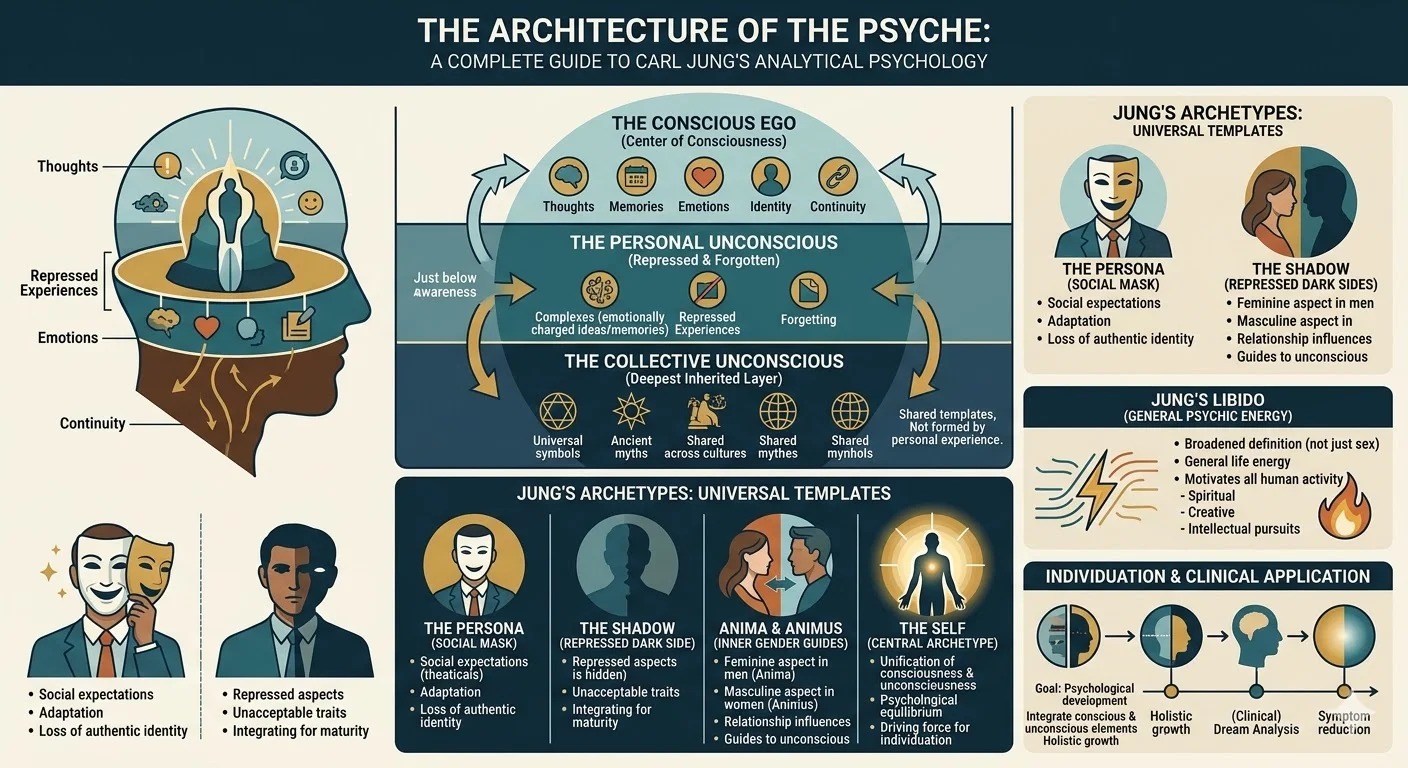
Analytical psychology divides the human psyche into three distinct but interacting realms.
The Conscious Ego
The ego serves as the center of consciousness. It comprises the thoughts, memories, and emotions of which an individual is actively aware. In clinical practice, we often observe that the ego provides a crucial sense of continuity and identity, yet it represents only a fraction of the total psychological structure (Stein, 1998).
The Personal Unconscious
Situated just below the threshold of consciousness, the personal unconscious houses experiences that were once conscious but have been repressed, forgotten, or ignored.
- This layer contains “complexes,” which are emotionally charged groups of ideas and memories (Jung, 1968).
- When a patient exhibits disproportionate emotional reactions to specific stimuli, it frequently points to an active complex rooted in the personal unconscious.
The Collective Unconscious
Jung’s most revolutionary contribution is the concept of the collective unconscious. Unlike the personal unconscious, this deepest layer is inherited rather than shaped by personal experience.
- It contains universal templates of human thought and behavior, shared across cultures and epochs (Jung, 1968).
- These templates manifest universally in myths, religions, and dreams across diverse populations.
Archetypes: The Universal Templates
Archetypes are the structural components of the collective unconscious. They do not have a specific physical form but act as organizing principles that shape how individuals perceive and respond to the world (Roesler, 2012).
- The Persona: This represents the social mask an individual wears to navigate societal expectations. While a well-developed persona is necessary for social adaptation, over-identification with it can lead to psychological rigidity and a loss of authentic identity (Stein, 1998).
- The Shadow: The shadow encompasses the repressed, dark, or socially unacceptable aspects of the personality. Psychological maturation requires confronting and integrating the shadow, a process that frequently surfaces during deep psychotherapy (Jung, 1968).
- The Anima and Animus: The anima represents the unconscious feminine aspect within a man, while the animus embodies the unconscious masculine aspect within a woman. These archetypes act as guides to the unconscious and heavily influence interpersonal relationships, particularly romantic attractions (Roesler, 2012).
- The Self: The Self is the central archetype, representing the unification of consciousness and unconsciousness. It is the driving force behind the individuation process, striving for wholeness and psychological equilibrium.
Libido: A Broader Conceptualization
A primary point of divergence between Jung and Sigmund Freud was the conceptualization of libido. Freud viewed libido strictly as sexual energy. In contrast, Jung expanded the definition to encompass generalized psychic energy (Jung, 1956). This energy motivates all human activity, including spiritual, intellectual, and creative pursuits. Research suggests that viewing libido as generalized life energy provides a more robust framework for understanding motivation in diverse clinical populations, especially when addressing issues of existential meaning rather than purely psychosexual development.
Critical Analysis: Bridging Jungian Theory to Clinical Practice
While some contemporary empirical psychologists critique analytical psychology for its abstract constructs, Jungian concepts remain highly relevant in modern clinical practice. The process of individuation provides a teleological framework for therapy, shifting the focus from mere symptom reduction to holistic psychological growth.
In clinical settings, dream analysis and active imagination are utilized to access the collective unconscious and engage with archetypal material (Stein, 1998). Modern psychodynamic approaches continue to leverage the concept of the shadow when addressing projection and interpersonal conflict. Furthermore, the integration of the anima or animus remains a vital therapeutic goal in couples counseling and individual relationship therapy. Research into narrative psychology and schema therapy frequently mirrors Jungian principles, demonstrating the enduring utility of archetypal frameworks in understanding human cognition and behavior (Roesler, 2012).
Conclusion
Carl Jung’s analytical psychology offers a profound architecture for understanding the human mind. By moving beyond early psychoanalytic models and introducing concepts like the collective unconscious and archetypes, Jung provided a map of psychological development that emphasizes wholeness. The clinical application of these theories continues to facilitate deep transformative work, underscoring the enduring value of individuation in the pursuit of mental health.
References
- Jung, C. G. (1956). Symbols of transformation (Collected Works of C. G. Jung, Vol. 5). Princeton University Press.
- Jung, C. G. (1968). The archetypes and the collective unconscious (Collected Works of C. G. Jung, Vol. 9, Part 1). Princeton University Press.
- Roesler, C. (2012). Are archetypes transmitted more by culture than biology? Questions arising from conceptualizations of the archetype. Journal of Analytical Psychology, 57(2), 223-246.
- Stein, M. (1998). Jung’s map of the soul: An introduction. Open Court Publishing.
