 Psychology Roots
Table of Contents
The Intersection of Childhood Stuttering, Depression, and Early Maternal Separation: A Clinical Analysis
In clinical practice, the management of childhood-onset fluency disorder often presents a complex diagnostic challenge, particularly when comorbid with severe emotional distress. While speech therapists and psychologists frequently debate the boundaries of professional competence, contemporary evidence suggests that stuttering is rarely an isolated motor speech deficit. Instead, it often manifests within a broader psychological framework characterized by emotional reactivity and traumatic history.
This article examines the etiology of stuttering through the lens of psychodynamic theory and developmental psychology, specifically focusing on the role of early maternal separation as a precursor to adolescent depression and persistent dysfluency.
Theoretical Foundations: Separation and the Etiology of Stuttering
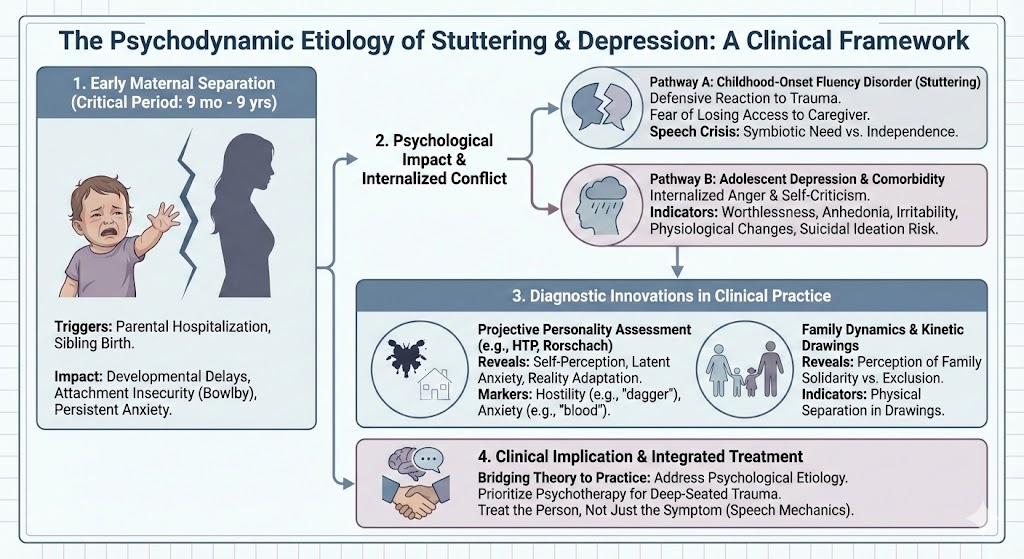
Classical psychodynamic perspectives posit that stuttering can serve as a defensive reaction to the trauma of early separation from the primary caregiver. This fear of losing immediate access to the mother can produce a crisis in speech development, where the child’s need for symbiotic fusion conflicts with the developmental imperative for independence.
The Impact of Early Separation
Research indicates that children are highly vulnerable to the psychological effects of separation during formative years. Prolonged separation, often due to parental hospitalization or the birth of a sibling, can lead to significant clinical outcomes:
- Developmental Delays: As observed by Rene Spitz, infants separated from caregivers for long periods exhibit developmental delays and withdrawn affects.
- Attachment Insecurity: John Bowlby emphasized that without a secure relationship with an adult caregiver, normal social and emotional development is compromised.
- Persistent Anxiety: Sara Klaniczay’s study found that a high percentage of children who stutter experienced lengthy maternal separation prior to the onset of the disorder.
Comorbidity: Stuttering and Adolescent Depression
Depression among school-aged children is a serious problem that often goes unnoticed until it reaches a critical stage. Individuals who stutter and suffer from comorbid depression face increased risks, including a higher likelihood of suicidal ideation.
Clinical Indicators of Childhood Depression
When evaluating a pediatric patient with fluency disorders, clinicians must remain vigilant for symptoms of major depressive disorder:
- Emotional State: Persistent feelings of worthlessness, irritability, hopelessness, or anhedonia.
- Physiological Changes: Significant changes in appetite or persistent difficulty in falling asleep.
- Psychogenic Symptoms: The presence of secondary symptoms such as enuresis (bed-wetting) often accompanies the onset of stuttering following trauma.
- Internalized Conflict: Depression often involves guilt and self-criticism related to early childhood loss.
Diagnostic Innovations in Clinical Practice
A comprehensive diagnostic process for complex cases of stuttering must extend beyond mere fluency counts. Projective techniques and thorough clinical interviews are essential for uncovering the underlying emotional landscape.
Projective Personality Assessment
The House-Tree-Person (HTP) technique and the Rorschach Inkblot Test remain valuable tools for assessing self-perception and latent anxiety.
- The HTP Test: This provides a measure of self-perceptions and attitudes through drawings of houses, trees, and persons.
- Rorschach Analysis: Evaluates sociability, anxiety, and the symbolic meaning of responses.
- Content Markers: Hostility and anxiety are frequently revealed through specific content such as “dagger” or “blood”.
The Role of Family Dynamics
Kinetic and fantasy family drawings reveal a child’s perception of family solidarity or exclusion. A child may perceive themselves as physically separated from the family unit, as seen in drawings where they watch TV in a separate room while others are together.
Critical Analysis: Bridging Theory to Practice
The diagnosis of stuttering requires a multi-disciplinary understanding of the patient’s history. For a child suffering from the burden of stuttering and depression, a linear approach focusing solely on speech mechanics is often insufficient.
Evidence suggests that if the diagnostic process reveals deep-seated emotional trauma or realistic suicidal intent, psychotherapy must be prioritized. Addressing the psychological etiology, particularly early separation anxiety, ensures that the clinician treats the person rather than just the symptoms.
References
- Bowlby, J. (1969). Attachment and Loss. Basic Books.
- Freud, S. (1957). Mourning and Melancholia. The Standard Edition of the Complete Psychological Works of Sigmund Freud.
- Klaniczay, S. (2000). On Childhood Stuttering and the Theory of Clinging. Journal of Child Psychotherapy.
- Lajos, P. (2026). Case Study of a 13-year-old Boy Suffering from Depression and Stuttering. Eötvös Loránd University.
- Rorschach, H. (1998). Psychodiagnostics: A Diagnostic Test Based on Perception.
