 Psychology Roots
Table of Contents
Treating Adolescent Social Anxiety Disorder: A Clinical Case Study on the Efficacy of Cognitive Behavioral Therapy
Social Anxiety Disorder represents a pervasive psychological condition in adolescence, characterized by a profound and persistent fear of social evaluation. In clinical practice, we frequently observe how this disorder impairs both academic functioning and interpersonal development.
This article examines a clinical case of a 15-year-old female student, referred to as Ms. B.A., who presented with severe social anxiety. Through a comprehensive psychological evaluation and a structured ten-session Cognitive Behavioral Therapy intervention, this case illustrates the empirical efficacy of cognitive restructuring and behavioral modification in school-based settings.
Clinical Presentation and Diagnostic Assessment
Demographic and Psychosocial Context
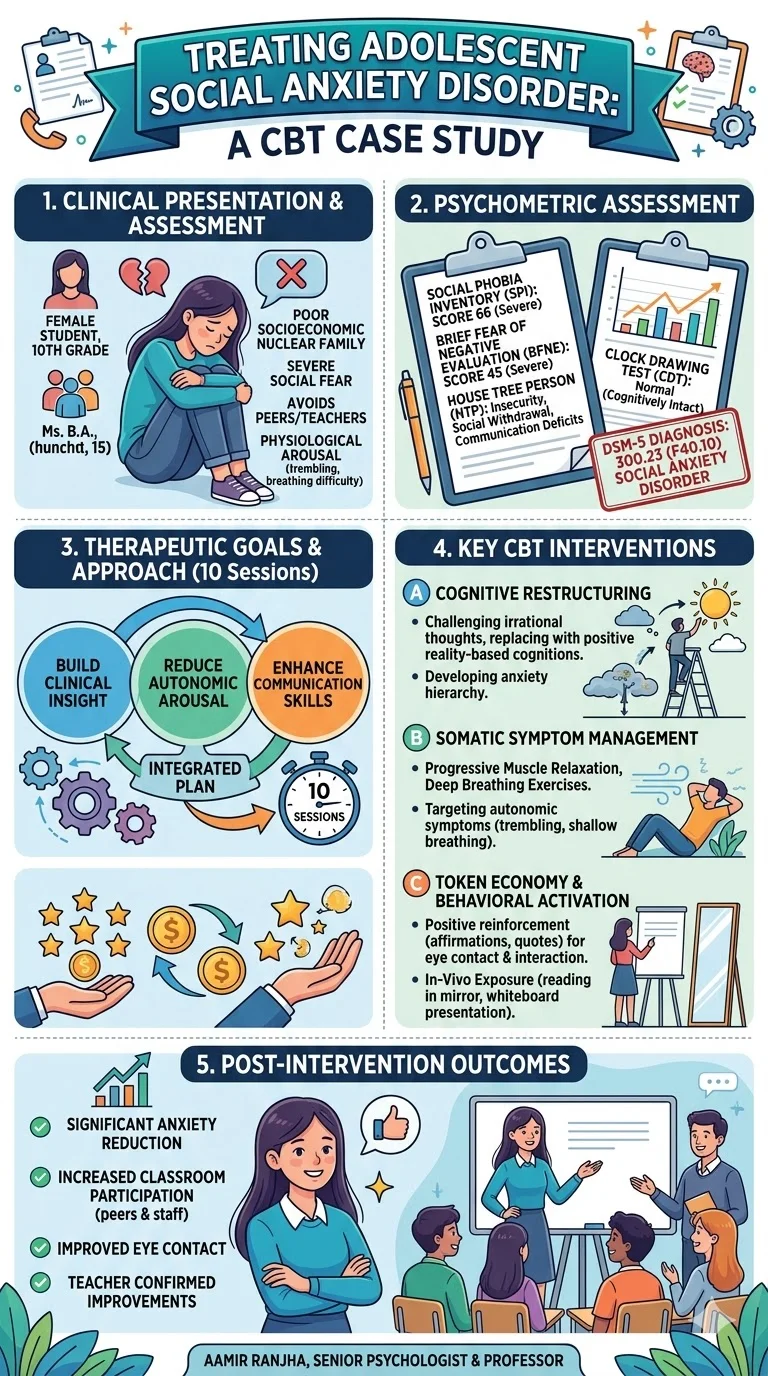
Ms. B.A. is a 15-year-old female currently enrolled in the tenth grade. She resides in a nuclear family system as the second born of six siblings. Her socioeconomic background is categorized as poor; her father is employed as a farmer, and her mother operates as a housewife. At the time of referral, she exhibited profound deficits in social confidence and interaction. She lacked friendships and actively avoided communication with peers, teachers, and family members.
Symptomatology
When called upon in the classroom or placed in social gatherings, she experienced severe physiological arousal. The client reported autonomic symptoms including a dry mouth, difficulty breathing, sweating, and bodily trembling. Furthermore, she failed to maintain eye contact and routinely froze upon the arrival of visitors or when asked to participate in group activities. Her teacher corroborated these observations. The teacher noted that while the student was academically diligent, she exhibited severe shivering and freezing behaviors when asked to participate verbally or approach the classroom whiteboard.
Psychometric Evaluation
To establish a rigorous diagnostic baseline, multiple psychometric instruments were administered.
- The Social Phobia Inventory yielded a quantitative score of 66, denoting severe social phobia.
- The Brief Fear of Negative Evaluation Scale resulted in a score of 45, signifying a severe fear of negative evaluation.
- The House Tree Person projective test highlighted profound feelings of insecurity, social withdrawal, dependency, and communication difficulties.
- The Clock Drawing Test confirmed the absence of any underlying cognitive impairment with a normal score of 1.
Based on the diagnostic criteria outlined in the DSM-5, the client was formally diagnosed with Social Anxiety Disorder, coded as 300.23 (F40.10).
Therapeutic Formulation and Intervention Strategy
The therapeutic goals aimed to build clinical insight, reduce autonomic arousal, and enhance interpersonal communication skills. The treatment spanned ten clinical sessions and integrated multiple evidence-based modalities. The core approach was Cognitive Behavioral Therapy. The therapeutic plan additionally incorporated Progressive Muscle Relaxation, deep breathing exercises, and a token economy.
Cognitive Restructuring
During the initial sessions, the clinical focus remained on rapport building and behavioral observation. The client articulated a profound fear of speaking in front of peers and adults. By the seventh session, cognitive restructuring techniques were actively deployed. The clinician guided the client to identify fear-provoking situations and construct an anxiety hierarchy. Irrational thoughts regarding negative evaluation were challenged and systematically replaced with positive, reality-based cognitions.
Behavioral Activation and Exposure
Behavioral techniques were subsequently introduced to bridge cognitive insight with functional action. A token economy system was implemented to positively reinforce sustained eye contact and verbal interaction. Positive behaviors earned affirmations and motivational quotations, which successfully increased her engagement. For in-vivo exposure, the client practiced reading aloud in front of a mirror multiple times a day. This progressed to a targeted classroom-based exposure task where she successfully approached the whiteboard to write the date and topic in front of her peers.
Critical Analysis: Bridging Theory to Practice
The integration of a token economy within a cognitive-behavioral framework provides a robust mechanism for shaping behavior in adolescents with severe anxiety. Research suggests that Cognitive Behavioral Therapy serves as the gold standard for adolescent anxiety, demonstrating significant efficacy in modifying the maladaptive thought patterns that maintain social phobias (Pegg et al., 2022). While cognitive restructuring addresses the internal pathology of Social Anxiety Disorder (Archer, 2022), the immediate positive reinforcement of the token economy bridges the gap between insight and action. In this case, the client possessed the cognitive capacity for insight but lacked the behavioral momentum to overcome her physiological freeze response.
Furthermore, the utilization of Progressive Muscle Relaxation and deep breathing exercises effectively modulated her autonomic nervous system. By actively addressing the somatic symptoms of her anxiety, such as trembling and shallow breathing, the clinician lowered her physiological baseline, thereby facilitating more successful cognitive and behavioral interventions.
Conclusion
The clinical evaluation of the intervention indicated a marked improvement in the symptomatology of the client. Post-intervention feedback from her teacher confirmed a significant reduction in anxiety behaviors and a notable increase in classroom participation. The client successfully initiated communication with peers and demonstrated the confidence to interact with other teaching staff. She also exhibited vastly improved eye contact during social interactions. This case fundamentally reinforces the empirical validity of a multi-modal Cognitive Behavioral Therapy approach in treating adolescent Social Anxiety Disorder within an educational and clinical context.
References
- Archer, R. (2022). The effectiveness of cognitive behavioral therapy (CBT) for social anxiety disorder in adolescents: A meta-analysis of randomized controlled trials. Journal of Public Health & Environment, 5(2), 162.
- Pegg, S., Hill, K., Argiros, A., Olatunji, B. O., & Kujawa, A. (2022). Cognitive behavioral therapy for anxiety disorders in youth: Efficacy, moderators, and new advances in predicting outcomes. Current Psychiatry Reports, 24(12), 899-906. https://doi.org/10.1007/s11920-022-01384-7
