 Psychology Roots
Table of Contents
The Foundations and Clinical Applications of Behavioural Therapy: A Comprehensive Guide
Behavioural therapy represents a cornerstone of modern psychological intervention. Rooted in empirical science, this approach prioritizes the present moment over historical exploration, focusing on observable behaviours rather than unconscious psychological forces. In clinical practice, we consistently observe that establishing clear, measurable goals yields rapid and sustainable behavioural change.
While traditional behaviourism once operated as an independent modality, contemporary clinical psychology typically integrates these principles into broader cognitive-behavioural frameworks to enhance overall treatment efficacy. This comprehensive guide explores the foundational theories, mechanisms of action, and clinical methodologies of behavioural therapy.
Historical Evolution of Behavioural Therapy
Behavioural therapy emerged in the early 1900s and solidified its position as a primary psychological paradigm during the 1950s and 1960s. During its initial development, the approach faced significant resistance from the dominant psychoanalytic establishment, which prioritized internal subconscious exploration. The progression and validation of the behavioural field relied on the rigorous empirical work of several key theorists:
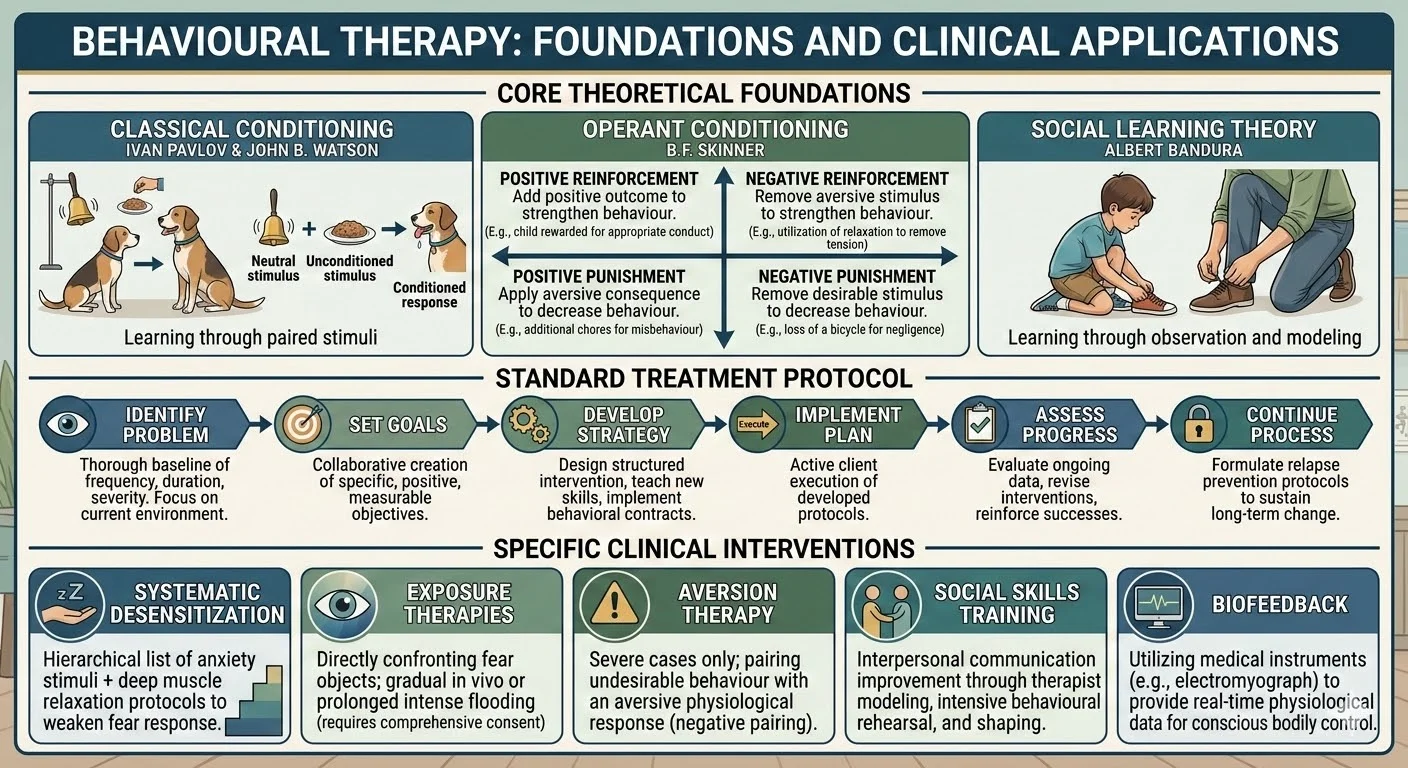
- Ivan Pavlov (1849–1936): Pavlov discovered classical conditioning accidentally while studying the digestive processes of dogs. He demonstrated that pairing an unconditioned stimulus, such as food, with a neutral stimulus, such as a bell, eventually causes the neutral stimulus to elicit a conditioned response identical to the original unconditioned response.
- John B. Watson (1878–1958): Recognized academically as the father of behaviourism, Watson asserted that learning principles could explain all human behaviour. His controversial “Little Albert” research demonstrated that pairing a loud noise with a white rat could condition a fear response in a child, which subsequently generalized to similar objects like fur coats and bearded men.
- B.F. Skinner (1904–1958): Skinner developed operant reinforcement theory, positing that the consequences immediately following a behaviour dictate its future frequency. Skinner strictly emphasized observable actions and entirely rejected the concept of inner psychological causes.
- John Dollard (1900–1980) and Neal Miller (1909–2002): Dollard and Miller expanded foundational theory by conceptualizing habitual responses, which form when a stimulus and response are frequently paired and rewarded. They categorized behaviour into four distinct interactive elements: drive, cue, response, and reinforcement.
- Joseph Wolpe (1915–1977): Wolpe introduced reciprocal inhibition, a physiological mechanism where eliciting a novel response decreases the strength of a concurrent maladaptive response. Wolpe utilized this principle to develop systematic desensitization for treating specific phobias.
- Albert Bandura (1925–2021): Bandura integrated classical and operant conditioning with social learning, demonstrating that individuals successfully acquire new behaviours indirectly through the observation and modelling of others.
Core Theoretical Concepts
Classical Conditioning
Classical conditioning occurs when an unconditioned stimulus naturally produces an unconditioned response without prior learning. Through repeated pairing, a previously neutral stimulus transforms into a conditioned stimulus, capable of eliciting a conditioned response independently.
Operant Conditioning
Operant conditioning, alternatively known as instrumental learning, dictates that learned responses are strictly controlled by their subsequent consequences. This paradigm relies on two primary mechanisms of reinforcement and punishment:
- Positive Reinforcement: Strengthens targeted behaviour through the application of a rewarding outcome, such as providing a child with a reward for appropriate conduct.
- Negative Reinforcement: Strengthens behaviour by removing an aversive stimulus, such as utilizing relaxation exercises to successfully remove physiological stress.
- Positive Punishment: Decreases the likelihood of a behaviour recurring by applying an aversive consequence, such as assigning additional chores following misbehaviour.
- Negative Punishment: Decreases behaviour frequency by removing a desirable stimulus, such as the loss of a bicycle due to a failure to secure it properly.
Social Learning
Social learning extends traditional conditioning by proposing that individuals can undergo conditioning indirectly. Observing the consequences of another person’s behaviour directly influences the observer’s future actions, a process distinctly evident when children emulate the reinforced behaviours of their siblings.
Personality Development in Behaviourism
Behaviourists theorize that human personality develops continuously through learning and unlearning processes across the entire lifespan. Biologically, humans are born with three foundational building blocks: primary drives, specific reflexes, and innate responses to particular stimuli. Primary drives relate to basic physiological needs like food and warmth. Specific reflexes govern automatic bodily processes, whereas innate responses dictate fundamental biological reactions, such as rapidly withdrawing from pain.
Beyond these biological foundations, environmental factors fundamentally shape an individual’s personality framework. For instance, a warm family environment utilizing non-punitive parenting techniques typically fosters high self-efficacy, which defines an individual’s core belief in their own capabilities and competence.
Therapeutic Methodology and Clinical Interventions
The behavioural treatment framework operates on highly specific guiding principles. Clinicians view all behaviour as purposeful and acquired primarily through modelling and reinforcement. Therapy focuses systematically on the present environment, maintaining that current maintaining factors sustain even long-standing maladaptive behaviours. Clients must actively collaborate in defining measurable goals and completing assigned homework tasks between sessions.
Standard Treatment Protocol
The standard clinical sequence involves distinct, measurable steps:
- Identify the Problem: Clinicians establish a thorough baseline regarding the frequency, duration, and severity of the presenting issue.
- Identify Goals: The therapist and client collaboratively set realistic, specific, positive, and measurable objectives.
- Develop Strategies: The clinician designs a structured intervention, teaches new coping skills, and often implements a written behavioural contract.
- Implement the Plan: The client actively executes the developed behavioural protocols.
- Assess Progress: The clinician evaluates the ongoing data, revises areas of need, and heavily reinforces clinical successes to maintain client motivation.
- Continue the Process: The therapeutic dyad formulates relapse prevention protocols to sustain long-term psychological change.
Specific Clinical Modalities
Behavioural interventions focus exclusively on symptom and behaviour modification rather than pursuing deep psychodynamic insight. Scientifically validated treatments utilized in modern clinics include:
- Systematic Desensitization: This counterconditioning technique successfully weakens the association between a stimulus and a panic response. Clients build a hierarchical list of anxiety-arousing stimuli and progress through it while employing deep muscle relaxation protocols.
- Exposure Therapies: In vivo desensitization exposes clients to real-world anxiety triggers, starting briefly and increasing duration gradually. Flooding exposes the client to a highly fearful situation for a prolonged period, requiring careful ethical consideration and comprehensive informed consent before implementation.
- Aversion Therapy: Reserved strictly for severe or treatment-resistant cases, this controversial method pairs an undesirable behaviour with an aversive physiological response to reduce target behaviour frequency.
- Social Skills Training: Clients improve interpersonal communication through therapist modelling, intensive behavioural rehearsal during clinical sessions, and gradual behavioural shaping.
- Biofeedback: Clinicians utilize medical instruments, such as an electromyograph, to provide real-time physiological data, enabling clients to consciously control bodily tension and accurately apply relaxation protocols.
Clinical Applications and Efficacy
Extensive literature supports the application of behavioural therapy across a wide spectrum of psychological conditions. It effectively treats anxiety disorders, sexual dysfunctions, depressive episodes, eating and weight disorders, childhood behavioural issues, and severe interpersonal difficulties. Furthermore, recent empirical research demonstrates that behavioural principles significantly improve patient adherence to medical regimens in chronic disease management, expanding the utility of operant conditioning directly into preventative cardiovascular care and general hospital settings.
Critical Analysis: Strengths and Limitations
Evaluating any clinical modality requires strict objective analysis. The primary strength of the behavioural approach lies in its robust empirical accountability and scientifically validated treatment outcomes. The broad variety of targeted techniques allows for flexible clinical application across diverse populations.
Conversely, critics argue that behaviourism often treats superficial symptoms without addressing foundational psychological trauma or underlying cognitive schemas. Furthermore, the theory faces academic criticism for relying heavily on animal research models during its foundational years and for minimizing the complex role of human cognitive processes and free will. Despite these limitations, behavioural therapies have profoundly contributed to our understanding of human learning processes and remain indispensable for identifying and treating complex psychological conditions.
References
- Corey, C. (2005). Theory and practice of counseling & psychotherapy (7th ed.). Thomson Learning.
- Corsini, R. J., & Wedding, D. (Eds.). (2000). Current psychotherapies (6th ed.). Thomson Learning, Inc.
- Guilliard, B., James, R., & Bowman, J. (1994). Theories and strategies in counseling and psychotherapy (3rd ed.). Allyn & Bacon.
- McLeod, S. (n.d.a). The behaviourist approach in psychology. Simply Psychology.
- McLeod, S. (n.d.b). Operant conditioning. Simply Psychology.
- Seligman, L. (2006). Theories of counseling and psychotherapy: Systems, strategies, and skills (2nd ed.). Pearson Education, Ltd.
- Weiten, W. (2007). Psychology: Themes & variations (7th ed.). Thomson Publishing Inc.
