 Psychology Roots
Table of Contents
The Psychological Impact of Media Depictions of Social Taboos: An Analysis of Prime Time Television
In clinical practice and academic research, we consistently observe the profound influence of mass media on human behavior and cognitive paradigms. Media outlets serve as powerful agents of socialization, and public consumption of media has escalated significantly with the proliferation of new television channels. Audiences are regularly subjected to diverse content that often conflicts with established cultural norms. Viewers learn social and moral principles directly from these mass media sources.
Consequently, the patterns of human thoughts and actions are heavily dependent upon the behaviors modeled on screen. This article examines the intersection of media psychology and cultural norms by analyzing the prevalence of social taboos in electronic media, specifically focusing on prime time television broadcasts in Pakistan.
Theoretical Foundations: Social Learning and Media Psychology
To comprehensively understand how television content influences viewers, we must examine the cognitive mechanisms of human learning. Albert Bandura’s Social Learning Theory posits that individuals acquire new behaviors, attitudes, and emotional reactions through the observation and imitation of others.
Bandura’s Framework in Modern Media
Television acts as a potent source of observational learning. It shares images and messages with unparalleled efficacy, making it a primary mechanism for behavioral modeling.
- Cognitive Assimilation: Human beings learn unaccountable patterns of living and adapt specific rituals based on the behaviors exhibited by media characters.
- Normative Influence: Media creates thinking patterns through mediated communication, and the underlying social structure plays a critical role in how television is consumed and interpreted.
When prime time programming features content that deviates from societal norms, it generates psychological tension. A taboo is fundamentally a social prohibition regarding an area of human activity that is forbidden based on moral judgment, religious beliefs, or scientific consensus. When media normalizes these prohibited behaviors, it can induce cognitive dissonance among viewers and gradually shift the boundaries of what a society deems acceptable.
Empirical Analysis of Prime Time Television
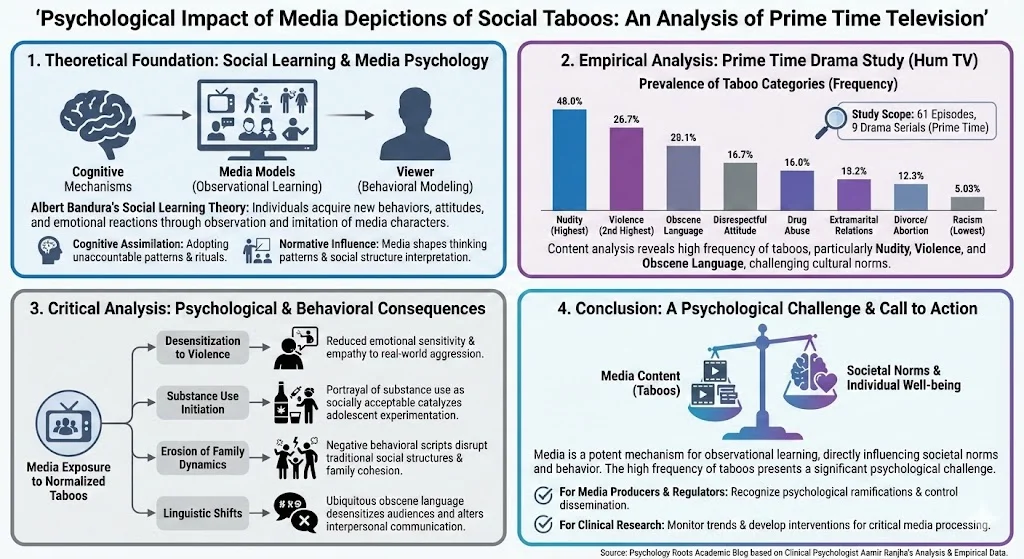
A comprehensive content analysis of Hum Television prime time dramas provides empirical evidence regarding the prevalence of social taboos in mainstream media. The analysis evaluated 61 episodes across nine different drama serials broadcast during March and April of 2012. The prime time slot is particularly critical because it represents the period when the majority of the audience, including the highly impressionable youth demographic, is actively engaged.
Prevalence and Categorization of Taboo Content
The study identified nine distinct categories of social taboos present in the broadcasts.
- Nudity: This category demonstrated the highest overall occurrence. In the context of the region’s Islamic values, nudity encompasses any visual deviation from prescribed modest attire.
- Violence: Violent content ranked as the second highest taboo observed. The World Health Organization defines violence as the intentional use of physical force or power that results in psychological harm, injury, or deprivation.
- Obscene Language: The use of language violating the accepted standards of decency and modesty ranked highly. Exposure to offensive language on television normalizes vulgarity in daily discourse.
- Disrespectful Attitude: Behaviors demonstrating a lack of respect, particularly toward elders or family members, were frequently recorded.
- Drug Abuse: The depiction of the habitual use of illegal substances or alcohol to alter emotional states was present. Research indicates that messages about alcohol in television programs function as direct information sources regarding drinking behaviors.
- Extramarital Relations: Illicit romantic or sexual relationships outside of marriage were depicted, despite strong cultural and religious prohibitions against such actions.
- Divorce and Abortion: The legal dissolution of marriage and abortion were portrayed, often depicting scenarios where individuals are coerced by relatives beyond legally permissible situations.
- Racism: Practices of racial discrimination and ideologies of hierarchy were observed, albeit at the lowest frequency.
The drama serial “Mehar Bano Aur Shah Bano” contained the highest frequency of social taboo content, with an occurrence recorded every 3.97 minutes. Other serials, such as “Sunjha” and “Bilqees Kaur”, exhibited the highest occurrences of obscene language, while “Hum Safer” and “Mujhe Rothne Na Dena” featured prominent violent content.
Cultural Context and Cognitive Dissonance
The psychological impact of these depictions is magnified by the cultural framework of the target audience. Society in Pakistan is fundamentally based on Islamic values. Concepts regarding nudity, violence, and familial relations are strictly delineated by religious doctrine. For example, the exposure of specific body parts contradicts the teachings of the Quran. When viewers are exposed to content that contradicts their internalized moral compass, it disrupts traditional social structures and family cohesion. The presence of such content prevents families from engaging in collective viewing, isolating demographics within the household.
Critical Analysis: Bridging Theory to Clinical Practice
In clinical settings, we frequently address the psychological fallout of unregulated media consumption. The continuous exposure to violence, nudity, and antisocial behavior on television is not a benign environmental factor. See also: Cognitive Behavioral Therapy efficacy for treating media-induced anxiety.
Behavioral and Emotional Consequences
The normalization of taboos through media can precipitate several adverse psychological outcomes.
- Desensitization to Violence: Continuous viewing of violent acts reduces emotional sensitivity to real-world aggression and lowers empathetic responses, meaning viewers encounter violent content in approximately two to three programs per viewing session.
- Substance Use Initiation: The portrayal of drug and alcohol consumption in a socially acceptable light serves as a catalyst for adolescent experimentation. Longitudinal studies demonstrate a positive relationship between recalling media advertisements for alcohol and subsequent consumption rates in young adulthood.
- Erosion of Family Dynamics: Media portrayals of disrespectful attitudes and extramarital relations provide negative behavioral scripts. Prior empirical research indicates a correlational relationship between television consumption and rising divorce rates in specific populations.
- Linguistic Shifts: The ubiquitous nature of obscene language in prime time programming desensitizes audiences to vulgarity. Viewers are exposed to high frequencies of objectionable words per hour, which fundamentally alters interpersonal communication patterns.
Conclusion
The integration of social taboos into electronic media prime time dramas presents a significant psychological challenge. The high frequency of nudity, violence, and offensive language in broadcasts serves as a potent mechanism for observational learning, directly influencing societal norms and individual behavior. It is imperative for media producers and regulatory bodies to recognize the psychological ramifications of their content. By understanding and controlling the dissemination of taboo subjects, stakeholders can mitigate adverse behavioral outcomes and provide healthy, constructive entertainment. Future clinical research must continue to monitor these viewing trends and develop interventions to assist individuals in critically processing media narratives. See also: Media Literacy and Psychological Resilience.
References
- Bandura, A. (1977). Social Learning Theory. Prentice Hall.
- Chong, A., & La Ferrara, E. (2009). Television and Divorce: Evidence from Brazilian Novelas. Journal of the European Economic Association, 7(2-3), 458-468.
- Connoly, G. M., Zhang, J.-F., Casswell, S., & Silva, P. A. (1994). Alcohol in the Mass Media and Drinking by Adolescents: A Longitudinal Study. Addiction, 89(10), 1255-1263.
- Griffin, E. M. (1997). A First Look at Communication Theory (3rd ed.). The McGraw-Hill Companies, Inc.
- Krug, E. G., et al. (2002). World Report on Violence and Health. World Health Organization.
- Nathanson, A. I., Smith, S. L., & Wilson, B. J. (2002). Prime Time Television: Assessing Violence During the Most Popular Viewing Hours. Journal of Communication, 52(1), 84-111.
- Russell, D. W., & Russell, C. A. (2009). Alcohol Messages in Prime Time Television Series. Journal of Consumer Affairs, 43(1), 108-128.
- Sapolsky, B. S., & Kaye, B. K. (2009). Taboo or Not Taboo? That is the Question: Offensive Language on Prime Time Broadcast and Cable Programming. Journal of Broadcasting and Electronic Media.
- Shah, A. A., & Bhatti, M. B. (2012). Analysis of social taboos in electronic media prime time dramas: Hum television. International Islamic University, Islamabad.
