 Psychology Roots
Table of Contents
Measuring Motivation in Experimental Social Psychology: A Methodological Review
Motivation, defined as the psychological force that enables action, remains a central construct in the scientific study of human behavior. However, because motivation is an internal psychological state that cannot be observed or recorded directly, it presents a significant methodological challenge for researchers and clinicians alike. How do we empirically quantify the drive to achieve a goal?
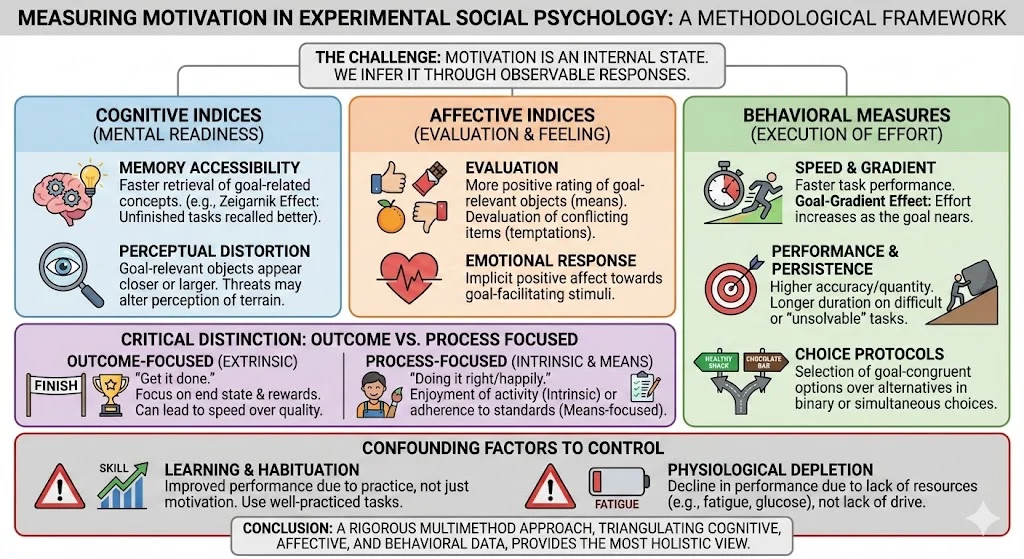
In experimental social psychology, the prevailing approach involves inferring motivation through observable responses. These responses are categorized into cognitive, affective, and behavioral domains. Furthermore, accurate measurement requires distinguishing between different dimensions of motivation: the outcome-focused drive to complete a goal versus the process-focused drive to engage in the means of goal pursuit. This article provides a critical examination of these measurement paradigms, drawing upon the comprehensive framework established by Touré-Tillery and Fishbach (2014).
Cognitive and Affective Indices of Motivation
The cognitive representation of a goal connects to a network of related constructs in associative memory. When a goal is activated, the motivational system prepares the individual for action by increasing the accessibility of these constructs.
Memory and Accessibility
Motivation manifests as the ease with which goal-related concepts are retrieved from memory. The Zeigarnik effect illustrates this phenomenon; individuals recall uncompleted tasks (unfulfilled goals) more readily than completed ones because the motivational state sustains cognitive accessibility. Upon goal completion, this accessibility is actively inhibited to allow cognitive resources to shift to new tasks. Therefore, higher recall rates or faster reaction times in lexical decision tasks regarding goal-related terms serve as robust indicators of motivational strength.
Evaluation and Perception
Motivational states alter how individuals evaluate their environment. Active goals lead to more positive evaluations of goal-relevant objects (facilitating means) and the devaluation of conflicting constructs (temptations). For example, hungry individuals appraise food items more positively while devaluing non-food items.+2
Furthermore, motivation can distort basic visual perception. Research demonstrates that objects associated with active goals may appear larger or closer, while threats (associated with avoidance motivation) may alter the perception of physical terrain, such as the steepness of a hill.
Behavioral Measures: Tracing Goal Congruence
While cognitive measures assess the mental readiness for action, behavioral measures capture the execution of goal-directed effort.
Speed and the Goal-Gradient Effect
The speed at which an individual performs a task often correlates with motivational intensity. This is particularly evident in the goal-gradient effect, where motivation increases as one approaches the goal. Individuals tend to accelerate their efforts—such as rating songs faster or visiting a website more frequently—as they near a reward.
Performance and Persistence
Performance metrics, including accuracy and the quantity of output, provide direct evidence of motivation. High motivation enhances performance on tasks ranging from word puzzles to mathematical problems, particularly when proximal subgoals are set. Persistence, defined as the duration of engagement in the face of difficulty, is another critical behavioral metric. The “unsolvable task” paradigm measures motivation by tracking how long a participant persists on a task they believe is solvable.
Choice Protocols
Binary choices between conflicting goals offer a clear indication of relative motivational strength. For instance, choosing a healthy snack over a chocolate bar indicates a stronger health motivation than hedonic motivation. Simultaneous choice paradigms (selecting multiple items for future consumption) tend to favor “virtuous” high-level goals more than sequential choice paradigms.
Distinguishing Dimensions: Outcome vs. Process
A sophisticated assessment of motivation must differentiate between outcome-focused motivation and process-focused motivation.
Outcome-Focused Motivation
This dimension, often termed extrinsic motivation, targets the desired end state or external reward. It is characterized by a “get it done” mentality. High outcome-focused motivation typically results in increased speed and a focus on efficiency, occasionally at the expense of quality or ethical standards.
Process-Focused Motivation
This dimension encompasses the drive to attend to the elements of goal pursuit itself. It includes intrinsic motivation (enjoying the activity) and means-focused motivation (adhering to proper standards or rules).
- Intrinsic Motivation: Manifests as “doing it happily.” It is measured by subjective reports of interest and behavioral persistence that exceeds what is necessary for mere completion.
- Means-Focused Motivation: Manifests as “doing it right.” This is often U-shaped; adherence to standards (e.g., accuracy, honesty) is highest at the beginning and end of a sequence.
Researchers must be vigilant regarding the trade-offs between these dimensions. For example, high speed might indicate strong outcome motivation but low means-focused motivation (accuracy).
Confounding Factors: Learning and Depletion
Valid measurement requires isolating motivation from ability and physiological capacity.
Learning and Habituation
Repeated exposure to a task improves performance through learning, which can mimic the effects of increased motivation. A linear increase in speed might reflect skill acquisition rather than the goal-gradient effect. To control for this, experimental designs should utilize well-practiced tasks or tasks where learning is irrelevant.
Physiological Depletion
Goal pursuit consumes resources. A decline in performance may result from physiological depletion (e.g., fatigue, glucose variance) rather than a lack of motivation. The “ego depletion” model suggests that exerting self-control impairs subsequent performance. Researchers must distinguish between a subject who will not persist (motivational deficit) and one who cannot persist (capacity deficit).
Critical Analysis
From a clinical and academic perspective, the methodology outlined by Touré-Tillery and Fishbach serves as a rigorous template for experimental design. In clinical practice, we often observe patients who report high motivation yet exhibit low behavioral adherence. The distinction between outcome-focused and process-focused motivation is vital here. A patient may be outcome-focused (wanting to be healthy) but lack process-focused motivation (hating the exercise routine).
Effective psychological assessment utilizes a multimethod approach. Relying solely on self-report (“How motivated are you?”) is fraught with social desirability bias and limited introspective access. By triangulating cognitive accessibility, behavioral persistence, and performance accuracy, we gain a holistic view of the motivational architecture driving a specific behavior.
Conclusion
The measurement of motivation requires precision and a clear theoretical understanding of the construct being assessed. Researchers must define whether they are investigating the drive to finish a task or the drive to engage in the process. Furthermore, experimental designs must rigorously control for non-motivational factors such as learning and physiological depletion. By employing a combination of cognitive, affective, and behavioral measures, psychology can continue to advance its understanding of the forces that drive human action.
References
Bandura, A., & Schunk, D. H. (1981). Cultivating competence, self-efficacy, and intrinsic interest through proximal self-motivation. Journal of Personality and Social Psychology, 41, 586-598.
Bargh, J. A., Gollwitzer, P. M., Lee-Chai, A., Barndollar, K., & Trotschel, R. (2001). The automated will: Nonconscious activation and pursuit of behavioral goals. Journal of Personality and Social Psychology, 81, 1014-1027.
Baumeister, R. F., Bratslavsky, E., Muraven, M., & Tice, D. M. (1998). Ego depletion: Is the active self a limited resource? Journal of Personality and Social Psychology, 74, 1252-1265.
Ferguson, M. J., & Bargh, J. A. (2004). Liking is for doing: The effects of goal pursuit on automatic evaluation. Journal of Personality and Social Psychology, 87, 557-572.
Fishbach, A., & Choi, J. (2012). When thinking about goals undermines goal pursuit. Organizational Behavior and Human Decision Processes, 118, 99-107.
Kivetz, R., Urminsky, O., & Zheng, Y. (2006). The goal-gradient hypothesis resurrected: Purchase acceleration, illusionary goal progress, and customer retention. Journal of Marketing Research, 43, 39-58.
Touré-Tillery, M., & Fishbach, A. (2014). How to measure motivation: A guide for the experimental social psychologist. Social and Personality Psychology Compass, 8(7), 328-341. doi:10.1111/spc3.12110
Zeigarnik, B. (1927). Studies concerning action and affect psychology, III. The retaining of completed and uncompleted actions. Psychologische Forschung, 9, 1-85.
