 Psychology Roots
Table of Contents
The Science of Drive: An Advanced Guide to Measuring Motivation in Experimental Psychology
In clinical practice and experimental research, “motivation” is a term we use liberally, yet it remains one of the most elusive constructs to quantify. We cannot place motivation on a scale like a biological specimen. It is an internal force: an invisible energy that directs behavior.
For students and researchers, the challenge is operationalization. How do we translate this abstract psychological state into concrete, observable data?.
Drawing from the seminal work of Touré-Tillery and Fishbach (2014), this article dissects the methodology of measuring motivation. We will move beyond simple self-reports, which are often plagued by social desirability bias, and explore objective cognitive and behavioral paradigms. Furthermore, we will critically examine the distinction between outcome-focused and process-focused motivation, a differentiation that is crucial for accurate data interpretation.
The Duality of Motivation: Outcome vs. Process
To measure motivation effectively, one must first understand what is driving the behavior. In my lectures, I often distinguish between the destination and the journey.
Outcome-Focused Motivation (“Getting it Done”)
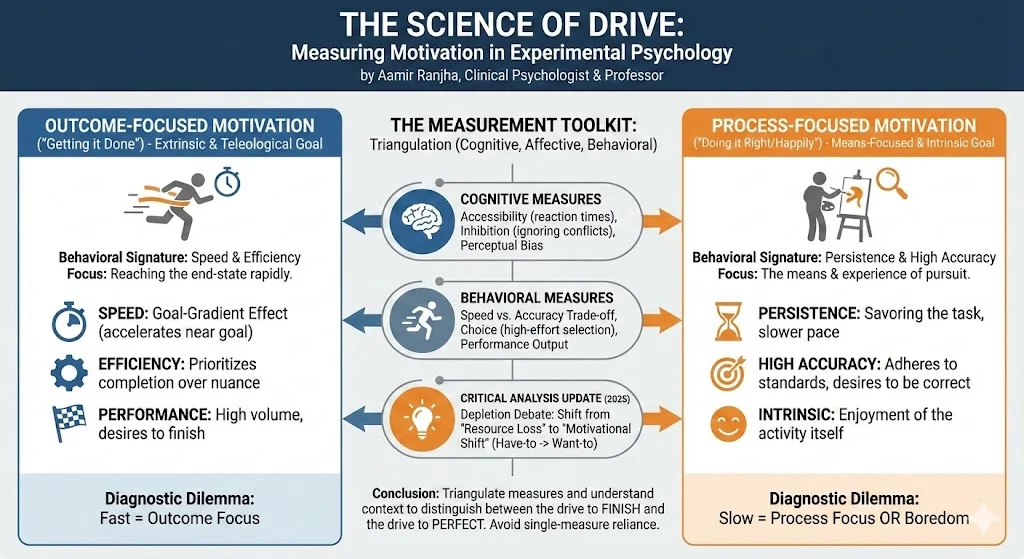
This is the drive to reach a specific end-state. It is extrinsic and teleological. When a client or participant is outcome-focused, their cognitive and behavioral resources are funneled toward completion.
- Behavioral Signature: Speed and efficiency.
- Example: A student rushing to finish an assignment to get a grade. They prioritize completion over the nuance of the learning experience.
Process-Focused Motivation (“Doing it Right” or “Doing it Happily”)
This dimension emphasizes the means of goal pursuit. It is often subdivided into:
- Means-Focused Motivation: The desire to adhere to standards, rules, or ethics (e.g., performing a task with high precision).
- Intrinsic Motivation: The desire to enjoy the experience itself (e.g., reading a book for pleasure rather than for a test).
- Behavioral Signature: Persistence, high accuracy, and often a slower pace to ensure quality or enjoyment.
The Measurement Toolkit
Relying solely on a participant saying “I am motivated” is methodologically weak. As Touré-Tillery and Fishbach (2014) argue, robust experimental design requires triangulation across cognitive, affective, and behavioral measures.
A. Cognitive Measures
Motivation changes how we organize memory and perception.
- Accessibility: Highly motivated individuals show faster reaction times to goal-related words in lexical decision tasks. If you are hungry (motivated to eat), you will recognize food-related concepts faster than non-food concepts.
- Inhibition: Motivation is also measured by what the brain ignores. A focused mind actively inhibits conflicting constructs (e.g., a student suppressing thoughts of a party while studying).
- Perceptual Bias: Motivation alters visual perception. Research has shown that desired objects may appear physically larger, while threats (like a steep hill for a tired hiker) appear more daunting.
B. Behavioral Measures
Behavior is the ultimate manifestation of drive. We look for congruence between the goal and the action.
- Speed: Generally, speed indicates outcome-focused motivation. The Goal-Gradient Effect suggests that as individuals get closer to a goal, they accelerate: like a runner sprinting the final 100 meters.
- Performance: Accuracy and output volume often signal motivation. However, high accuracy usually signals process-focused motivation (desire to be correct), while high volume/speed signals outcome-focused motivation (desire to finish).
- Choice: In binary choices, selecting a high-effort, goal-congruent option (e.g., choosing a salad over a burger) is a direct proxy for motivational strength.
The Diagnostic Dilemma: Speed vs. Accuracy
One of the most critical insights for researchers is the trade-off between speed and accuracy.
If you observe a participant working slowly, it could mean two contradictory things:
- Low Motivation: They are bored or disengaged.
- High Process Motivation: They are savoring the task (intrinsic) or being extremely careful (means-focused).
How to distinguish them? You must introduce a secondary measure or a manipulation. For instance, Touré-Tillery and Fishbach (2012) utilized the “U-shaped” pattern of ethical adherence. They found that people are most motivated to “do the right thing” (process focus) at the beginning and end of a task sequence, but more likely to cut corners (outcome focus) in the middle.
Critical Analysis: The “Depletion” Debate
As a professor, I must address a significant theoretical evolution since the 2014 publication of the source text.
Touré-Tillery and Fishbach (2014) discuss “physiological depletion” (often called Ego Depletion) as a potential confound: the idea that self-control relies on a limited biological resource (like glucose) that runs out.
Current Academic Consensus (2025 Update): Recent large-scale replication efforts have cast doubt on the “limited resource” model of ego depletion. The field has largely shifted toward the Process Model of Depletion (Inzlicht & Schmeichel, 2012), which argues that fatigue is not a loss of fuel, but a shift in motivation. When we “deplete,” our brain simply re-prioritizes “have-to” goals (work) to “want-to” goals (leisure).
For researchers today, this means that a drop in performance should likely be interpreted as a motivational lapse (which can be reversed with incentives) rather than a physiological inability to continue.
Conclusion
Measuring motivation requires a sophisticated approach that moves beyond self-report. By distinguishing between the drive to finish (outcome) and the drive to perfect (process), researchers can avoid misinterpreting data.
Key Takeaways for Your Research:
- Context Matters: Working fast is good for outcome goals, but bad for process goals.
- Triangulate: Use speed, accuracy, and choice together to get a full picture.
- Update Your Theory: Be wary of “resource depletion” explanations; look for motivational shifts instead.
References
- Touré-Tillery, M., & Fishbach, A. (2014). How to measure motivation: A guide for the experimental social psychologist. Social and Personality Psychology Compass, 8(7), 328–341.
- Inzlicht, M., & Schmeichel, B. J. (2012). What is ego depletion? Toward a mechanistic revision of the resource model of self-control. Perspectives on Psychological Science, 7(5), 450–463.
- Touré-Tillery, M., & Fishbach, A. (2012). The end justifies the means, but only in the middle. Journal of Experimental Psychology: General, 141(3), 570–583.
