 Psychology Roots
Table of Contents
The Science and Strategy of Psychological Testing
In the popular imagination, “psychological testing” often conjures images of inkblots or IQ scores. While these are certainly part of the landscape, the reality is far more pervasive. From the moment a child enters a gifted program to the structured interview that lands a graduate their first job, psychological testing is the invisible architecture underlying many of life’s pivotal decisions.
As a clinical psychologist and educator, I often remind my students that testing is not merely an academic exercise; it is a high-stakes practice that shapes trajectories. Whether it is diagnosing a mental disorder, determining medical treatment, or selecting an astronaut for a mission, the tools we use must be precise, valid, and reliable.
This article explores the foundational principles of psychological testing, dismantling the common misconceptions and laying out the scientific rigor required to measure the invisible constructs of the human mind.
Defining the Undefinable: What is a Psychological Test?
At its core, a psychological test is a systematic procedure for observing behavior and describing it with the aid of numerical scales or fixed categories. However, a more functional definition—one that bridges research and practice—involves three distinct steps:
- Behavioral Performance: The test requires the individual to perform a specific behavior. This could be solving a math problem, defining a word, or recounting a story based on a picture.
- Attribute Measurement: This behavior is not measured for its own sake but as a proxy for a personal attribute, trait, or characteristic (e.g., intelligence, extroversion, anxiety).
- Outcome Prediction: Frequently, these measurements are used to predict future outcomes, such as success in graduate school or the likelihood of recovering from a depressive episode.
It is crucial to understand that a “test” is not synonymous with a “quiz.” A structured employment interview, a driving test, and an assessment center simulation are all psychological tests because they demand observable behavior to measure an underlying competency.
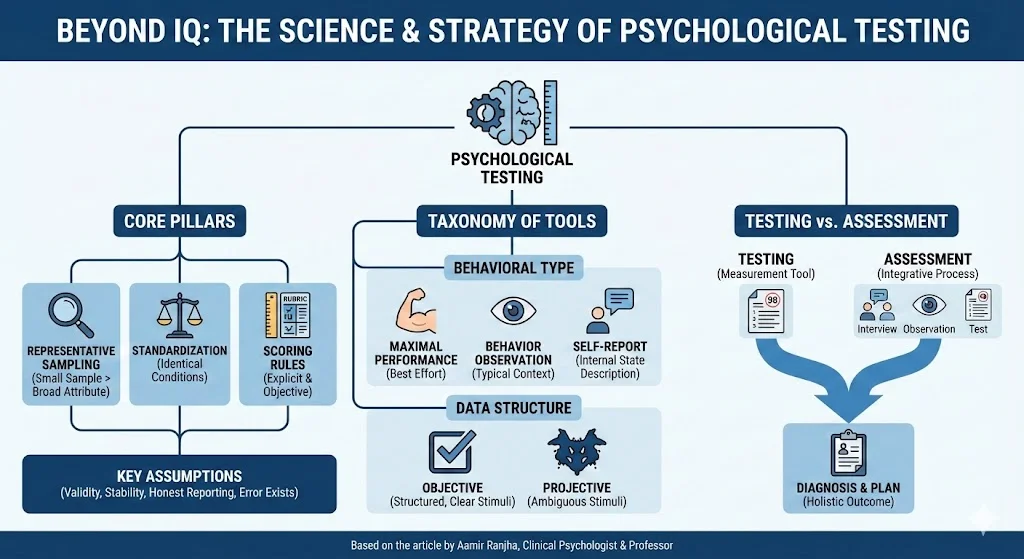
The Three Pillars of a Good Test
Not all surveys or questionnaires qualify as psychological tests. To be scientifically valid, a test must possess three defining characteristics:
- Representative Sampling: A test cannot measure every instance of a behavior. Instead, it must capture a representative sample. Just as a blood test uses a single vial to judge the health of the entire circulatory system, a psychological test uses a sample of questions (e.g., 50 math problems) to estimate a broader attribute (e.g., quantitative reasoning).
- Standardization: The conditions of administration must be identical for all test-takers. Variations in lighting, the examiner’s tone, or the instructions given can introduce “error variance,” distorting the results. Standardization ensures that the score reflects the person’s ability, not the environment.
- Scoring Rules: Subjectivity is the enemy of measurement. Good tests have explicit rules for scoring—whether it is a strict key for a multiple-choice exam or a detailed rubric for an essay—ensuring that two different psychologists would derive the same score from the same performance.
The Assumptions We Make
When we administer a test, we operate under several theoretical assumptions. Recognizing these is vital for ethical practice:
- Validity: We assume the test actually measures what it claims to measure. A test of “mechanical ability” must predict mechanical performance, not just reading comprehension.
- Stability: We assume that the trait being measured is relatively stable over time (unless the test is designed to measure fluctuating states like mood).
- Honest Reporting: We assume test-takers are capable of reporting their thoughts accurately and honestly. This is particularly challenging in forensic settings or high-stakes hiring, where “faking good” is a known phenomenon.
- Error Exists: No test is perfect. We assume that every score consists of the “true score” plus some degree of error (attributed to the test, the environment, or the test-taker’s state).
A Taxonomy of Tools: Classifying Psychological Tests
Psychologists categorize tests based on the type of behavior they elicit and the structure of the data they provide.
Maximal Performance vs. Behavioral Observation vs. Self-Report
- Tests of Maximal Performance: These require the examinee to do their absolute best. Intelligence tests (e.g., WAIS-IV) and classroom exams fall here. The score is determined by success.
- Behavior Observation Tests: These assess typical behavior in a specific context, often without the subject’s full awareness of the specific metrics. A “mystery diner” evaluating a server or a clinical observation of a child in a classroom are prime examples.
- Self-Report Tests: These rely on the individual to describe their own internal state. The Minnesota Multiphasic Personality Inventory (MMPI) and the Myers-Briggs Type Indicator (MBTI) are classic self-report measures.
Objective vs. Projective
- Objective Tests: Structured with clear stimuli and finite response options (e.g., True/False, Multiple Choice). They are generally easier to score and have higher reliability.
- Projective Tests: These present ambiguous stimuli—inkblots (Rorschach) or pictures (Thematic Apperception Test)—under the assumption that the respondent will “project” their unconscious conflicts and personality structure onto the neutral image.
Psychological Assessment vs. Testing: A Critical Distinction
Novices often use the terms “testing” and “assessment” interchangeably, but in clinical practice, they are distinct.
Psychological Testing is the technical process of administering a specific tool to obtain a score. It is a measurement activity.
Psychological Assessment is a broader, integrative process. It involves multiple sources of data—clinical interviews, behavioral observations, history taking, and psychological tests—to answer a referral question or solve a problem. A test gives you a number; an assessment gives you a diagnosis and a treatment plan.
The Weight of Responsibility
The history of psychological testing, tracing back to the civil service exams of Ancient China (2200 BCE) and formalized by Alfred Binet in 1905, is a testament to humanity’s desire to quantify potential. However, with this power comes ethical responsibility.
A poor test or a misinterpreted score can deny a student necessary education, bar a qualified candidate from a job, or lead to an incorrect medical diagnosis. As we rely increasingly on standardized metrics in education (e.g., No Child Left Behind) and corporate recruitment, understanding the psychometric foundations of these tools is not just academic—it is a societal necessity.
References
- Miller, L. A., & Lovler, R. L. (2019). Foundations of psychological testing: A practical approach (6th ed.). SAGE Publications.
- Cohen, R. J., & Swerdlik, M. E. (2018). Psychological testing and assessment: An introduction to tests and measurement. McGraw-Hill Education.
- Hogan, T. P. (2019). Psychological testing: A practical introduction. Wiley.
- Groth-Marnat, G., & Wright, A. J. (2016). Handbook of psychological assessment. John Wiley & Sons.
- Maloney, M. P., & Ward, M. P. (1976). Psychological assessment: A conceptual approach. Oxford University Press.
