 Psychology Roots
Table of Contents
The Efficacy and Evolution of Art Therapy in Clinical Practice: A Comprehensive Analysis
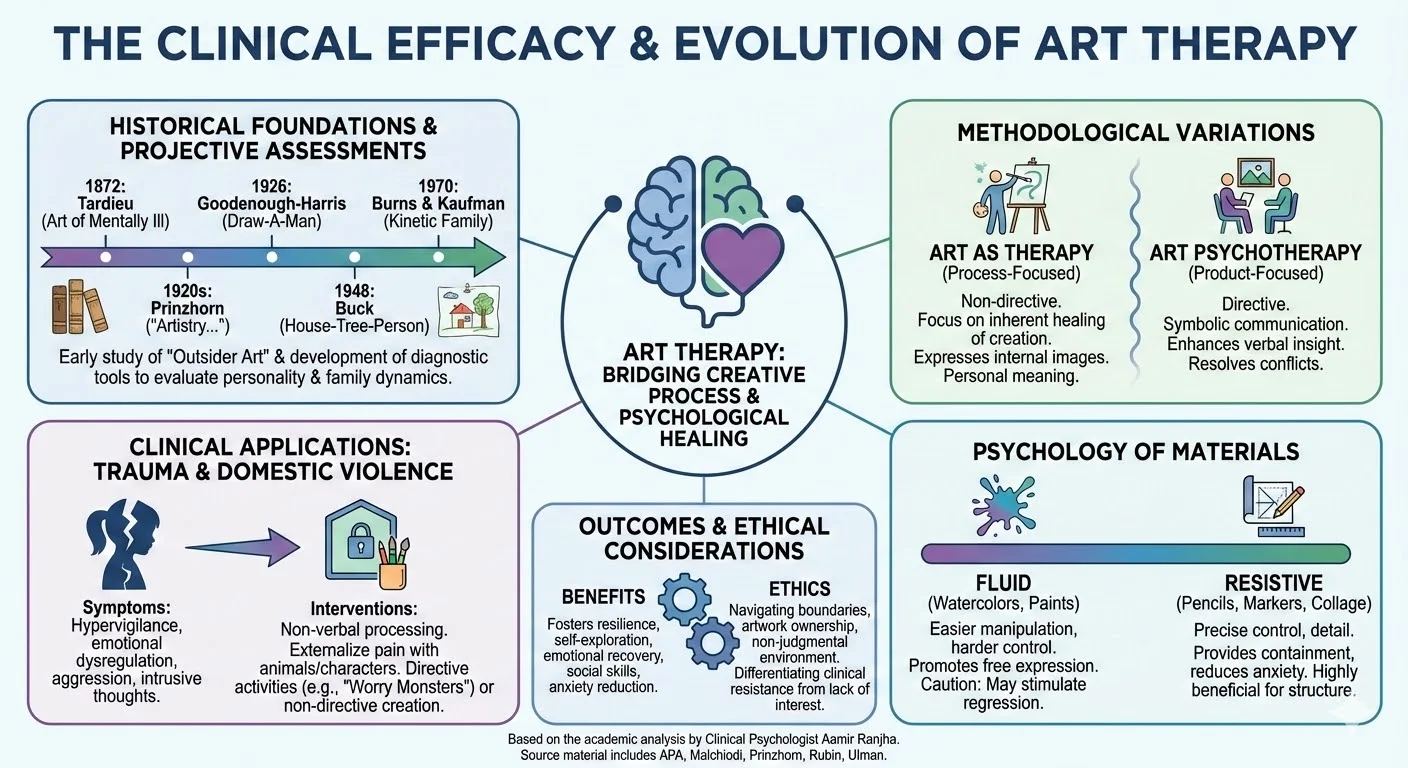
Art therapy represents a vital intersection between the creative process and psychological healing. It is defined as a mental health profession in which clients, guided by an art therapist, utilize art media and the creative process to explore feelings, reconcile emotional conflicts, and foster self-awareness. Furthermore, this modality is highly effective for managing behavior, developing social skills, reducing anxiety, and increasing self-esteem.
By functioning as its own language, art communicates complex internal states in ways that traditional verbal processing often cannot. This article provides a rigorous academic examination of art therapy, tracing its historical roots, methodological variations, clinical applications in trauma, and the psychological impact of chosen materials.
Historical Context and the Art of the Mentally Ill
The formalized study of artwork created by individuals with psychological conditions began in the late nineteenth century. In 1872, French psychiatrist Ambroise Tardieu published foundational work examining the characteristics of artwork produced by patients with mental illness. Subsequently, Paul Max Simon published a series of studies in 1888 detailing the drawings of this demographic.
The field expanded significantly in the 1920s when Hans Prinzhorn collected art from hospitals across Europe, culminating in the publication of Artistry of the Mentally Ill. Prinzhorn hypothesized that art making was a universal, creative urge. Concurrently, Swiss psychiatrist Walter Morgenthaler published detailed observations of Adolf Wölfli, a patient diagnosed with schizophrenia who created numerous images during his thirty-year confinement in a psychiatric hospital. These early explorations laid the groundwork for the modern understanding of “Outsider Art,” which is solely dedicated to self-taught and intuitive artists.
Projective Assessments and Diagnostic Utility
Historically, the clinical interest in art led to the development of projective testing, where images were utilized to diagnose and evaluate mental conditions by deciphering the unconscious mind. While researchers debated whether recurring symbols could reliably connect to specific emotional disorders, several standardized assessments emerged. In clinical practice, we observe that the meaning of an art image is deeply personal and subject to change over time, necessitating careful interpretation.
Prominent historical assessments include the following:
- The Draw-A-Man test was developed by Goodenough-Harris in 1926 as a non-verbal intelligence test for language-impaired children.
- The House-Tree-Person assessment was introduced by Buck in 1948 as a series of three drawings intended for personality evaluation.
- Machover introduced the Draw-A-Person test in 1949 to further assist in personality assessment.
- Burns and Kaufman developed the Kinetic Family Drawing in 1970 to evaluate family dynamics and a child’s attitude toward their family system.
Methodological Variations: Art as Therapy versus Art Psychotherapy
Modern art therapy encompasses distinct methodological frameworks. Depending on treatment goals and client comfort, clinicians must strategically select the appropriate theoretical approach.
Art as Therapy
This non-directive approach emphasizes the inherent healing properties of the creative process itself.
- The focus remains on the process rather than the final product, allowing the individual to follow their own personal process.
- The client is encouraged to draw from within, expressing internal images and thoughts.
- The individual derives personal meaning and interpretation from their highly personalized artwork.
- This method is frequently utilized in Open Art Studio Groups, which emphasize acceptance, receptive listening, and using art for self-expression and healing.
Art Psychotherapy
Conversely, art psychotherapy is often more directive and focuses heavily on symbolic communication.
- There is a distinct emphasis on the product and how the image itself enhances verbal communication to achieve clinical insight.
- The therapist may utilize clarifying, questioning, and confrontation to make connections between the images and the client’s behaviors or perceptions.
- This modality actively aims to resolve conflicts, foster problem-solving, and explore alternative perspectives.
Clinical Applications in Trauma and Domestic Violence
In pediatric clinical psychology, art therapy serves as a critical intervention for children exposed to domestic violence. Children who witness such violence often remain in a continuous state of threat, terror, and alarm. These traumatic experiences manifest in various clinical symptoms.
- Children frequently exhibit sleep disturbances, hypervigilance, and an increased startle response.
- Emotional dysregulation is common, presenting as depression, irritability, and anxiety.
- Behavioral manifestations include aggression, repetitive play, separation anxiety, and sometimes a lack of empathy or biting.
- Cognitive impacts involve intrusive thoughts, difficulty concentrating, and a decrease in overall attention span.
Art interventions create a safe environment where children can process trauma without relying on verbal articulation. Utilizing animals, colors, or characters allows children to process trauma through non-threatening imagery. By externalizing internal pain, the individual can distance themselves from painful experiences. Clinicians often utilize directive activities such as creating “Worry Monsters” or “Feelings Boxes,” or non-directive approaches that grant the client permission to freely create and safely release complex emotional experiences.
The Psychology of Materials
A crucial component of clinical efficacy in art therapy is the deliberate selection of materials. The specific characteristics of art materials directly impact the session, the art-making activity, and the client’s emotional state.
- Fluid Materials: Media such as watercolors, paints, and chalks are easier to manipulate but harder to control. These materials benefit clients who need permission to play and freely express themselves. However, clinicians must exercise caution, as fluid materials can stimulate regression in children who are guarded or have experienced trauma.
- Resistive Materials: Media such as pencils, felt-tip markers, and collage offer more precise control and detail. These materials are highly beneficial for clients requiring structure to reduce anxiety or lower their energy levels, as they tend to produce a calmer state. They provide necessary containment and control during the therapeutic process.
Critical Analysis and Ethical Considerations
While art therapy is a powerful clinical tool, it is not without limitations. Clinicians must differentiate between clinical resistance and a simple lack of interest in art making. Some individuals find other modalities, such as music or sports, more gratifying. Furthermore, clients may experience difficulty being spontaneous due to previous artistic experiences or fear of judgment regarding the aesthetic quality of their work.
Ethically, supervisors and clinicians must navigate complex boundaries. The field requires careful consideration regarding whether the therapist should create art alongside the client. Additional ethical dilemmas include determining who owns the art, protocols for holding onto or displaying the artwork, and addressing the implications if the artwork is sold for profit. Maintaining a non-judgmental environment where the therapist reserves assumptions and actively listens remains the cornerstone of ethical practice.
Conclusion
Art therapy operates as an essential modality within the psychological sciences, bridging the gap between unconscious emotional states and conscious realization. From its historical origins in analyzing the artwork of asylum patients to its modern application in trauma recovery, the discipline provides a unique, non-verbal language for healing. By understanding the methodological variations and the psychological impact of specific materials, clinicians can tailor interventions to foster resilience, self-exploration, and profound emotional recovery.
References
- Malchiodi, C. A. (2012). Art therapy and health care. Guilford Press.
- Prinzhorn, H. (1972). Artistry of the mentally ill: A contribution to the psychology and psychopathology of configuration. Springer-Verlag. (Original work published 1922)
- Rubin, J. A. (2016). Approaches to art therapy: Theory and technique (3rd ed.). Routledge.
- Ulman, E. (2001). Art therapy: Problems of definition. American Journal of Art Therapy, 40(1), 16-26.
