 Psychology Roots
Table of Contents
Alfred Adler’s Individual Psychology: A Comprehensive Analysis of Striving, Social Interest, and Personality Dynamics
In the landscape of early 20th-century psychotherapy, Alfred Adler stands as a pivotal figure who dared to break from the Freudian orthodoxy. While Sigmund Freud reduced human motivation to biological drives and the unconscious conflicts of the id, ego, and superego, Adler proposed a more holistic and socially embedded view of the human condition. His framework, known as Individual Psychology, posits that human beings are not merely driven by the past but are pulled by the future.
This article provides an in-depth analysis of Adlerian theory. It examines the mechanisms of striving, the architecture of the “Style of Life,” and the critical role of social interest in psychological health.
The Core Motivation: Striving for Success or Superiority
At the heart of Individual Psychology lies a single, dynamic force: the striving for success or superiority. Adler argued that all human beings begin life with a sense of inferiority. This is not initially a pathological condition but a natural consequence of being born small, weak, and dependent in a world of adults.
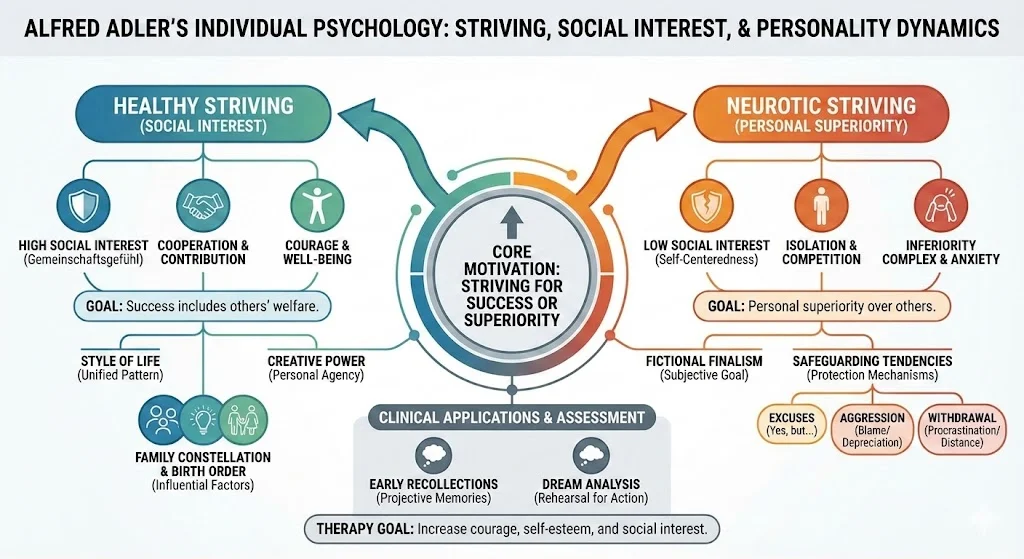
These feelings of incompleteness act as a catalyst. They ignite an innate drive to overcome deficits and move toward perfection and wholeness. Adler distinguished between two primary trajectories of this striving:
- Striving for Success: Psychologically healthy individuals strive for success in a way that includes the well-being of others. Their pursuit of excellence is socially useful and cooperative.
- Striving for Personal Superiority: Neurotic individuals, burdened by exaggerated feelings of inferiority, strive for personal superiority over others. This path is often solitary, competitive, and socially useless.
The Final Goal and Fictional Finalism
Adler introduced the concept of Fictional Finalism, inspired by the philosophy of Hans Vaihinger. He posited that human behavior is guided by a “final goal” set in early childhood, usually by age 4 or 5. This goal is a fiction, a subjective creation, that unifies the personality. It is not objective reality that shapes us, but our subjective perception of reality and our expectation of the future.
For example, a child who feels neglected might create a fictional final goal of becoming totally self-reliant and emotionally detached to ensure safety. Every subsequent action, thought, and feeling will be organized to achieve this unconscious goal.
The Unity of Personality: Style of Life
A defining feature of Adlerian theory is the insistence on the unity of the person. Adler rejected the divisibility of the psyche, which stands in sharp contrast to Freud’s compartmentalization. In Individual Psychology, thoughts, feelings, and actions are consistent with the individual’s unique Style of Life.
The Style of Life is the consistent “flavor” or pattern of a person’s existence. It serves as the blueprint for how individuals approach the three major tasks of life:
- Neighborly Love (Friendship and social relations)
- Sexual Love (Intimacy and partnership)
- Occupation (Work and contribution to society).
Creative Power
Adler emphasized personal agency through the concept of Creative Power. While heredity and environment provide the “bricks and mortar” of personality, the individual acts as the architect. We are not passive victims of our biology or upbringing; we actively interpret our experiences and construct our Style of Life accordingly. This explains why two children raised in the same abusive environment might develop vastly different personalities, as one becomes defeated while the other becomes a resilient striver.
Organ Dialect
The unity of personality extends even to the physical body. Adler coined the term Organ Dialect, or organ jargon, to describe how the body expresses the mind’s intent. Physical symptoms often speak a language the conscious mind refuses to articulate. For instance, a child who wets the bed may be using their bladder to express a rebellion against parental authority that they dare not speak aloud.
Social Interest: The Barometer of Mental Health
Perhaps Adler’s most enduring contribution is the concept of Social Interest, or Gemeinschaftsgefühl in German. This term roughly translates to a “community feeling” or a sense of oneness with all humanity.
Adler established Social Interest as the sole criterion for human values and mental health.
- High Social Interest: The individual cooperates with others, contributes to the common good, and faces life’s problems with courage.
- Low Social Interest: The individual is self-centered, isolated, and strives for personal superiority at the expense of others. Adler viewed all neuroses, psychoses, and criminal behavior as stemming from a lack of social interest.
Social interest is innate but must be cultivated. The mother-child bond is the first social relationship where this potential is either nurtured or stifled.
The Architecture of Maladjustment: Safeguarding Tendencies
When individuals lack social interest and suffer from exaggerated feelings of inferiority, they develop a “useless” Style of Life. To protect their fragile self-esteem from public disgrace, they employ Safeguarding Tendencies.
Unlike Freudian defense mechanisms, which operate unconsciously to protect the ego from anxiety, safeguarding tendencies are often conscious or pre-conscious strategies designed to protect the individual’s inflated sense of self-importance.
Adler categorized these into three main types:
- Excuses: The most common form, typically expressed as “Yes, but” or “If only” strategies. These allow the individual to preserve their illusion of superiority by blaming external circumstances for their inaction.
- Aggression: This can take the form of depreciation (putting others down to feel superior), accusation (blaming others for one’s failures), or self-accusation (using guilt or self-torture to manipulate and hurt others).
- Withdrawal: Escaping life’s problems by creating distance. This includes moving backward (regressing to a safer state), standing still (avoiding responsibility), hesitating (procrastination), and constructing obstacles (creating problems just to overcome them).
Developmental Influences: Family Constellation
Adler was a pioneer in examining the psychological impact of birth order and the Family Constellation. He argued that a child’s position in the family structure significantly influences their perspective and Style of Life.
- Firstborn: Initially the focus of attention, they experience a traumatic “dethronement” upon the arrival of a sibling. They often become authoritarian, conservative, and oriented toward the past.
- Secondborn: Born into a competitive situation, they often strive to overtake the older sibling. They tend to be optimistic, competitive, and ambitious.
- Youngest Child: The “baby” of the family is often pampered. They may become high achievers to surpass all siblings or, conversely, become dependent and helpless if spoiled.
- Only Child: Competes with the father and mother. They may develop an exaggerated sense of superiority and struggle when they are not the center of attention.
Note: Adler cautioned that it is the child’s perception of their position, not the numerical rank itself, that matters.
Clinical Applications: Assessment and Therapy
In clinical practice, Adlerian therapy aims to increase the patient’s courage, self-esteem, and social interest. Two primary tools are used to understand the patient’s Style of Life:
1. Early Recollections (ERs)
Adler asked patients to describe their earliest specific memories. He believed these memories are not causal but projective; we remember what fits our current Style of Life. A person who views the world as hostile will recall early memories of danger or abuse, reinforcing their current worldview. ERs act as a projective technique that reveals the individual’s core convictions.
2. Dream Analysis
Adler viewed dreams as rehearsals for future action. Unlike Freud, who saw dreams as wish fulfillment, Adler believed dreams provided clues to solving current problems, but often in a self-deceptive way. A dream of falling might indicate a fear of loss of status or a desire to avoid a difficult challenge. The “golden rule” of Adlerian dream interpretation is “Everything can be different,” meaning interpretations must be tentative and collaborative.
Critical Analysis
Adler’s theory offers a robust framework for understanding human agency and social connectedness. His emphasis on choice and responsibility aligns well with modern cognitive-behavioral and humanistic approaches. However, the theory faces criticism for low internal consistency in its terminology. Concepts like “Creative Power” are philosophically appealing but difficult to operationalize for scientific research. Furthermore, the proposition that early recollections are determined solely by the present Style of Life is difficult to falsify, as it is equally plausible that early experiences shape the Style of Life.
Despite these limitations, Adler’s insights into the social determinants of mental health remain profoundly relevant. His assertion that psychological health is defined by our contribution to the welfare of others is a timeless clinical truth.
Conclusion
Individual Psychology presents an optimistic and empowering view of the human experience. By shifting the focus from biological determinism to social teleology, Alfred Adler provided a roadmap for understanding how we create our own personalities. For the clinician, educator, and researcher, Adler’s work underscores the importance of fostering social interest and courage as the antidotes to the neurotic striving for personal superiority.
References
- Adler, A. (1927). Understanding Human Nature. Garden City Publishing. Adler, A. (1929). The Science of Living. Greenberg.
- Adler, A. (1930). The Education of Children. Greenberg.
- Adler, A. (1956). The Individual Psychology of Alfred Adler: A Systematic Presentation in Selections from his Writings (H. L. Ansbacher & R. R. Ansbacher, Eds.). Basic Books.
- Adler, A. (1964). Superiority and Social Interest: A Collection of Later Writings (H. L. Ansbacher & R. R. Ansbacher, Eds.). Northwestern University Press.
- Belangee, S. E. (2006). Dietary restriction as a sign of the masculine protest. Journal of Individual Psychology, 62(4), 393-405.
- Bottome, P. (1939). Alfred Adler: A Biography. Putnam.
- Clark, A. J. (2002). Early Recollections: Theory and Practice in Counseling and Psychotherapy. Brunner-Routledge.
- Feist, J., & Feist, G. J. (2009). Theories of Personality (7th ed.). McGraw-Hill.
- Hoffman, E. (1994). The Drive for Self: Alfred Adler and the Founding of Individual Psychology. Addison-Wesley.
- Kasler, J., & Nevo, O. (2005). Early recollections as a predictor of Holland’s vocational interest types. Journal of Individual Psychology, 61(3), 217-232.
- Laird, T. J., & Shelton, A. J. (2006). Alcohol problems and birth order among college students. Journal of Individual Psychology, 62, 12-23.
- Maslow, A. H. (1962). Toward a Psychology of Being. Van Nostrand.
