 Psychology Roots
Table of Contents
Methodological Rigor in Observational Research: A Comprehensive Guide for Psychologists
Observational research forms the empirical bedrock of psychological science. In clinical practice and academic supervision, it is frequently observed that the validity of any behavioral study relies entirely on the precision of its methodology. Psychologists hold an ethical obligation to improve societal conditions, and the cost of failing to conduct rigorous research to solve these problems is exceptionally high. This guide examines the fundamental architecture of observational methods, from sampling protocols to the mitigation of observer bias, providing a framework for robust psychological inquiry.
The Architecture of Observational Sampling
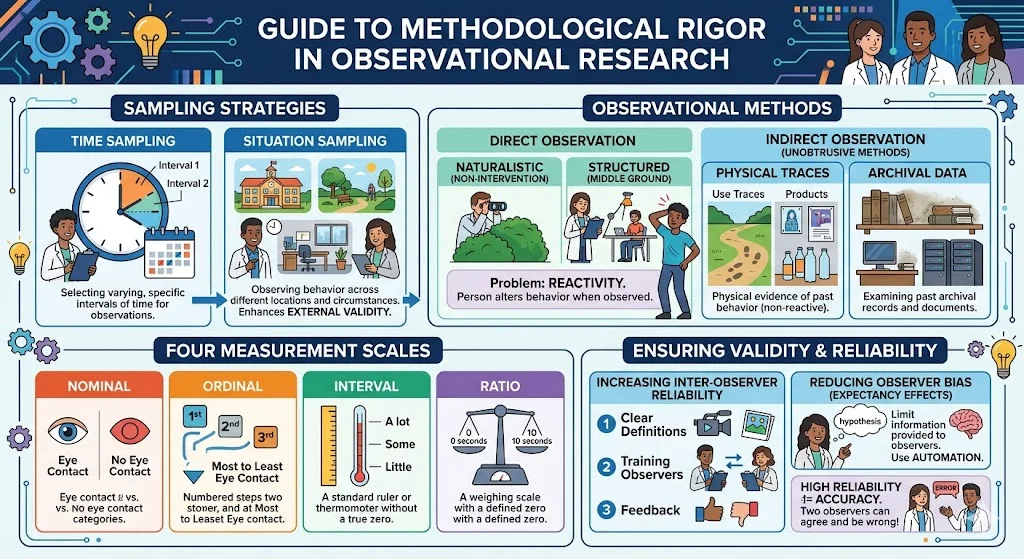
To achieve a generalized consensus of a group, researchers must utilize deliberate sampling strategies rather than relying on arbitrary observation. The two primary types of sampling utilized in observational studies are time sampling and situation sampling.
- Time Sampling: Researchers select varying, specific intervals of time for their observations. This ensures that the recorded behaviors are representative of the subjects’ standard routines rather than isolated anomalies.
- Situation Sampling: Researchers observe behaviors across different locations and under varying circumstances. This approach is explicitly used to accomplish the enhancement of external validity, ensuring that findings can be generalized beyond a single environment.
Direct Versus Indirect Observational Methods
Observational methods are broadly categorized by their degree of intervention and temporal focus. Direct observation examines behavior as it currently occurs, whether the researcher has intervened or not. Conversely, indirect observation examines past archival records or physical evidence.
Prior to initiating any observational study, ethical issues must be rigorously evaluated. Depending on the nature of the observation, researchers must weigh factors including deception, privacy, informed consent, and the overall risk-to-benefit ratio. In situations where ethical considerations prevent researchers from intervening directly, naturalistic observation becomes an essential and useful tool.
The Problem of Reactivity
A primary limitation of direct observation is reactivity. Reactivity is problematic because it prevents researchers from capturing normal behaviors or responses from the observed individuals. Instead, the subject alters their behavior based on how they believe the researcher expects them to act.
Structured Observation as a Methodological Compromise
Structured observation represents a methodological “middle ground” in psychological research. It rests carefully between the complete nonintervention of naturalistic observation and the strict manipulation of independent variables seen in laboratory experiments.
The primary advantage of this compromise is that it allows researchers to apply some degree of intervention while maintaining a natural setting. However, the defining disadvantage is that it remains difficult to replicate the same results unless the exact format of the study is duplicated perfectly.
Unobtrusive Measures: Physical Traces and Archival Data
When reactivity or ethical barriers restrict direct measurement, physical traces and archival data serve as highly attractive alternatives. Research involving these methods can be carried out with minimal ethical risk relative to more intrusive techniques. Therefore, unobtrusive observational methods represent a vital tool within the multimethod approach for investigating complex social issues.
Apart from observing behaviors in real-time, psychologists can assess physical traces, which provide tangible evidence of past behavior. Shaughnessy et al. (2009) categorize physical traces into two distinct forms:
- Use Traces: The physical evidence resulting from wear and tear. A classic example is the presence of bare spots on a lawn, indicating a frequently used shortcut between buildings.
- Products: The physical evidence or artifacts left behind from past behavior, such as empty bottles collected after a social gathering.
Because physical traces are collected indirectly after individuals have vacated the environment, the measurement process is entirely non-reactive. The subjects’ behaviors are not influenced by the act of measurement itself. Psychologists can utilize these traces creatively to test behavioral hypotheses or assess the validity of verbal reports. For example, researchers can compare a teenager’s verbally expressed musical preferences against the physical products present in their environment, such as posters on their bedroom wall.
The Quantification of Behavior: Measurement Scales
Precision in research requires accurate data reduction and coding. Researchers record and rank behaviors using specific measurement scales. To illustrate this, consider the measurement of eye contact between pairs of interacting individuals:
- Nominal Scale: Categorizes the event into mutually exclusive groups, defined simply as the presence of eye contact versus no eye contact.
- Ordinal Scale: Ranks the behavior sequentially, such as grading subjects from the most eye contact to the least eye contact.
- Interval Scale: Measures the behavior on a standardized scale, classifying the interaction as having very little, some, or a lot of eye contact.
- Ratio Scale: Utilizes a definitive true zero point; if absolutely no eye contact occurred, the value is recorded strictly as zero.
Mitigating Bias and Ensuring Reliability
Even the most meticulously designed observational study is vulnerable to human error. To systematically increase inter-observer reliability, researchers must adhere to three procedural steps:
- Provide exact, clear definitions of the target behaviors, frequently utilizing photographs or video recordings for reference.
- Train observers thoroughly, ensuring they have ample opportunities to practice their recording techniques.
- Provide continuous, structured feedback regarding the accuracy of their preliminary observations.
It is critical to note that high inter-observer reliability does not inherently ensure that the observations are accurate or valid. Two observers could theoretically agree on a classification while both being fundamentally in error, resulting in an inaccurate record of behavior.
Furthermore, researchers must actively defend against observer bias, specifically expectancy effects. This bias frequently occurs when observers are made aware of the study’s underlying hypothesis or expected outcome. To reduce observer bias, principal investigators should limit the background information provided to their observing team or utilize automation, such as electronic recording equipment, to document behaviors objectively.
