 Psychology Roots
Table of Contents
Evidence-Based Interventions in Positive Psychology: A Clinical Review of Three Core Tools
The paradigm shift in modern psychology from a strictly pathologizing model to one of flourishing has necessitated the development of rigorous, empirically supported interventions. Positive psychology does not merely seek the absence of distress but actively promotes the presence of well-being through the cultivation of strengths, values alignment, and self-compassion. As clinicians and researchers, we recognize that sustainable psychological resilience requires practical mechanisms to bridge the gap between theoretical constructs and daily functioning.
This article provides a critical clinical review of three foundational tools in positive psychology: the Strengths Wheel, the Bull’s-Eye Values Survey, and Compassionate Chair Work. These interventions address three distinct but updated domains of human functioning: competence (strengths), direction (values), and emotional regulation (self-compassion).
1. The Strengths Wheel: Moving Beyond Identification to Optimization
Character strengths are defined as pre-existing capacities for behaving, thinking, or feeling that are authentic and energizing to the individual. Unlike skills, which are learned proficiencies, or talents, which are innate biological aptitudes, character strengths are intrinsic traits that evoke a sense of authenticity when exercised.
The Phenomenon of Strengths Blindness
In clinical practice, a significant barrier to flourishing is “strengths blindness.” Research indicates that approximately two-thirds of individuals are unaware of their core strengths. This lack of awareness often stems from the “taking-strengths-for-granted effect,” where individuals view their innate capacities as ordinary rather than exceptional. Furthermore, societal and educational systems often prioritize the remediation of weaknesses over the cultivation of strengths, leading to “strengths estrangement”.
Clinical Application: The Strengths Wheel
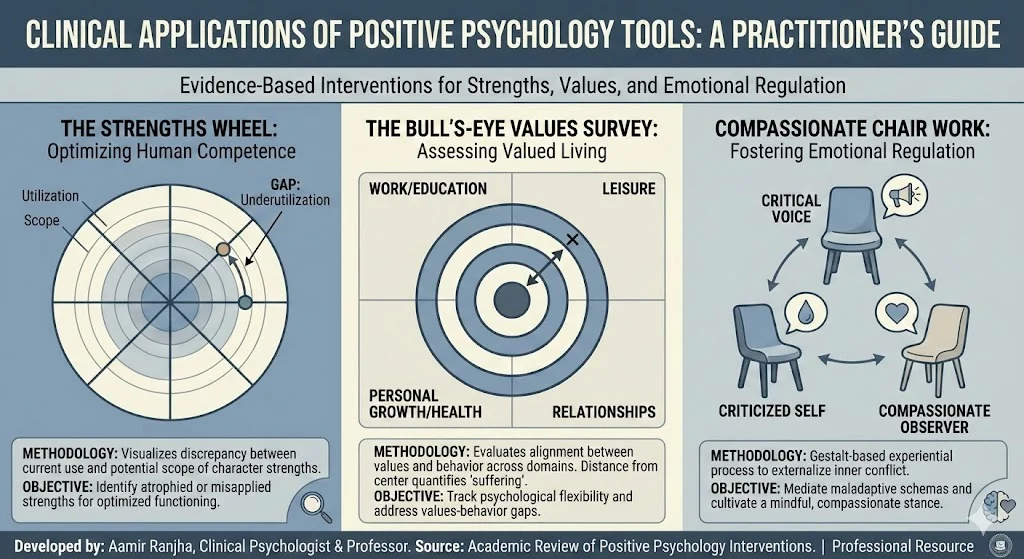
The Strengths Wheel is a graphical assessment tool designed to visualize the discrepancy between current strength use and the scope for potential use.
- Methodology: The client plots two distinct data points for specific strengths on a circular graph: their current utilization level and the available scope for expansion within a specific context, such as the workplace.
- Interpretation: A large gap between current use and scope indicates underutilization and a clear avenue for intervention. Conversely, strengths can be “overused” or applied maladaptively; for instance, excessive humor in a professional setting may undermine leadership credibility.
- Objective: The goal is to optimize functioning by identifying where strengths are atrophying due to disuse and where they are being misapplied.
2. The Bull’s-Eye Values Survey: Assessing Valued Living
In the context of Acceptance and Commitment Therapy (ACT) and positive psychology, values are defined as verbally constructed, global desired life consequences. Unlike goals, which are finite and achievable, values are continuous directions of life that can only be concretized from moment to moment.
The Values-Behavior Gap
A core focus in therapy is addressing the discrepancy between an individual’s stated values and their actual behavior. Clients often endorse high-value domains (e.g., parenting, health) yet exhibit behaviors inconsistent with those values (e.g., excessive work hours, sedentary lifestyle).
Clinical Application: The Bull’s-Eye Survey
The Bull’s-Eye Values Survey (BEVS) serves as both an assessment of psychological flexibility and a measure of treatment progress. It evaluates four key domains:
- Work/Education: Career aims and professional development.
- Leisure: Recreative activities and sources of enjoyment.
- Relationships: Intimacy, family dynamics, and social connections.
- Personal Growth/Health: Spirituality, physical health, and self-care.
The instrument utilizes a dartboard metaphor. The center (“Bull’s Eye”) represents perfect alignment between values and action. Clients mark an ‘X’ to represent their current standing; the distance from the center visually quantifies the “suffering” or dissatisfaction in that domain. This visual representation is particularly effective for tracking clinical progress over time and identifying barriers to valued living.
3. Compassionate Chair Work: Mechanisms of Emotional Regulation
Self-compassion is a robust predictor of mental health, negatively correlating with depression, anxiety, and stress (r=-0.54). It comprises three components: self-kindness, a sense of common humanity, and mindfulness.
Addressing the Inner Critic
Individuals with low self-compassion often possess a harsh “inner critic” or maladaptive schema. To address this, clinicians employ techniques derived from Schema Therapy, specifically “Chair Work”. This Gestalt-based intervention facilitates a dialogue between fragmented parts of the self.
Clinical Application: The Three-Chair Technique
This exercise externalizes internal conflicts by assigning specific roles to physical chairs:
- The Critical Voice: The client vocalizes their self-criticism, attending to the harsh tone and emotional content.
- The Criticized Self: The client moves to a second chair to articulate the emotional impact of receiving that criticism (e.g., feeling hurt or unsupported).
- The Compassionate Observer (Wise Friend): From a third chair, the client adopts a detached, wise perspective to mediate the conflict and offer support to the criticized self.
This experiential process allows clients to cognitively restructure their relationship with failure, moving from over-identification with mistakes to a mindful, compassionate stance.
Conclusion
The integration of these tools facilitates a comprehensive approach to psychological well-being. The Strengths Wheel enhances competence and authenticity; the Bull’s-Eye Survey ensures behavioral alignment with deeply held values; and Compassionate Chair Work provides the emotional safety net required to face challenges. For the clinician, these instruments offer structured, evidence-based methods to operationalize the abstract concepts of positive psychology.
References
- Arntz, A., & Jacob, G. (2013). Schema therapy in practice: An introductory guide to the schema mode approach. John Wiley & Sons.
- Barnard, L., & Curry, J. (2011). Self-compassion: Conceptualizations, correlates, & interventions. Review of General Psychology, 15, 289-303.
- Driver, M. (2011). Coaching positively: Lessons for coaches from positive psychology. Open University Press.
- Hayes, S. C., Strosahl, K. D., & Wilson, K. G. (1999). Acceptance and commitment therapy: An experiential approach to behavior change. Guilford Press.
- Linley, A. (2008). Average to A+: Realising strengths in yourself and others. CAPP.
- Lundgren, T., Luoma, J. B., Dahl, J., Strosahl, K., & Melin, L. (2012). The Bull’s-Eye Values Survey: A psychometric evaluation. Cognitive and Behavioral Practice, 19, 518-526.
- MacBeth, A., & Gumley, A. (2012). Exploring compassion: A meta-analysis of the association between self-compassion and psychopathology. Clinical Psychology Review, 32, 545-552.
- Neff, K. D. (2003). Self-compassion: An alternative conceptualization of a healthy attitude toward oneself. Self and Identity, 2, 85–101.
- Niemiec, R. M. (2013). VIA character strengths: Research and practice. In Well-being and cultures: Perspectives from positive psychology. Springer.
- Young, J. E., Klosko, J. S., & Weishaar, M. E. (2003). Schema therapy: A practitioner’s guide. Guilford Press.
