 Psychology Roots
Table of Contents
The Historical Trajectory of Psychology in Pakistan: From Philosophical Roots to Clinical Practice
The evolution of psychology in the Indian subcontinent, and specifically within Pakistan, represents a fascinating transition from philosophical discourse to a robust empirical science. In academic and clinical practice, understanding this history is crucial for contextualizing our current diagnostic frameworks and therapeutic interventions. This article delineates the trajectory of psychological sciences in Pakistan, highlighting key institutional milestones, the adaptation of psychometric tools, and the emergence of modern clinical psychology.
The Pre-Partition Foundations: Philosophy and Early Experimentation
The roots of psychological inquiry in the region can be traced back to Muslim philosophical traditions. However, the formal introduction of psychology as an empirical discipline occurred in the early 20th century.
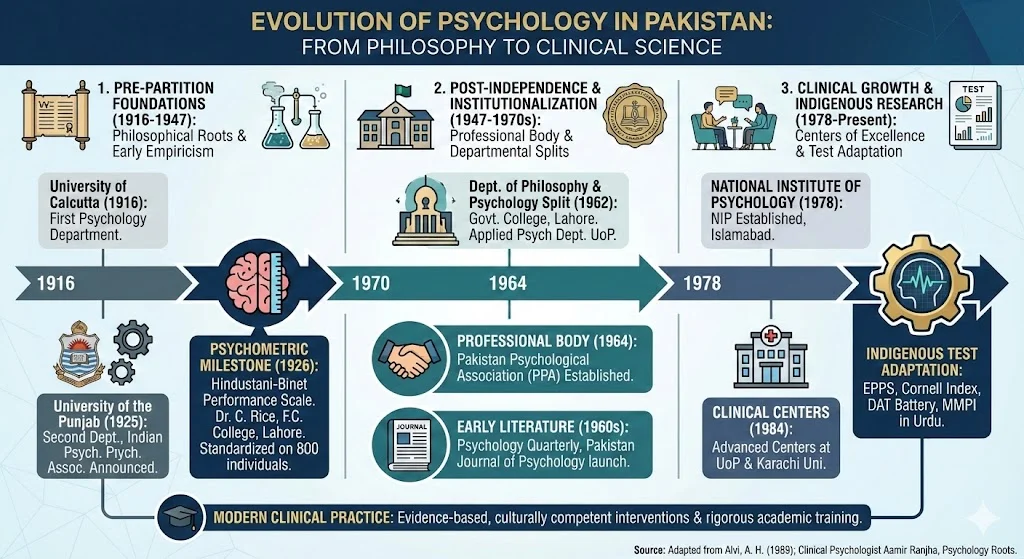
- Institutional Beginnings: The first department of psychology in India was established at the University of Calcutta in 1916. The University of the Punjab followed suit in 1925, the same year the Indian Psychological Association was officially announced.
- Academic Pioneers: Qazi Muhammad Aslam, initially trained in philosophy, became the first teacher of experimental psychology after receiving training under Professor San Gupta in Calcutta and later under F. C. Bartlett at Cambridge.
- Psychometric Milestones: A critical advancement was the adaptation of the Binet-Simon Scale of Intelligence by Dr. C. Rice at F.C. College, Lahore, in 1926. This Hindustani-Binet Performance Scale was standardized in both Urdu and Punjabi on a sample of approximately 800 individuals from urban and rural areas.
- The Psychoanalytic Influence: While structuralism initially dominated academic settings, Freudian psychoanalysis gained significant popularity among the general public and practitioners, leading to the formation of the Indian Psychoanalytical Society in 1928.
Post-Independence Expansion and Institutionalization
Following the creation of Pakistan in 1947, psychologists returning from international training programs, such as the Fulbright program, played a pivotal role in modernizing the discipline.
- Departmental Independence: The 1960s marked a crucial period where psychology separated from philosophy. The Department of Philosophy and Psychology at Government College, Lahore, split in 1962, coinciding with the establishment of the Department of Applied Psychology at the University of the Punjab. Universities in Karachi, Sindh, and Peshawar also developed full-fledged departments during this era.
- Professional Organizations: Recognizing the need for a cohesive professional body, the Pakistan Psychological Association was established in 1964.
- Centers of Excellence: The National Institute of Psychology in Islamabad was founded in 1978. By 1984, advanced Centers of Clinical Psychology were established at the Universities of the Punjab and Karachi due to acute national interest in the field.
Indigenous Test Construction and Adaptation
In clinical practice and occupational selection, culturally validated tools are indispensable. Pakistani psychologists have made substantial progress in psychometrics:
- The adaptation of major personality inventories, including the Edwards Personal Preference Schedule (EPPS) and the Cornell Index.
- The standardization of the Differential Aptitude Test (DAT) battery by the Vocational Cell of the Punjab Labor Department, utilizing extensive regional normative data.
- The translation and adaptation of the Minnesota Multiphasic Personality Inventory (MMPI) into Urdu by researchers at Karachi University for both normal and abnormal population samples.
The Proliferation of Psychological Literature
The dissemination of research has been vital to the academic growth of the discipline. The Journal of Clinical Psychology briefly appeared in 1949. Subsequent decades saw the launch of enduring publications such as the Psychology Quarterly from Government College in 1962, the Pakistan Journal of Psychology from Karachi University in 1978, and the clinical magazine Psyche, which also began in 1978. These platforms facilitated a robust exchange of empirical findings and theoretical discourse.
Critical Analysis
Bridging this historical narrative to contemporary clinical application reveals a significant professional evolution. Initially, psychologists in the region were often conflated with philosophers or even palmists by the general public. Today, evidence-based practice forms the core of our profession. The early emphasis on adapting Western psychometric tools, such as Dr. Rice’s work on the Binet scale, laid the groundwork for modern diagnostic accuracy. However, as observed in contemporary clinical supervision, an ongoing challenge remains the continuous normative updating of these tools to reflect the shifting socio-cultural dynamics of the Pakistani population. The shift from pure philosophical inquiry to applied, experimental, and clinical methodologies underscores the maturation of the discipline and highlights the necessity for rigorous, culturally competent clinical training.
Conclusion
The development of psychology in Pakistan is a testament to the persistent efforts of early scholars and clinicians who transitioned the field from philosophical abstraction to a rigorous empirical science. From the early laboratories at Government College, Lahore, to the modern Centers of Clinical Psychology, the infrastructure for psychological research and practice has expanded exponentially. For current practitioners and students, this history provides a foundational understanding of the cultural and academic context that shapes modern psychological interventions in Pakistan.
References
Alvi, A. H. (1989). Development of psychology in Pakistan. Psyche. (Foreword by N. A. Pirzada; Published by B. A. Sufi).
