 Psychology Roots
Table of Contents
The Intersection of Time Management Stress and Alcohol Consumption in Collegiate Athletics
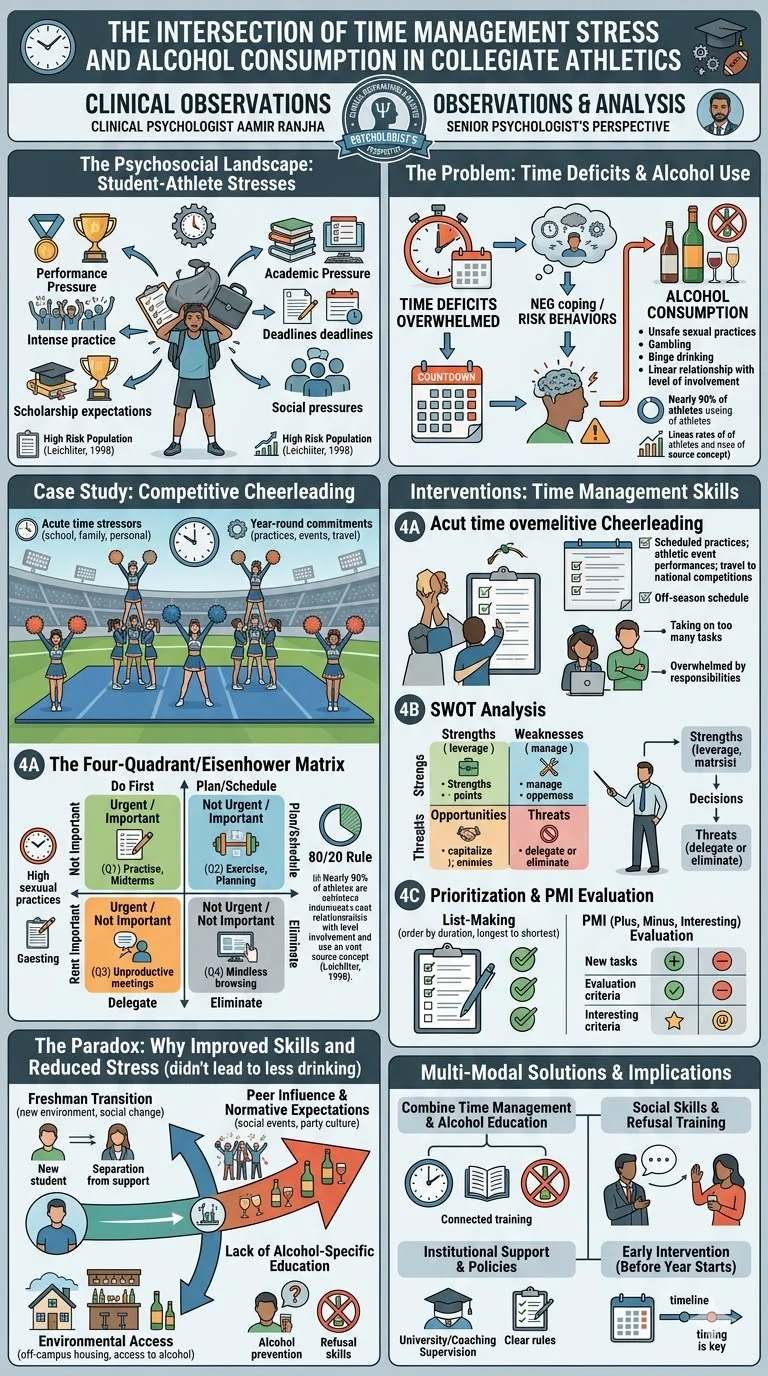
College athletes experience significant stress due to the demanding expectations of both athletic performance and academic excellence. The challenge of balancing coursework, part-time employment, and rigorous athletic participation often leaves these individuals feeling inadequate in fulfilling their responsibilities. This stress is notably amplified for scholarship recipients and those engaged in highly competitive sports. In response to this perceived stress, individuals frequently mobilize behavioral changes to cope, which can unfortunately include maladaptive habits like alcohol consumption.
In clinical practice and academic supervision, we consistently observe that college students separated from their traditional support systems are highly vulnerable to utilizing alcohol as a stress reduction mechanism. This article provides a critical analysis of the relationship between time management deficits, perceived stress, and alcohol use, utilizing a specific cohort of competitive collegiate cheerleaders as a primary case study.
The Psychosocial Landscape of the Student-Athlete
Historically, conventional wisdom suggested that student-athletes were at a lower risk for alcohol abuse compared to the general student population. However, empirical evidence strongly refutes this assumption. College athletes are at a heightened risk for maladaptive behaviors, including unsafe sexual practices, gambling, and substance abuse.
Research highlights a concerning prevalence of alcohol use among college athletes, with some national studies indicating a usage rate of nearly 90 percent. Furthermore, a linear relationship exists between the level of athletic involvement and the quantity and frequency of alcohol consumed. Student-athletes are also twice as likely to engage in binge drinking compared to their non-athletic peers. The pressure to perform flawlessly, driven by coaches and teammates, places these individuals at severe risk for stress and subsequent alcohol utilization.
Time Management as a Stress Mediator
Time management encompasses the application of practical skills designed to prioritize and organize daily responsibilities. Effective time management serves as a critical stress mediator. It allows individuals to exert greater control over their schedules, thereby enhancing productivity and allowing for necessary relaxation. The core psychological component in this dynamic is the perceived control of time; individuals who feel they command their situations exhibit significantly lower stress levels.
Conversely, ineffective time management precipitates conflict between overwhelming task loads and insufficient personal time. This deficiency not only elevates psychological stress but also increases vulnerability to health risk behaviors. When individuals consistently fail to achieve their goals within a designated timeframe, the resulting stress can trigger a cascade of negative coping strategies.
The Competitive Cheerleading Context
Competitive cheerleading is a rigorous sport demanding strength, endurance, complex gymnastic proficiency, and precision timing. The nature of this sport generates acute time stressors, forcing athletes to constantly negotiate between school, family, and personal obligations.
The commitments are extensive:
- Scheduled practices, athletic event performances, and travel to national competitions directly compete with class attendance and study time.
- Even during the brief two-month off-season, athletes must maintain rigorous practice schedules to preserve and enhance their skill levels.
- Consequently, these athletes frequently report feeling overwhelmed and sense a distinct loss of control over their time management.
Empirical Interventions: Enhancing Time Management Skills
To address these vulnerabilities, structured interventions targeting time management behaviors are essential. An analysis of a 31-member collegiate cheerleading squad reveals the efficacy of targeted, centralized training. Baseline assessments indicated that the most frequent stressors involved taking on too many tasks simultaneously (81 percent) and feeling overwhelmed by responsibilities (76 percent).
A comprehensive seven-week intervention utilized several proven cognitive-behavioral and organizational frameworks to address both internal and external stressors.
The Four-Quadrant Approach
The initial phase utilized the 80/20 rule, recognizing that individuals often expend 80 percent of their effort to complete only 20 percent of their tasks. Participants were trained to evaluate the “goodness of fit” of new responsibilities by categorizing them into four distinct quadrants based on urgency and importance.
- Tasks categorized as High Urgency and High Importance were prioritized.
- Tasks identified as Low Urgency and Low Importance were targeted for elimination.
SWOT Analysis Integration
Participants subsequently engaged in a SWOT analysis, identifying personal Strengths, Weaknesses, Opportunities, and Threats regarding their daily schedules.
- This exercise trained athletes to effectively refuse requests that aligned with their weaknesses.
- It empowered them to delegate “threat tasks” to others who might view them as opportunities.
Prioritization and PMI Categorization
Further interventions required participants to maintain structured task lists, ordering responsibilities from the longest to the shortest duration. They also utilized the PMI (Plus, Minus, Interesting) method to evaluate new tasks.
- A “plus” indicated a positive use of time aligned with personal goals.
- A “minus” represented a negative use of time related to personal weaknesses.
The application of these structured interventions yielded a highly significant improvement in the subjects’ time management skills. Statistical analysis demonstrated high magnitude significance in reducing feelings of being overwhelmed and increasing perceived control over time.
Critical Analysis: The Paradox of Alcohol Consumption
Despite the documented improvement in time management skills and the theoretical reduction in associated stress, the anticipated decrease in alcohol consumption did not materialize. In fact, post-intervention metrics revealed substantial increases in hazardous drinking behaviors.
Several critical variables explain this paradoxical outcome:
- The Freshman Transition: A significant portion of the sample (52 percent) consisted of incoming freshmen. The transition from high school to the college environment frequently triggers profound shifts in social behavior.
- Peer Influence and Normative Expectations: The university setting presents strong environmental pressures. The behavior of partying is often viewed by students as a critical opportunity for peer socialization.
- Environmental Access: During the study period, several teammates relocated to off-campus housing, dramatically increasing the accessibility of unregulated social gatherings and altering the primary locations for drinking.
- Absence of Specific Psychoeducation: The intervention focused exclusively on time management and lacked a dedicated alcohol education component.
Conclusion and Clinical Implications
While time management training is a highly effective clinical tool for reducing perceived stress and improving organizational autonomy, it is not a panacea for complex behavioral issues like substance abuse. This analysis clearly demonstrates the potent influence of peer networks and normative campus expectations on student-athletes.
For psychological interventions to successfully mitigate alcohol risk among collegiate athletes, practitioners must adopt a multi-modal approach. Time management skill acquisition must be paired directly with social skills training focused on alcohol refusal. Furthermore, institutions must enforce clear, consistent alcohol policies to modify the broader environmental risk factors. Interventions should ideally be timed prior to the commencement of the academic year to proactively address the turbulent transition into collegiate life.
References
- Brady, K. T. (1999). The role of stress in alcohol use, alcoholism, treatment, and relapse. Alcohol Research & Health, 23, 263-271.
- Cabell, J. B. (1998). Coping with college stress, a new job, or any change. Health and Stress, 9, 1-2.
- Coakley, J. (1998). Deviance in sport. Sport in Society (6th ed., p. 161).
- Dipboye, C. (1990). College students’ time management: Correlations with academic performance and stress. Journal of Educational Psychology, 82(4), 760-768.
- Flynn, H. A. (1998). Comparison of cross-sectional and daily reports between depression and use of alcohol in college students. Alcohol Clinical and Experimental Research, 35, 48-52.
- Gall, M. D. (1988). Making the grade. Rocklin, California.
- Hudd, S. (2000). Stress at college: Effects on health habits, health status and self-esteem. College Student Journal, 217-228.
- Leichliter, J. (1998). Alcohol use and related consequences among students with varying levels of involvement in college athletics. Journal of American College Health, 257-268.
- Lipsey, M. (1990). Design sensitivity: Statistical power for experimental research. Newbury Park, CA: Sage Publications.
- Macan, T. (1990). College students’ time management: Correlations with academic performance and stress. Journal of Educational Psychology, 82(4), 760-768.
- Misra, R. (2000). College students’ academic stress and its relation to their anxiety, time management, and leisure satisfaction. American Journal of Health Sciences.
- Mohr, L. B. (1992). Impact analysis for program evaluation. Newbury Park, CA: Sage Publications.
- Nattiv, A. (1999). Lifestyles and health risks of collegiate athletes. Clinical Journal of Sports Medicine.
- Perkins, H. W. (1999). Stress-related drinking leads to alcohol problems. Journal of Studies on Alcohol, 4(8), 2-5.
- Pohorecky, L. A. (1991). Stress and alcohol interaction: An update of human research. Alcoholism: Clinical and Experimental Research, 15, 438-459.
- Sadava, S. W., & Pak, A. W. (1993). Stress-related problem drinking and alcohol problems: A longitudinal study and extension of Marlatt’s model. Canadian Journal of Behavioural Science, 25, 446-464.
- Sayette, M. (1999). Does drinking reduce stress? Alcohol Research & Health, 23(4), 250-256.
- Schuler, R. (1979). Managing stress means managing time: The two are so intertwined that controlling one can only help the other. Personnel Journal, 851-854.
- Selby, R. (1998). The health of university athletes. Journal of American College Health.
- Volpicelli, J. R. (1987). Uncontrollable events and alcohol drinking. British Journal of Addiction, 82, 381-392.
- Weiss, S. (1999). A comparison of maladaptive behaviors of athletes and nonathletes. The Journal of Psychology, 315-322.
- Welcher, H. (1997). Binge drinking, tobacco, and illicit drug use and involvement in college athletics. Journal of American College Health, 195-207.
