Psychology Roots
Table of Contents
Multifaceted Approaches to Stress Management: A Clinical Perspective on Regulation and Resilience
The perception that stress is an immutable force in daily life is a pervasive cognitive distortion; while external demands such as financial obligations, professional workloads, and familial responsibilities remain constant, the psychological capacity to regulate one’s response offers a significant degree of agency.
In clinical practice, we observe that the foundational element of effective stress management is the realization of internal control. By assuming agency over lifestyle choices, cognitive patterns, and emotional regulation, individuals can mitigate the deleterious effects of pressure.
The Etiology and Perception of Stress
Stress is defined as the physiological and psychological response to life changes. Since existence inherently involves transitions, ranging from mundane daily commutes to significant life events such as marriage or bereavement, the total elimination of stress is neither feasible nor the objective. Rather, the clinical goal is the reduction of unnecessary strain and the effective management of unavoidable stressors.
The genesis of stress, or “stressors,” is highly subjective. The appraisal of a situation as “stressful” versus “challenging” is mediated by individual personality traits, available coping resources, and habitual thought patterns. Consequently, a trigger that precipitates anxiety in one individual may remain benign to another. However, specific environmental conditions universally correlate with high stress and burnout risk, particularly those characterized by high demand, low autonomy, insufficient resources, potential for harsh judgment, and severe consequences for failure.
Physiological and Psychological Manifestations
The somatic and emotional impact of stress is as idiosyncratic as its perception. Clinical presentations vary widely, ranging from tension headaches and gastrointestinal distress to immune system suppression and mood dysregulation. Chronic exposure to high stress levels compromises overall well-being, disrupting emotional equilibrium and cognitive function. Effective management is therefore critical not merely for symptom relief but for restoring the capacity to function effectively and maintain resilience against future adversity.
Coping Mechanisms and Behavioral Interventions
1. Cognitive Reframing and the “Four A’s” Model
A primary therapeutic intervention involves the identification of stress sources, a process often obscured by habitual behaviors and lack of introspection. To isolate these sources, individuals are encouraged to utilize a stress journal to track precipitating events, emotional and physical reactions, and behavioral responses.
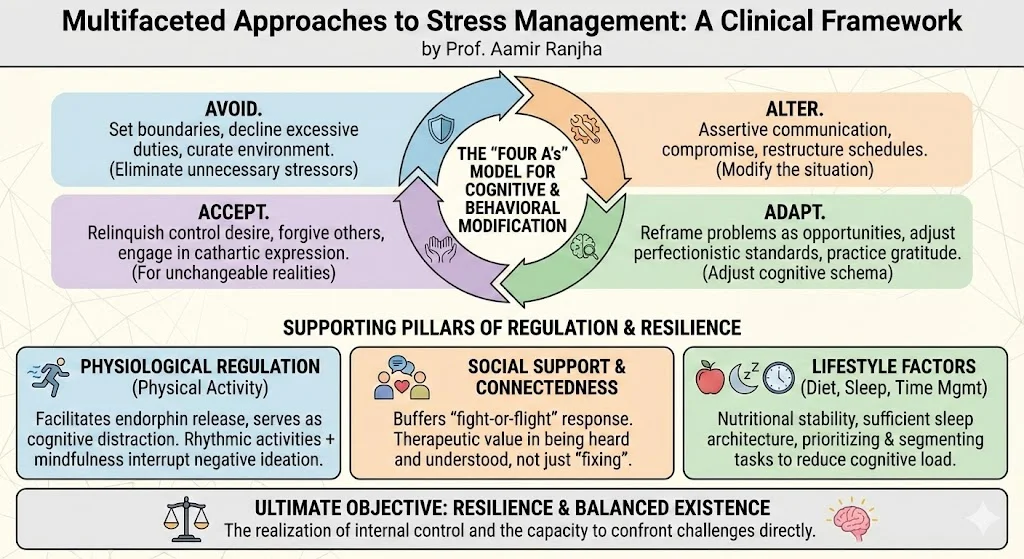
When addressing predictable stressors, the “Four A’s” framework provides a structured approach for cognitive and behavioral modification:
- Avoid: Eliminate unnecessary stressors by setting boundaries, declining excessive responsibilities (learning to say “no”), and curating one’s environment to reduce exposure to anxiety-inducing stimuli.
- Alter: If avoidance is impossible, modification of the situation is required. This involves assertive communication, compromise, and the restructuring of schedules to prevent burnout.
- Adapt: When the stressor is immutable, the individual must adjust their cognitive schema. This includes reframing problems as opportunities, adjusting perfectionistic standards, and practicing gratitude to maintain perspective.
- Accept: For unchangeable realities, such as loss or systemic economic issues, acceptance is the only viable coping strategy. This necessitates relinquishing the desire for control, forgiving others, and engaging in cathartic expression.
2. Physiological Regulation through Physical Activity
Physical mobilization is a potent counter-regulatory mechanism against the stress response. Exercise facilitates the release of endorphins and serves as a cognitive distraction from ruminative worry. While thirty minutes of continuous activity is optimal, cumulative movement throughout the day also yields benefits. Rhythmic activities, such as walking, swimming, or running, are particularly effective when combined with mindfulness, as they interrupt the cycle of negative ideation.
3. Social Support and Emotional Connectedness
Face-to-face interaction serves as a fundamental biological buffer against the “fight-or-flight” response. Interpersonal connection releases hormonal cascades that counteract defensive physiological states, thereby mitigating depression and anxiety. Building a robust network does not require others to “fix” the stressor; rather, the therapeutic value lies in being heard and understood. Strategies for enhancing social capital include volunteering, regular check-ins with loved ones, and participation in community groups.
4. Lifestyle Factors: Diet, Sleep, and Time Management
Resilience is biologically mediated by lifestyle choices. Nutritional intake plays a critical role; a balanced diet stabilizes energy, whereas substances like caffeine, sugar, and alcohol can exacerbate mood instability and disrupt sleep architecture. Furthermore, time management deficits significantly contribute to anxiety. Interventions such as prioritizing tasks, segmenting complex projects, and delegating responsibilities are essential for reducing the cognitive load.
Critical Analysis: The Necessity of Autonomy
The literature consistently emphasizes that the realization of control is the foundation of stress management. Externalizing the locus of control, blaming others or viewing stress as a personality trait, impedes the ability to regulate emotional states. True efficacy in stress management is achieved only when the individual accepts responsibility for their role in creating or maintaining their stress levels.
Conclusion
Stress management is not a monolithic intervention but a personalized regimen of cognitive, behavioral, and lifestyle adjustments. By systematically identifying stressors, employing the “Four A’s,” maintaining physiological health through exercise and diet, and fostering social connections, individuals can transcend the state of chronic pressure. The ultimate objective is a balanced existence characterized by the resilience to confront challenges directly.