 Psychology Roots
Table of Contents
The Pedagogical Alliance: Analyzing the Impact of Student-Teacher Dynamics on Academic Outcomes
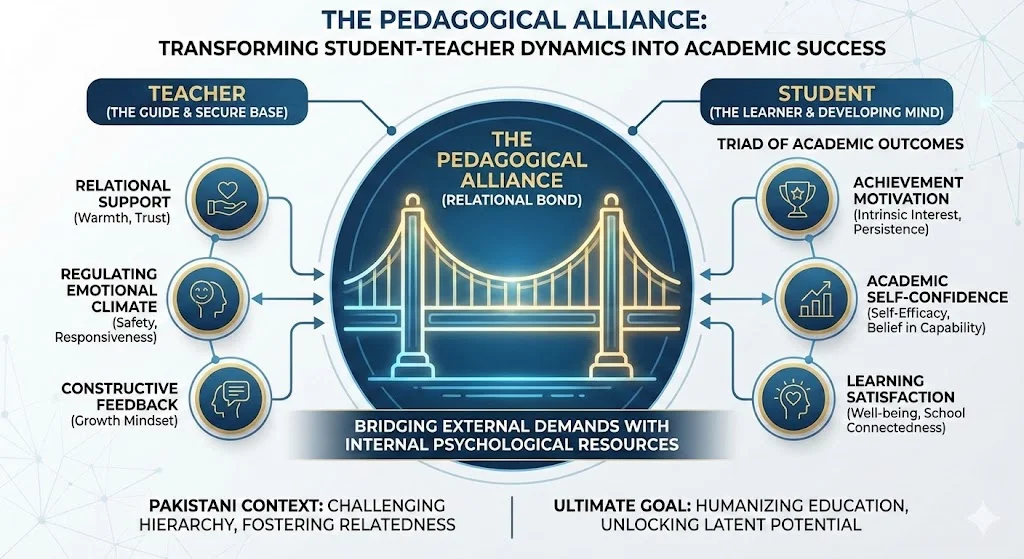
In the landscape of educational psychology, the classroom is not merely a site of instruction but a complex ecosystem of interpersonal dynamics. While curriculum and pedagogy are often prioritized, a growing body of evidence suggests that the relationship between students and teachers is of vital importance. This “pedagogical alliance” is the bridge that connects a teacher’s knowledge and efficiency to a student’s potential and aspirations.
For adolescents navigating the critical transition of high school, this relationship serves as a developmental foundation. It connects the external demands of schooling with the internal psychological resources of the student, specifically their motivation, self-efficacy, and overall satisfaction with learning.
This article explores the theoretical and empirical foundations of the student-teacher relationship (STR). It specifically examines its influence on three critical variables: Achievement Motivation, Academic Self-Confidence, and Learning Satisfaction. Furthermore, it contextualizes these dynamics within the specific socio-cultural framework of Pakistan, where research on linking these variables remains scarce.
The Theoretical Framework: Beyond “Being Nice”
The student-teacher relationship is often trivialized as simply “liking” a teacher. However, psychological theory defines it as a distinct dyadic system with profound cognitive implications.
The Bridge to Potential
The student-teacher relationship functions like a bridge. When this bridge is strong, it supports the student’s cognitive foundation and helps form perceptual expectancies for future non-familial relationships. Research indicates that supportive and strong relations are essential for the healthy development of all school-going students. This connection is particularly vital for students at risk of school failure, as positive relations serve as a protective source.
Regulating the Emotional Climate
Teachers do more than instruct; they regulate the classroom’s emotional climate. Effective practices and interactions in the classroom have the greatest influence on student learning outcomes. When teachers show regard for students and responsiveness to their questions and interests, it directly links to student achievement.
The Triad of Academic Outcomes
The proposed investigation focuses on how the quality of the STR influences three specific domains of student functioning.
A. Achievement Motivation
Motivation is an explanatory concept that aids in understanding why people behave in certain manners. Academic motivation is defined as a student’s desire regarding their academic subjects, observed in their persistency, approach, and level of interest.
There is a strong theoretical link between STR and motivation. Connected relationships defined by caring, trust, and respect increase a student’s motivation to learn. Conversely, low academic self-esteem can lead to feelings of unworthiness, depression, and doubt. The current study hypothesizes a significant positive effect of the teacher-student relation on achievement motivation.
B. Academic Self-Confidence (Self-Efficacy)
Self-confidence denotes a sense of one’s competency, capabilities, and skills to effectively deal with a variety of situations. In an academic context, this is often referred to as academic self-efficacy, which is the student’s perception of their capability to manage learning behavior and master academic material.
Teachers have the ability to train students in a manner that attracts them toward enhancing their self-efficacy. This is critical because students with high self-efficacy are more likely to seek help and persist, whereas those with low self-efficacy are less likely to do so. The relationship acts as a catalyst; supportive interactions foster the self-trust necessary for professional development.
C. Learning Satisfaction
School satisfaction is a cognitive-affective evaluation of the overall satisfaction with school life experience. It is a multidimensional construct affected by individual, relational, and environmental factors.
Evidence suggests that interpersonal support, such as relationships with teachers, is a significant correlate of school satisfaction. Positive interpersonal relationships at school lead to high levels of satisfaction with general life and happiness. In fact, interpersonal support has been indicated as the best predictor of school satisfaction.
The Gap in Pakistani Literature
While global literature on STR is robust, the specific intersection of these variables remains under-researched in Pakistan.
Although studies have explored factors affecting academic motivation or self-confidence individually, the collective impact of teacher-student relations on these variables has not been studied adequately. Existing local research has touched on how a teacher’s friendly behavior can ameliorate passive-aggressive behavior or aid academic integration. However, no previous research has investigated the specific combination of variables under consideration here.
Addressing this gap is not just an academic exercise. It is a necessary step to improve the understanding of relations between students and teachers, ultimately improving educational outcomes.
Methodological Framework for Investigation
To empirically validate these relationships, a rigorous quantitative approach is required. The following framework outlines the standard for investigating these variables.
Participants & Sampling
A representative sample of 300 high school students (150 males, 150 females) is essential. The target demographic includes 9th and 10th-grade students from government and private schools in Swabi, with an age range of 15 to 18 years. Purposive sampling is employed to manage this specific population.
Psychometric Instrumentation
Reliable measurement is the backbone of psychological research. The following instruments are the industry standards for this domain:
- Student-Instructor Relationship Scale: Developed by Creasey, Jarvis, and Knapcik (2009), this 36-item instrument assesses the quality of the relationship on dimensions of connectedness and anxiety.
- Academic Motivation Scale (AMS-HS 28): Assesses high school student intra-personal competencies across 7 sub-scales, including intrinsic motivation and amotivation.
- Academic Self-Efficacy Scale: Developed by Muris (2001), this scale measures the self-perception of youth regarding their ability to manage academics.
- High School Satisfaction Scale: Assesses five areas of satisfaction, including the quality of school services and relationships with classmates.
Statistical Analysis
To move beyond simple correlation, Linear Regression Analysis will be used to determine the impact of the teacher-student relation on the dependent variables. Additionally, T-tests will be used to investigate differences in gender, educational level, and family type.
Conclusion: The Human Element in Education
The data suggests a clear narrative. The interaction between teachers and students provides a chance to establish positive relations that significantly influence learning outcomes.
For educators and policymakers, the implications are profound. An effective relation between teacher and student might provide a base that aids other aspects of schooling to function properly. By fostering these connections, we support student self-confidence, foster self-trust, and increase motivation to learn.
References
- Ahmedi, S. (2020). Academic self-efficacy and learning behavior.
- Al-Nasseri, N., Renganathan, S., Al-Nasseri, & Al-Balushi. (2014). The essence of connected relationships.
- Birch, S. H., & Ladd, G. W. (1998). Supportive relations and healthy development.
- Creasey, G., Jarvis, P., & Knapcik, E. (2009). The Student-Instructor relationship scale.
- Hayes, D., et al. (2006). Teachers and schooling making a difference.
- Iqbal, S., Courtney, M., & Rashid, A. (2019). Student-teacher relationship and maladaptive behavior.
- Komarraju, M., & Nadler, D. (2013). Academic self-confidence and performance.
- Konu, A., & Rimpela, M. (2002). School Well-being Model.
- Lodi, E., Patrizi, P., Boerchi, D., & Magnano, P. (2019). High school satisfaction questionnaire.
- Marzano, R. J. (2003). Effective practices of teachers.
- Mercinah, S., & Nirmala, D. (2013). The bridge of knowledge: Student-teacher relationships.
- Muris, P. (2001). Academic Self-Efficacy Scale.
- Pintrich, P. R. (2003). Motivation and learning.
- Shrauger, J. S., & Schohn, M. (1995). Self-confidence and self-perception.
- Soroya, S., Hashmi, A., & Soroya, M. (2014). Student-teacher relationship and academic integration.
- Vallerand, R. J., Blais, M. R., Brière, N. M., & Pelletier, L. G. (1989). Academic motivation scale.
- Wong, J., & Siu, A. (2017). School satisfaction definition.
- Zullig, K. J., Huebner, E. S., & Patton, J. M. (2011). Adolescents’ environmental satisfaction factors.
