 Psychology Roots
Table of Contents
Cognitive Behavioral Therapy in the Culinary Arts: Mitigating Occupational Stress Through the Lens of Role Conflict and Job Autonomy
The hospitality industry, particularly the culinary sector, is frequently romanticized in media as a domain of passion and artistry. However, the clinical reality for professionals within this sphere, specifically trainee chefs, is often characterized by debilitating occupational stress. The disconnect between the high-pressure demands of a commercial kitchen and the psychological resources available to the individual often results in significant mental health deterioration. This article explores the efficacy of Cognitive Behavioral Therapy (CBT) as an intervention for occupational stress, specifically targeting the psychological mechanisms of role conflict and job autonomy within the culinary profession.
The Psychopathology of the Commercial Kitchen
Occupational stress is not merely a sensation of pressure; it is a harmful physical and emotional response that occurs when job requirements do not match the capabilities, resources, or needs of the worker. In the United States alone, occupational stress precipitates up to 40% of workplace turnovers, a statistic that holds profound implications for the labor-intensive hospitality sector.
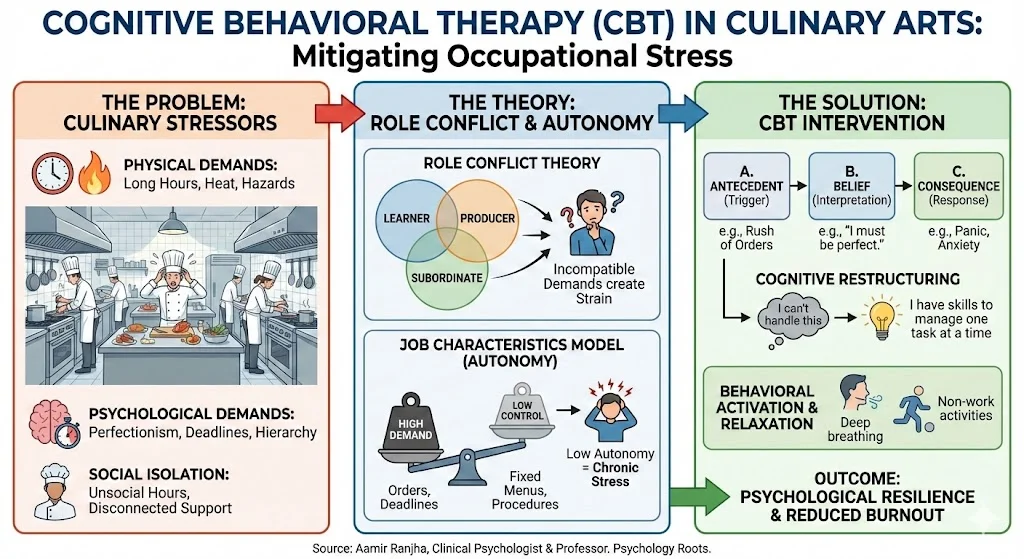
For trainee chefs, the environment is uniquely pathogenic. The kitchen is a “total institution” characterized by:
- Physical Demands: Long working hours, disruption of circadian rhythms, and physical hazards such as heat and sharp instruments.
- Psychological Demands: Perfectionism, rigid deadlines, and often, an authoritarian hierarchy that borders on abusive.
- Social Isolation: The “unsocial” hours disconnect chefs from familial and social support systems, exacerbating stress.
Research indicates that the health status of hospitality workers is often lower than the general population, with elevated rates of depression and stress symptoms. The trainee chef, often young and inexperienced, enters this environment with high expectations that are rapidly eroded by the “semantic jungle” of role conflict and the crushing weight of low job autonomy.+2
Theoretical Frameworks: Why Chefs Burn Out
To understand the utility of CBT in this context, we must first analyze the structural contributors to stress using established organizational psychology frameworks.
Role Conflict Theory
Rooted in the work of Parsons and later expanded by Kahn et al. (1964), Role Conflict Theory posits that stress arises when an individual faces incompatible demands. For a trainee chef, this conflict is endemic. They are expected to be:
- Learners: Needing time to acquire skills.
- Producers: Required to output high-volume, high-quality food immediately.
- Subordinates: Navigating the rigid “brigade” system while managing their own developing professional identity.
When these roles clash, such as the need for speed versus the need for learning safety, the individual is forced to compromise, leading to psychological withdrawal or “strain”.
The Job Characteristics Model and Autonomy
Hackman and Oldham’s (1980) Job Characteristics Model identifies autonomy, the degree of freedom and discretion in scheduling and procedures, as a critical determinant of work motivation and mental health.
In a commercial kitchen, autonomy is scarce. Menus are fixed, recipes are standardized, and timelines are dictated by customers. This lack of control is a primary stressor. The Demand-Control-Support model further elucidates that high demand coupled with low control is the specific recipe for psychological distress. When a chef feels responsible for the outcome (a perfect dish) but lacks the authority to control the variables (resources, time, staffing), stress becomes chronic.
The Clinical Intervention: Cognitive Behavioral Therapy (CBT)
While structural changes in the hospitality industry are necessary, they are slow to implement. Therefore, equipping individuals with psychological resilience is paramount. CBT is the gold standard for stress management interventions, consistently producing the highest results in workplace settings.
The efficacy of CBT lies in its ability to restructure the cognitive distortions that exacerbate occupational stress. It targets the individual’s appraisal of the stressor rather than the stressor itself.
The Mechanism of Change
A targeted 8-week CBT intervention for trainee chefs typically moves through the following phases:
- Psycho-education and the ABC Model: Chefs are taught to identify the Antecedent (e.g., a rush of orders), their Belief (e.g., “I must be perfect or I am a failure”), and the Consequence (e.g., panic, anxiety). By recognizing that the belief mediates the stress response, the cycle can be interrupted.
- Cognitive Restructuring: Trainees often harbor maladaptive core beliefs such as “If I make a mistake, I will be fired” or “I am powerless.” CBT utilizes Socratic questioning to challenge these automatic negative thoughts (ANTs). For example, a chef might learn to reframe “I can’t handle this pressure” to “This is a busy shift, but I have the skills to manage one ticket at a time”.
- Behavioral Activation and Relaxation: Given the physical nature of the job, somatic techniques are essential. Progressive Muscle Relaxation (PMR) and deep breathing exercises are integrated to lower physiological arousal during service. Furthermore, behavioral activation encourages chefs to reclaim non-work activities, combating the social isolation inherent in the profession.
- Problem Solving (SOLVED Technique): Passive coping is replaced with active problem-solving. Chefs are trained to define the problem (e.g., Role Conflict with a sous chef), brainstorm solutions, and implement a strategy rather than ruminating on the injustice of the situation.
Critical Implications for the Industry
The application of CBT in the culinary world addresses a critical gap. The hospitality industry often focuses on technical competence, such as knife skills, sauce making, and plating, while neglecting the “soft skills” of emotional regulation and stress management.
Research suggests that interventions focusing on individual coping strategies, such as CBT, can significantly lower absenteeism and turnover intentions. For the trainee chef in Pakistan or elsewhere, this training acts as a psychological inoculation. It does not remove the heat of the kitchen, but it provides the heat-resistant armor necessary to survive and thrive within it.
Conclusion
Occupational stress in the culinary arts is a multifactorial issue driven by role conflict and low job autonomy. While organizational reform is the ultimate goal, Cognitive Behavioral Therapy offers a potent, evidence-based tool for immediate relief. By shifting the locus of control from external demands to internal cognitive regulation, CBT empowers the next generation of chefs to master not just their craft, but their own psychological well-being.
References
Atkinson, W. (2004). Stress: Risk management’s most serious challenge? Risk Management, 51(6), 1-5.
Biddle, B. J. (1979). Role theory: Expectations, identities and behaviors. Academic Press.
Bohle, P., Quinlan, M., Kennedy, D., & Williamson, A. (2004). Working hours, work-life conflict and health in precarious and “permanent” employment. Revista de Saúde Pública, 38, 19-25.
Crompton, S. (2011). What’s stressing the stressed? Main sources of stress among workers. Canadian Social Trends, 92, 44-51.
Hackman, J. R., & Oldham, G. R. (1980). Work redesign. Addison Wesley.
Johannessen, H. A., Tynes, T., & Sterud, T. (2013). Effects of occupational role conflict and emotional demands on subsequent psychological distress. Journal of Occupational and Environmental Medicine, 55(6), 605–613.
Karasek, R., & Theorell, T. (1990). Healthy work: Stress, productivity, and the reconstruction of working life. Basic Books.
Richardson, K. M., & Rothstein, H. R. (2008). Effects of occupational stress management intervention programs: A meta-analysis. Journal of Occupational Health Psychology, 13, 69-93.
Rizzo, J. R., House, R. J., & Lirtzman, S. I. (1970). Role conflict and ambiguity in complex organizations. Administrative Science Quarterly, 15(2), 150-163.
Robbins, S. (2005). Organizational Behavior. Prentice Hall.
Zohar, D. (1994). Analysis of job stress profile in the hotel industry. International Journal of Hospitality Management, 13(3), 219-231.
