 Psychology Roots
Table of Contents
Developmental Trajectories and Maltreatment Indicators: A Clinical Framework
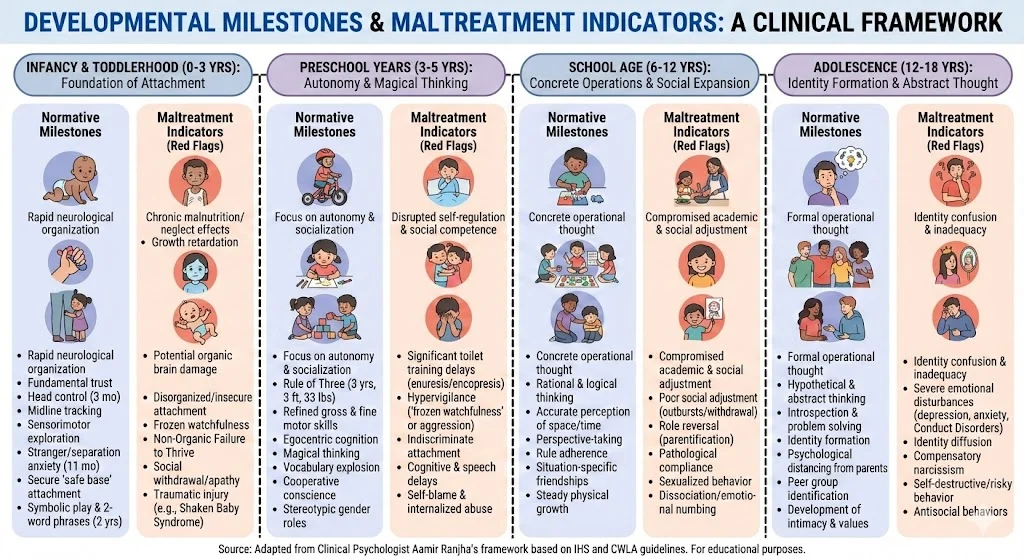
The assessment of human development requires a rigorous understanding of the biological, cognitive, and psychosocial milestones that characterize the transition from infancy to young adulthood. For clinicians, social workers, and forensic psychologists, the ability to distinguish between normative developmental variations and the pathological sequelae of maltreatment is a critical competency.
This analysis draws upon established developmental charts utilized in child welfare training to provide a structured overview of normative expectations and the specific deviations often associated with neglect, physical abuse, and emotional trauma.
Infancy and Toddlerhood: The Foundation of Attachment
The period from birth to approximately three years is characterized by rapid neurological organization and the establishment of fundamental trust.
Normative Milestones
In the domain of physical and cognitive development, infants progress from reflexive, uncoordinated movements to purposeful manipulation of the environment. By three months, an infant typically demonstrates the ability to prop the head at a 90-degree angle and visually track objects through the midline. The sensorimotor stage involves physical exploration to stimulate brain cell development; behaviors such as repeating movements are functional attempts to master the environment.
Socially, the trajectory moves from responsiveness to social stimuli at five months to the emergence of stranger anxiety and separation anxiety around eleven months. A critical marker of healthy attachment is the child’s ability to use the parent as a “safe base” for exploration and to seek comfort effectively when distressed. By age two, symbolic play begins, alongside the emergence of two-word phrases.
Clinical Indicators of Maltreatment
When a child is subjected to chronic malnutrition or neglect during this critical window, the physiological consequences are severe. Clinicians may observe growth retardation and potential organic brain damage. The psychological impact of disorganized or insecure attachment manifests distinctively; these children may appear “frozen” or watchful, exhibiting fearfulness rather than curiosity.
Key red flags include:
- Non-Organic Failure to Thrive: Often linked to chronic illness from medical neglect.
- Social Withdrawal: Apathy, unresponsiveness, or a lack of discrimination between significant caregivers and strangers.
- Traumatic Injury: Head injuries (e.g., Shaken Baby Syndrome) can result in cerebral palsy, blindness, or deafness.
The Preschool Years: Autonomy and Magical Thinking
As children enter the preschool age (3 to 5 years), the focus shifts toward autonomy, socialization, and the refinement of motor skills.
Normative Milestones
Physically, this stage is often defined by the “Rule of Three”: three years old, three feet tall, and roughly thirty-three pounds. Children refine complex gross motor skills such as hopping and riding tricycles, while fine motor skills improve to allow for cutting with scissors and drawing shapes.
Cognitively, the preschool child is egocentric and engages in “magical thinking,” often struggling to separate fantasy from reality. This era is marked by a vocabulary explosion, with speech becoming intelligible to 75% of listeners by age three. Socially, play evolves from parallel to cooperative interaction; children begin to develop a conscience and an understanding of social roles, although their grasp of gender roles remains stereotypic.
Clinical Indicators of Maltreatment
Maltreatment in this stage often disrupts the acquisition of self-regulation and social competence. Clinicians may observe significant delays in toilet training, including enuresis (bedwetting) and encopresis (soiling), often as a regression or reaction to stress.
Behavioral manifestations include:
- Hypervigilance: An exaggerated response to mild stressors, often described as “frozen watchfulness” or extreme aggression.
- Indiscriminate Attachment: Overly clingy behavior or superficial attachments to strangers.
- Cognitive and Speech Delays: Poor pronunciation and incomplete sentences are common, as is an inability to concentrate.
- Self-Blame: Due to egocentric cognition, these children frequently internalize abuse, believing they are inherently “bad”.
School Age: Concrete Operations and Social Expansion
The school-age period (6 to 12 years) is defined by the development of concrete operational thought, rule adherence, and the expansion of social networks beyond the family.
Normative Milestones
Cognitive development becomes rational and logical. Children develop an accurate perception of events and understand concepts of space, time, and dimension. Perspective-taking abilities mature significantly; by age 10 or 11, a child can accurately consider others’ viewpoints and distinguish between behavior and intent.
Socially, friendships become situation-specific, and there is a strong adherence to rules, which provide structure and security. Physically, growth slows to a steady 3-4 inches per year until the onset of puberty.
Clinical Indicators of Maltreatment
In the context of abuse, the school-aged child’s academic and social adjustment is frequently compromised. These children may display poor social adjustment, characterized by emotional outbursts or extreme withdrawal.
Specific indicators include:
- Role Reversal: The child acts as a caregiver to the parent or younger siblings (parentification).
- Pathological Compliance: Being overly solicitous or manipulative as a survival strategy.
- Sexualized Behavior: While some curiosity is normal, age-inappropriate knowledge or reenactment of sexual acts is a strong indicator of sexual abuse.
- Dissociation: Emotional numbing or extremes of emotion, sometimes leading to “self-medication” in older children.
Adolescence: Identity Formation and Abstract Thought
Adolescence (12 to 18 years) is the critical transition to adulthood, dominated by the search for identity and the onset of formal operational thought.
Normative Milestones
Cognitive development reaches the level of formal operations, allowing for hypothetical and abstract thinking. Adolescents develop the capacity for introspection and systematic problem solving.
Psychosocially, the primary task is identity formation. Early adolescence (12-14) involves psychological distancing from parents and identification with peer groups. Middle adolescence (15-17) sees the development of intimacy, loyalty in friendships, and the integration of values into a coherent self-concept.
Clinical Indicators of Maltreatment
Maltreated adolescents often suffer from identity confusion and a pervasive sense of inadequacy. The inability to trust in oneself or others can lead to severe emotional disturbances, including depression, anxiety, and Conduct Disorders.
Critical signs of trauma include:
- Identity Diffusion: An inability to envision a future or a direction, often appearing immobilized.
- Compensatory Narcissism: Developing grandiose expectations or narcissistic traits to mask low self-esteem.
- Self-Destructive Behavior: Engagement in risky, testing, or antisocial behaviors, often reflecting an expectation of failure.
Conclusion
The developmental chart provides a baseline for understanding the typical progression of human growth; however, it is the deviations from these norms that offer the most profound clinical insights. For professionals in psychology and child welfare, recognizing the specific behavioral signatures of maltreatment, from the frozen watchfulness of an infant to the identity confusion of an adolescent, is essential for accurate diagnosis and the formulation of effective therapeutic interventions.
References
- Institute for Human Services. (2007). Developmental Milestones Chart. The Ohio Child Welfare Training Program.
- Rycus, J. S., & Hughes, R. C. (1998). The Field Guide to Child Welfare Volume III: Child Development and Child Welfare. Child Welfare League of America Press.
