 Psychology Roots
Table of Contents
The Interplay of Heredity and Environment: A Biopsychosocial Perspective on Human Development
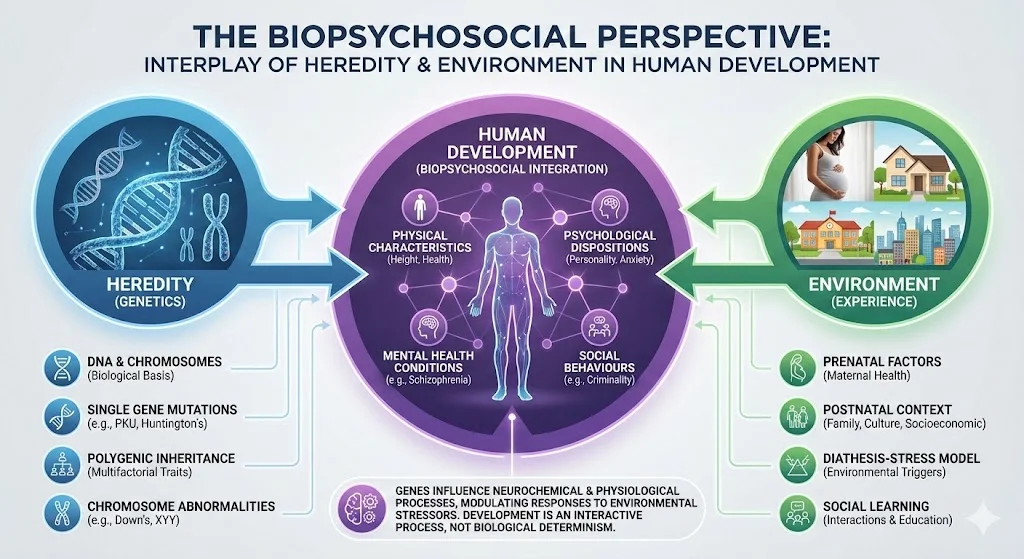
The longstanding debate in psychology regarding the origins of human behaviour, often dichotomized as “nature versus nurture”, has evolved into a sophisticated understanding of biopsychosocial integration. It is now widely accepted within the scientific community that both genetic predispositions and environmental influences are essential for development.
This principle applies universally, whether examining physical characteristics such as height, psychological dispositions like anxiety, complex mental health conditions such as schizophrenia, or socially defined behaviours like criminality.
From a genetic standpoint, an individual inherits strictly their DNA, a specific sequence of amino acids encoded within genes and chromosomes. All other characteristics are acquired throughout the lifespan as the individual interacts with their surroundings. The trajectory from an individual’s genetic constitution to their adult phenotype is immensely complex, shaped by an intricate web of interactions between internal biological factors and external prenatal and postnatal environments.
Genetic Diversity and Individuality
Human beings exhibit profound genetic and biochemical diversity. Research by Harris (1970) posited that, with the exception of monozygotic identical twins, every individual possesses a unique enzymatic constitution.
This biochemical uniqueness manifests in various physical, neurochemical, and physiological characteristics. Consequently, these biological variations influence personality traits and determine an individual’s relative susceptibility or resilience to environmental stressors. Ultimately, genes exert their effects on behaviour indirectly, mediated through their influence on growth patterns and the organism’s methods of responding to the environment.
Methodologies for Distinguishing Hereditary and Environmental Effects
To understand the relative contributions of heredity and environment, researchers employ family, twin, and adoption studies.
- Family Studies: The fundamental premise is that if genes influence a trait, there should be a discernible degree of familial resemblance. The absence of such resemblance refutes the genetic hypothesis. If a resemblance exists, its strength can be compared to the proportion of genes shared by relatives. First-degree relatives (parents, children, siblings, and dizygotic twins) share approximately 50% of their genes. Second-degree relatives (uncles/aunts, grandparents, half-siblings) share 25%, while third-degree relatives (first cousins) share 12.5%.
- Twin Studies: These studies are particularly valuable for testing non-genetic hypotheses. Dizygotic (DZ) twins share half their genes, while monozygotic (MZ) twins share 100%. If a trait is purely environmental, MZ and DZ twins should show similar concordance rates. Conversely, if MZ twins exhibit significantly greater similarity than DZ twins, it provides robust support for genetic involvement.
The Spectrum of Genetic Influences
Genetic factors influence psychological and behavioural outcomes through three primary mechanisms: chromosome abnormalities, single major genes, and polygenic inheritance.
1. Chromosome Abnormalities
While relatively rare, chromosomal anomalies have well-documented psychological and medical impacts.
- Down’s Syndrome: Caused by an extra chromosome 21, this condition accounts for approximately 25% of hospital admissions for severe mental subnormality.
- Turner’s Syndrome (45, XO): Females missing an X chromosome often experience difficulties in spatial perception.
- Klinefelter’s Syndrome (47, XXY): Males with an extra X chromosome are overrepresented among subnormal patients exhibiting behavioural abnormalities. Research by Theilgaard et al. (1971) confirmed that these psychological abnormalities were linked to the genetic anomaly rather than general subfertility or family background.
- XYY Syndrome (47, XYY): An extra Y chromosome is associated with an overrepresentation of males in institutions for persistent criminal behaviour. For instance, a Scottish hospital study found one in 35 patients had the XYY karyotype, compared to one in 700 in the general newborn male population. However, the majority of XYY males remain psychologically normal.
2. Single Gene Mutations
Specific single genes can have major effects on behaviour, though such conditions are infrequent.
- Huntington’s Chorea: A dominant condition leading to mental deterioration, typically manifesting in middle adulthood.
- Phenylketonuria (PKU): A recessively inherited metabolic error. Its profound negative effects on intelligence can be prevented through early dietary intervention, illustrating a powerful gene-environment interaction.
- Sex-Linked Recessive Traits: Red-green colour blindness affects around 8% of males, transmitted via carrier mothers to half their sons.
- Perceptual Variations: The inability to taste the chemical phenylthiocarbamide (P.T.C.) is caused by a recessive gene, highlighting how genetic make-up alters subjective environmental experiences.
3. Polygenic Inheritance and the Diathesis-Stress Model
Chromosome abnormalities and single-gene mutations account for a small fraction of psychological variation. Most graded characteristics, such as intelligence, musical ability, and personality traits, result from multifactorial origins. The polygenic model posits that traits arise from the combined secondary effects of multiple genes interacting with numerous environmental factors, moving away from the simplistic “one gene, one trait” paradigm.
For example, musical ability likely depends on an accumulation of predisposing genes combined with environmental inputs like music lessons. Similarly, conditions like anxiety are best understood through the diathesis-stress theory, proposed by Rosenthal (1970). This model suggests that both genetic vulnerability (diathesis) and environmental triggers (stress) are multiple and exist on a continuum. This framework also applies to binary conditions like epilepsy or criminality, where graded predisposing factors must cross a certain threshold for the trait to manifest.
Critical Analysis: Bridging Theory and Clinical Practice
In clinical practice, understanding the polygenic and interactive nature of human behaviour is paramount. Biometrical analysis allows clinicians and researchers to map out how familial resemblances fit various genetic and environmental hypotheses. While scientists may not be able to identify the precise role of every single influence contributing to individual variation, they can estimate the relative contributions of genetics and environment within specific populations.
Furthermore, the recognition that psychological traits and social behaviours depend on intricate mental processes and social learning does not diminish the importance of genetic factors. The pathway from genes to behaviour in psychology is highly complex. However, establishing the baseline genetic influence allows for more targeted environmental interventions, as seen in the dietary management of PKU. The ultimate goal of behaviour genetics is to identify specific contributing factors and understand their developmental interactions.
Conclusion
The contemporary view of human development rejects biological determinism in favour of an interactionist model. While chromosome abnormalities and single gene mutations provide clear examples of genetic impact, the vast majority of human psychological variation is polygenic. Genes do not dictate behaviour directly; rather, they influence neurochemical and physiological processes that modulate how an individual responds to their environment. Recognizing this intricate pathway from genes to behaviour enhances our ability to develop effective psychological interventions and educational strategies tailored to individual predispositions.
References
- Eysenck, H. J., & Wilson, G. D. (1976). A textbook of human psychology. MTP Press.
- Harris, H. (1970). The principles of human biochemical genetics. North-Holland.
- Rosenthal, D. (1970). Genetic theory and abnormal behavior. McGraw-Hill.
- Shields, J. (1976). Heredity and environment. In H. J. Eysenck & G. D. Wilson (Eds.), A textbook of human psychology (pp. 145-160). MTP Press.
- Theilgaard, A., Nielsen, J., Sørensen, A., Frøland, A., & Johnsen, S. G. (1971). A psychological-psychiatric study of patients with Klinefelter’s syndrome, 47, XXY. Acta Jutlandica, 43(1), 1-148.
