 Psychology Roots
Table of Contents
The Efficacy of Mental Imagery in Mitigating Competitive Sport Anxiety and Enhancing Athletic Performance
In both clinical and sport psychology, the optimization of human performance under pressure remains a central focus of empirical investigation. High-stakes athletic environments consistently trigger profound physiological and psychological stress responses. Among the various psychological skills training methods utilized to manage these responses, mental imagery stands out as a critical cognitive tool.
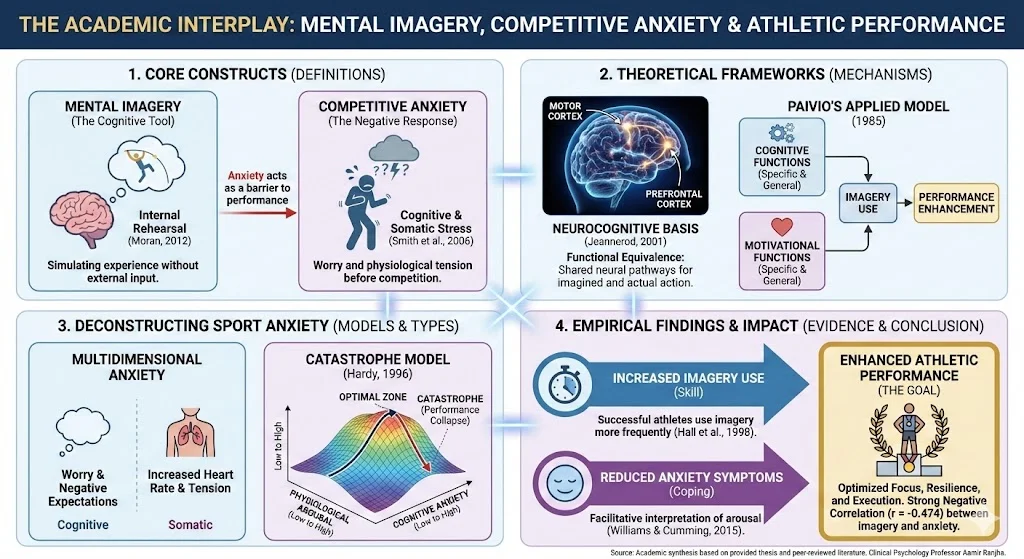
Mental imagery is defined as an internal representation mimicking real experiences that occurs while awake and conscious. It allows athletes to internally simulate a physical skill or environmental stressor without relying on external sensory input. Extensive research, including empirical data gathered from university-level athletes, demonstrates a robust correlation between the systematic use of mental imagery, the reduction of competitive anxiety, and overall athletic success.
This article evaluates the theoretical frameworks underpinning mental imagery, dissects the multidimensional construct of sport anxiety, and analyzes empirical evidence linking imagery usage to peak athletic performance.
The Neurocognitive Foundations of Mental Imagery
Mental imagery is not an isolated cognitive ability; rather, it represents a multisensory orchestration across various brain regions. Advances in neuroimaging have fundamentally shifted our understanding of how the brain processes imagined actions. Functional magnetic resonance imaging (fMRI) and positron emission tomography (PET) scans reveal that blood flow in the brain changes depending on the specific cognitive task undertaken.
When an athlete visualizes an action, such as mentally rotating a physical sequence or recalling a previous performance, distinct neural pathways are activated. For instance, visualizing mental rotations activates the parietal lobe. Recalling visual memories activates the occipital cortex. The observation that imagery and physical perception share identical neuropsychological pathways is formally known as the functional equivalence hypothesis. Because imagery utilizes the same information processing mechanisms as actual perception, athletes cannot effectively imagine a complex scenario while simultaneously processing high-level external sensory input.
Theoretical Frameworks Governing Imagery
To understand how imagery translates into performance enhancement, several theoretical models have been proposed in the literature:
- The Neuromuscular Theory suggests that imagining a movement triggers minute neural innervations in the corresponding muscles.
- The Bio-informational Theory posits that an image is a combination of stimulus propositions (the imagined scenario) and response propositions (the emotional or behavioral reaction).
- The Triple Code Theory incorporates the stimulus and somatic response but adds a third component: meaning.
- According to the Triple Code Theory, the individual differences in how athletes interpret imagery must be acknowledged because the same visual prompt carries different psychological meanings for different people.
- Paivio’s applied model of imagery bridges the gap between theory and clinical application by categorizing imagery into cognitive and motivational functions.
- Paivio’s model is further subdivided into specific and general levels, creating categories such as Cognitive Specific, Cognitive General, Motivational Specific, and Motivational General (which includes mastery and arousal dimensions).
Deconstructing Competitive Sport Anxiety
In clinical practice, we often observe athletes confusing functional arousal with debilitating anxiety. Arousal is simply a physiological state of readiness. It prepares the human body for action, typically observed during fight-or-flight responses. Anxiety, conversely, is the negative cognitive interpretation of that physiological arousal. It is defined as a state of worry or tension that frequently emerges in the absence of an immediate physical threat.
Sport anxiety is universally recognized as a multidimensional construct comprising both trait and state variables. Trait anxiety is a stable personality predisposition, whereas state anxiety is a highly specific response to an immediate situational stressor. Furthermore, researchers categorize the symptoms into somatic anxiety (physical nervousness) and cognitive anxiety (worry and negative expectations).
Several prominent models attempt to explain how this anxiety interacts with athletic execution:
- The Inverted-U Hypothesis: Performance improves as arousal increases up to an optimal midpoint; exceeding this point causes performance deterioration.
- Individualized Zone of Optimal Functioning (IZOF): Every athlete possesses a unique physiological and psychological zone where optimal performance occurs.
- Reversal Theory: The impact of arousal depends entirely on the athlete’s cognitive interpretation, oscillating between telic (goal-directed and anxious) and paratelic (playful and excited) states.
- Catastrophe Model: This three-dimensional paradigm suggests that while cognitive anxiety can enhance performance when physiological arousal is low, a sudden and catastrophic decline in performance occurs when both cognitive anxiety and physiological arousal peak simultaneously.
Empirical Findings: Imagery, Anxiety, and Success
Research utilizing tools like the Sport Imagery Questionnaire (SIQ) and the Sport Anxiety Scale-2 (SAS-2) provides quantifiable evidence of the interplay between mental rehearsal and psychological resilience. In a study analyzing 80 university athletes, robust statistical distinctions emerged between highly successful and less successful competitors.
- Successful university athletes utilize mental imagery at a significantly higher frequency than their less successful peers.
- The empirical data indicates a mean imagery score of 161.42 for successful athletes, compared to 141.47 for the less successful cohort.
- Higher levels of imagery skill correspond directly to lower levels of competitive sport anxiety.
- A strong negative correlation (r = -0.474) exists between the frequency of imagery use and the manifestation of sport anxiety.
These findings confirm that athletes possessing vivid mental practice capabilities can interpret physiological arousal in a facilitative manner, effectively buffering themselves against the detrimental symptoms of cognitive worry and somatic tension.
Critical Analysis
From a clinical and pedagogical perspective, the implications of these findings are substantial. The data clearly demonstrates that elite athletic success is not solely dependent on biomechanical efficiency or physiological endurance. Mental imagery operates as an active coping mechanism. By repeatedly simulating high-pressure environments, athletes engage in systematic desensitization. When imagery functions are actively integrated into training protocols, athletes enhance their cognitive focus and motivational resilience. They learn to reinterpret their elevated heart rates and somatic tension not as impending failure, but as biological readiness. Consequently, the routine assessment of imagery abilities using tools like the SIQ should become a standard diagnostic practice for sport psychologists aiming to formulate individualized intervention plans.
Conclusion
The relationship between mental imagery, competitive anxiety, and athletic performance is complex but empirically verifiable. Mental imagery serves as a powerful psychological intervention that regulates the debilitating effects of cognitive and somatic anxiety. Athletes who consistently employ structured imagery techniques demonstrate superior performance outcomes and enhanced psychological resilience. Moving forward, clinical sport psychology must prioritize the structured teaching of vivid, controllable imagery skills to athletes across all competitive levels.
References
- Ahsen, A. (1984). ISM: The Triple Code Model for imagery and psychophysiology. Journal of Mental Imagery, 15-42.
- Buckworth, J., & Dishman, R. K. (2002). Exercise Psychology. Human Kinetics.
- Frost, R. O., Marten, P., Lahart, C., & Rosenblate, R. (1990). The dimensions of perfectionism. Cognitive Therapy and Research, 14(5), 449-468.
- Hall, C. R., Mack, D. E., Paivio, A., & Hausenblas, H. A. (1998). Imagery use by athletes: Development of the Sport Imagery Questionnaire. International Journal of Sport Psychology, 29, 73-89.
- Hardy, L. (1996). Testing the predictions of the cusp catastrophe model of anxiety and performance. The Sport Psychologist, 10(2), 140-156.
- Jeannerod, M. (2001). Neural simulation of action: A unifying mechanism for motor cognition. NeuroImage, 14(1), S103-S109.
- Lang, P. J. (1979). A bio-informational theory of emotional imagery. Psychophysiology, 16(6), 495-512.
- Moran, A. P. (2012). Sport and Exercise Psychology: A Critical Introduction (2nd ed.). Routledge.
- Paivio, A. (1985). Cognitive and motivational functions of imagery in human performance. Canadian Journal of Applied Sport Sciences, 10(4), 22-28.
- Smith, R. E., Smoll, F. L., Cumming, S. P., & Grossbard, J. R. (2006). Measurement of multidimensional sport performance anxiety in children and adults: The Sport Anxiety Scale-2. Journal of Sport & Exercise Psychology, 28(4), 479-501.
- White, A., & Hardy, L. (1998). An in-depth analysis of the uses of imagery by high-level slalom canoeists and artistic gymnasts. The Sport Psychologist, 12(4), 387-403.
- Williams, S. E., & Cumming, J. (2015). Athlete imagery ability: A predictor of confidence and anxiety intensity and direction. International Journal of Sport and Exercise Psychology, 14(3), 268-280.
