 Psychology Roots
Table of Contents
Behavioral Testing in Pediatric Neuropsychology: Bridging Brain Data and Clinical Assessment
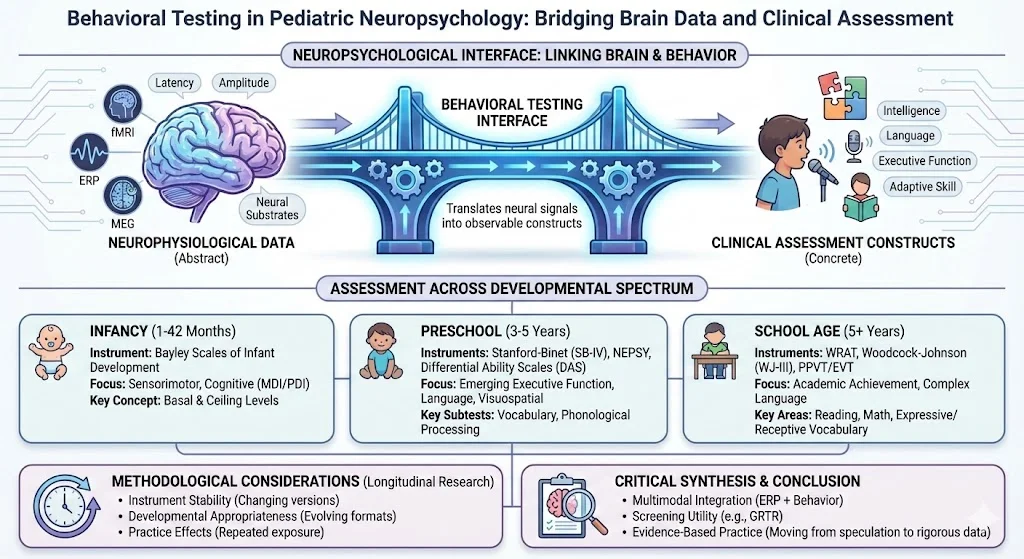
In the contemporary landscape of psychological science, the integration of neurophysiological data with behavioral assessment represents a critical frontier. While advances in neuroimaging, such as Event-Related Potentials (ERP), functional Magnetic Resonance Imaging (fMRI), and Magnetoencephalography (MEG), offer unprecedented views into neural architecture, these measures remain abstract without the context of observable human performance. Behavioral testing serves as the essential interpretive bridge, translating neural signals into clinically significant constructs of intelligence, cognitive skill, and adaptive functioning.
This article examines the methodological rigor required in behavioral testing with children, ranging from infancy through school age. It explores the selection of “gold standard” instruments, the complexities of longitudinal research design, and the synthesis of behavioral data with neurophysiological models to establish a robust evidence base for developmental psychology.
The Neuropsychological Interface: Linking Brain and Behavior
The fundamental premise of pediatric neuropsychology is that brain function and observed behavior are inextricably linked. While neuroimaging techniques can identify the timing (latency) and magnitude (amplitude) of neural processing, these metrics require behavioral correlates to possess explanatory power. For instance, when researchers observe ERP responses to speech sounds, the data gains clinical relevance only when correlated with the child’s actual performance on language and reading tests.
This convergence of data allows clinicians and researchers to move beyond theoretical speculation toward “hard data,” a requirement in an increasingly evidence-based scientific community. Ideally, behavioral tests are selected because they map onto specific neural substrates. A prime example includes executive functioning tasks linked to the frontal lobe, or phonological processing tasks that correspond to specific neural pathways involved in speech perception.
Methodological Considerations in Longitudinal Research
Investigating developmental trajectories often necessitates longitudinal designs, some spanning from birth to adolescence. This approach allows for the analysis of developmental change within individuals, as opposed to mere differences between age groups observed in cross-sectional studies.
However, longitudinal research presents distinct psychometric challenges:
- Instrument Stability: The “gold standard” assessments at the commencement of a study often become obsolete as new iterations (e.g., updated Wechsler or Bayley scales) are released. Researchers must navigate the hazard of changing instruments mid-stream versus using outdated measures.
- Developmental Appropriateness: As children mature, their capacity for interaction evolves. Assessment formats must shift from passive observation or simple manipulation in infancy to complex verbal and problem-solving tasks in school age.
- Practice Effects: Repeated administration of the same instrument can lead to familiarity, artificially inflating scores and threatening validity.
Assessment Protocols Across the Developmental Spectrum
Infancy: The Foundation of Assessment
Testing in the first years of life relies heavily on observation and manipulation of physical objects. The Bayley Scales of Infant Development stands as a preeminent tool in this domain, assessing children aged 1 to 42 months.
- Structure: The instrument utilizes age-based item sets. Clinicians must establish a “basal” (assumed mastery of lower items) and a “ceiling” (the level where the child fails all items) to determine the developmental range.
- Domains: Key indices include the Mental Development Index (MDI) and the Motor Development Index, which provide a composite view of cognitive and physical maturation.
- Research Application: In longitudinal contexts, specific items (e.g., language-related tasks) can be isolated for correlation with later linguistic competence, providing a granular view of developmental continuity.
Preschool: The Emergence of Executive Function
As children enter the preschool years (ages 3 to 5), assessment batteries become more diversified.
- Stanford-Binet Intelligence Scales (SB-IV): This instrument evaluates verbal and nonverbal reasoning. In preschool populations, a subset of subtests, such as vocabulary, comprehension, and pattern analysis, is typically administered to estimate cognitive ability.
- NEPSY (Developmental Neuropsychological Assessment): Designed for ages 3 to 12, the NEPSY is explicitly constructed to assess neurocognitive domains including attention, executive function, language, and sensorimotor skills. Subtests like “Phonological Processing” and “Verbal Fluency” are critical for identifying early signs of learning disabilities or specific language impairments.
- Differential Ability Scales (DAS): This tool provides distinct subtests for lower and upper preschool levels, assessing constructs such as block building (visuospatial) and verbal comprehension.
School Age: Academic and Cognitive Refinement
For children aged 5 and older, the focus expands to include formal academic achievement and complex language processing.
- Wide Range Achievement Test (WRAT): This instrument assesses fundamental academic codes, including reading (letter and word recognition), spelling, and arithmetic computation.
- Woodcock-Johnson Tests of Achievement (WJ-III): A comprehensive battery measuring curricular areas such as reading, mathematics, and written language. Its computerized scoring allows for detailed profiling of discrepancies between ability and achievement.
- Vocabulary Assessment: The Peabody Picture Vocabulary Test (PPVT) and the Expressive Vocabulary Test (EVT) form a “perfect couple” for language assessment. Co-normed for direct comparison, the PPVT measures receptive vocabulary (selecting pictures based on spoken words), while the EVT assesses expressive vocabulary (labeling and synonyms).
Screening and Early Identification
Comprehensive batteries are not always feasible or necessary. Screening tests serve to efficiently characterize populations or identify at-risk children. The Get Ready To Read (GRTR) screener, for example, evaluates phonological skills and print knowledge in 3 and 4-year-olds. Research demonstrates that performance on such screeners correlates significantly with formal measures like the WRAT, validating their utility in identifying children who may require more intensive evaluation.
Critical Analysis: Multimodal Integration
The integration of behavioral testing with ERP paradigms requires meticulous coordination. Behavioral assessments often serve a dual purpose in research settings: gathering psychometric data and “warming up” the child for the more restrictive environment of neurophysiological testing. Nonverbal tasks, such as block building or simple puzzles, are particularly effective for building rapport without inducing fatigue prior to ERP data collection.
However, researchers must remain vigilant regarding the limitations of specific modalities. Computerized assessments like the CANTAB, while standardized, may not be engaging for young children and often lack robust psychometric data for pediatric populations compared to traditional face-to-face administrations. Furthermore, test selection is a high-stakes decision; the use of outdated or insensitive measures can constitute a “fatal flaw” in research design, undermining the validity of the entire study.+2
Conclusion
Behavioral testing remains the cornerstone of pediatric neuropsychology, providing the “real-world” context necessary to interpret complex neurophysiological data. By carefully selecting valid, reliable instruments that align with the developmental stage of the child, from the Bayley Scales in infancy to the Woodcock-Johnson in school age, clinicians and researchers can construct a comprehensive picture of the developing brain. Ultimately, the synthesis of behavioral observation and neural measurement allows for a more precise understanding of cognitive development, moving the field from speculation to rigorous, evidence-based practice.
References
- Achenbach, T. M. (n.d.). Child Behavior Checklist.
- Bayley, N. (1993). Bayley Scales of Infant Development.
- Diamond, A. (n.d.). The “frontal lobe” executive functioning tasks.
- Dunn, L. M., & Dunn, L. M. (1997). Peabody Picture Vocabulary Test.
- Elliott, C. D. (1990). Differential Ability Scales.
- Kirk, U., & Kemp, S. (1997). NEPSY: A developmental neuropsychological assessment.
- Molfese, V., Molfese, D., Beswick, J., & Jacobi-Vessels, J. (n.d.). Behavioral Testing With Children.
- Whitehurst, G. J., & Lonigan, C. J. (2001). Get Ready to Read.
- Wilkinson, G. S. (1993). Wide Range Achievement Test 3.
- Williams, K. T. (1997). Expressive Vocabulary Test.
- Woodcock, R. W., & McGrew, K. S. (2001). Woodcock-Johnson III.
