 Psychology Roots
Table of Contents
The Evolution of Psychological Paradigms: From Behaviorism to the Gestalt Revolt
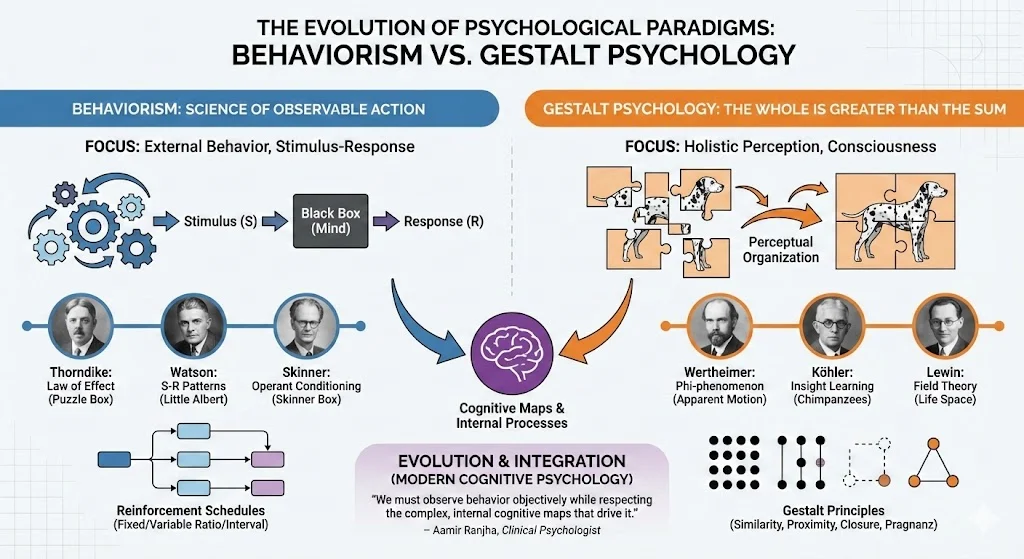
The history of psychology is characterized by a series of intellectual rebellions, each seeking to redefine the fundamental nature of human experience. Two of the most significant movements to emerge in the early 20th century were Behaviorism and Gestalt psychology. While Behaviorism sought to reduce human experience to observable stimulus-response mechanisms, Gestalt psychology argued for a holistic understanding of perception and consciousness.
This article examines the theoretical underpinnings of these schools of thought, analyzing the contributions of their founding figures and their enduring impact on modern psychological science.
The Behaviorist Revolution: The Science of Observable Action
Behaviorism emerged as a direct reaction against the introspective methods of structuralism. It fundamentally shifted the focus of psychology from the internal mind to external behavior. This school of thought posits that learning occurs primarily through conditioning processes.
Classical and Operant Foundations
The roots of this movement lie in the work of Ivan Pavlov and Edward Lee Thorndike. Thorndike, a pioneer in educational psychology, utilized the “puzzle box” to study animal intelligence. Through these experiments, he formulated the Law of Effect, which posits that responses followed by satisfaction are “stamped in” and learned, whereas those followed by discomfort are weakened. He further articulated the Law of Exercise, suggesting that repetition strengthens these stimulus-response connections , and the Law of Belongingness, which argues that only relevant responses are retained.
Building on these foundations, John B. Watson formally established behaviorism as a distinct school. Watson argued that for psychology to be a natural science, it must rely solely on “concrete facts” and observable behavior, rejecting introspection entirely. He viewed behavior as a complex system of stimulus-response (S-R) patterns.
B.F. Skinner expanded these concepts through Operant Conditioning. Unlike the passive association of classical conditioning, Skinner emphasized the role of reinforcement schedules. He identified four primary schedules: fixed ratio, variable ratio, fixed interval, and variable interval.
Neo-Behaviorism: Incorporating Internal Variables
As the discipline matured, rigid S-R models proved insufficient for explaining complex behaviors. Clark Hull introduced a mathematical approach to behavior theory. His formula,
SER = D x V x K x SHR
, attempted to quantify behavior (SER) as a function of Drive (D), Stimulus Intensity (V), Incentive (K), and Habit Strength (SHR).
Similarly, Edward Tolman introduced “Purposive Behaviorism”. He proposed the formula
B = f(S, A)
, where Behavior (B) is a function of Situation variables (S) and Antecedent variables (A). Tolman challenged the notion of mindless conditioning and argued for goal-directed behavior.
Edwin Guthrie offered a contrasting view. He minimized the role of reinforcement in favor of contiguity. Guthrie was less of an experimentalist and more of an observer, known for his theory of neurosis outlined in The Psychology of Human Conflict.
The Gestalt Revolt: The Whole is Greater than the Sum of its Parts
Around 1912, while Watson was attacking Wundt in America, a different revolution was brewing in Germany: the Gestalt revolt. The term “Gestalt” translates to “patterns” or “configuration”. This movement arose as a revolt against Wundt’s elementarism and argued that consciousness cannot be understood by breaking it down into isolated parts.
Principles of Perceptual Organization
Max Wertheimer, considered the father of Gestalt psychology, initiated this movement with his studies on the Phi-phenomenon, an illusion of motion created by the rapid succession of static images. His experiments demonstrated that perception is an active, constructive process rather than a passive reception of sensory data.
Gestalt psychologists identified several laws of perceptual organization:
- Similarity: Elements that look alike are perceived as a group.
- Proximity: Elements close to one another are perceived as a unit.
- Closure: The mind fills in gaps to create a complete image.
- Law of Pragnanz: We tend to order experience in a manner that is regular, orderly, symmetric, and simple.
Insight and Field Theory
Wolfgang Köhler contributed significantly through his research on problem-solving in chimpanzees. He proposed that learning occurs through insight, a sudden realization of the solution, rather than through trial and error. He also introduced the concept of isomorphism, suggesting a structural correspondence between mental maps and environmental objects.
Kurt Lewin expanded Gestalt principles into social psychology with his Field Theory. He viewed the environment as a field of forces with positive and negative attractions. Positive valences might include achieving life goals, while negative valences involve distinct repulsions or conflicts. Lewin famously categorized leadership styles into Authoritarian, Democratic, and Laissez-faire and analyzed internal conflicts, such as approach-approach and avoidance-avoidance.
The Instinctual Perspective: William McDougall
Parallel to these developments, William McDougall championed a Darwinian view of human behavior by emphasizing the role of instincts or “propensities”. He identified 18 distinct propensities that drive human action. These range from basic survival needs like food seeking and protection to complex social behaviors like gregariousness and self-assertion.
Critical Analysis
In my tenure as a professor, I often emphasize that the friction between Behaviorism and Gestalt psychology was necessary for the field’s evolution. Behaviorism provided the methodological rigor that psychology needed to establish itself as a credible science. By focusing on observable data, figures like Thorndike and Skinner allowed for the quantification of learning. However, their initial refusal to acknowledge internal mental states was a significant limitation.
Gestalt psychology corrected this over-simplification. By proving that the human mind organizes sensory input into meaningful wholes, they laid the groundwork for modern cognitive psychology. Lewin’s Field Theory, in particular, remains highly relevant in clinical settings today. Understanding a patient’s “life space” and the conflicting forces within it is essential for effective therapy.
Conclusion
The transition from the mechanistic views of behaviorism to the holistic perspective of Gestalt psychology represents a maturation of the discipline. While behaviorists like Watson and Skinner taught us how environmental contingencies shape action, Gestaltists like Wertheimer and Lewin taught us that the human mind is not merely a passive recorder of events but an active creator of reality. For modern practitioners and students, integrating these perspectives offers a comprehensive framework: we must observe behavior objectively while respecting the complex, internal cognitive maps that drive it.
References
- Guthrie, E. R. (1938). The Psychology of Human Conflict.
- Hull, C. L. (1943). Principles of Behavior.
- Koffka, K. (1924). The Growth of the Mind.
- Kohler, W. (1925). The Mentality of Apes.
- Lewin, K. (1935). A Dynamic Theory of Personality.
- McDougall, W. (1908). An Introduction to Social Psychology.
- Skinner, B. F. (1938). The Behavior of Organisms.
- Thorndike, E. L. (1911). Animal Intelligence.
- Tolman, E. C. (1932). Purposive Behavior in Animals and Men.
- Watson, J. B. (1913). Psychology as the behaviorist views it.
- Wertheimer, M. (1912). Experimental studies on the seeing of motion.
