 Psychology Roots
Table of Contents
Ethical Framework in Psychotherapy: A Comprehensive Guide to BACP Standards
The foundation of effective clinical practice rests upon a robust ethical framework. The British Association for Counselling and Psychotherapy provides a comprehensive guide designed to standardise and elevate the practice of counselling and psychotherapy. Being ethically mindful and willing to remain accountable for the ethical basis of practice are essential requirements for any practitioner.
In clinical practice, researchers and clinicians often observe that ethical dilemmas are rarely straightforward. Therefore, relying on a multifaceted approach that encompasses values, principles, and personal moral qualities is necessary to address the diverse needs of clients and the complexities of therapeutic settings.
Core Ethical Principles of Counselling and Psychotherapy
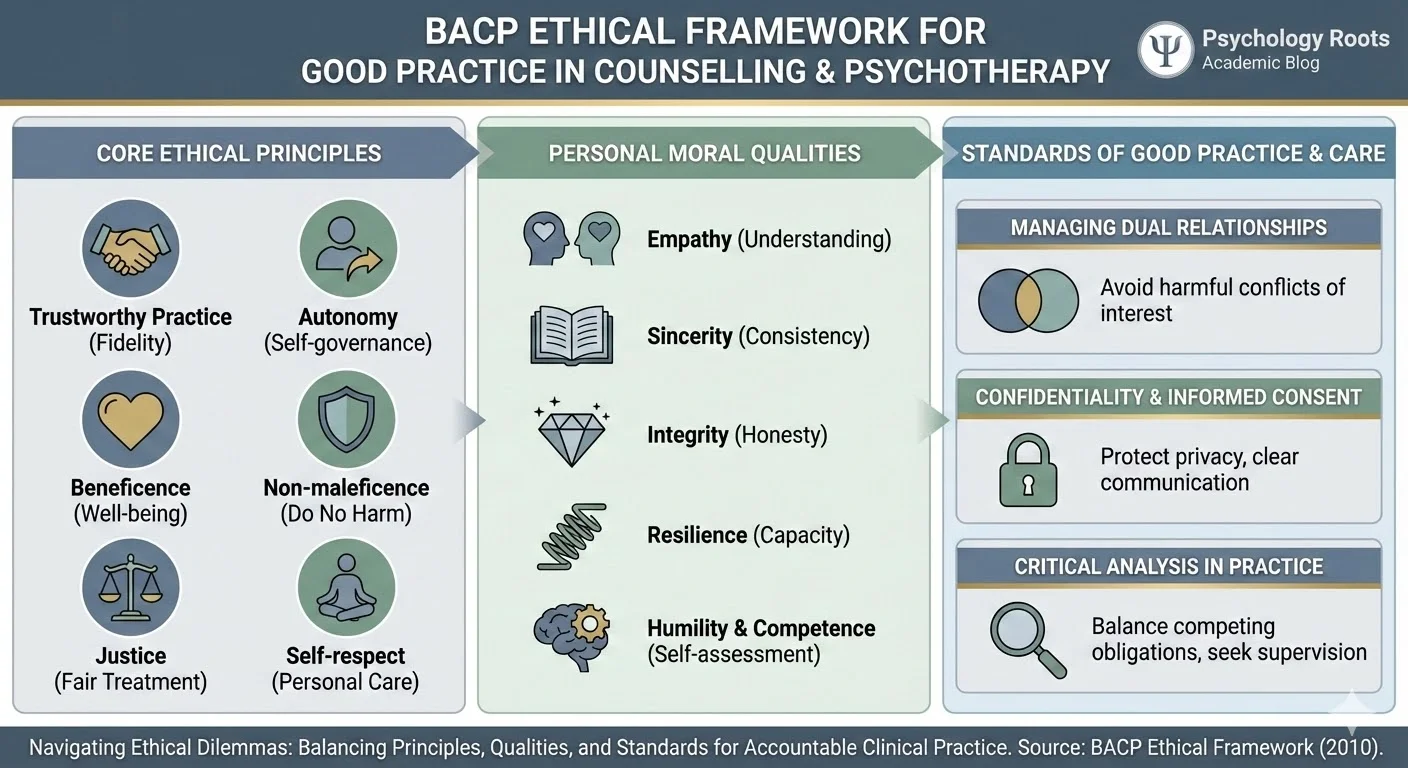
Ethical principles direct a practitioner’s attention to critical responsibilities and serve as a foundation for examining the justification of specific clinical decisions. The framework outlines several foundational principles:
- Trustworthy Practice: Honouring the trust placed in the practitioner, often referred to as fidelity, is fundamental to resolving ethical issues. Practitioners must honour agreements and regard confidentiality as a strict obligation arising from client trust.
- Autonomy: This principle emphasises respect for the client’s right to be self-governing and self-directing within therapy. It requires seeking freely given and adequately informed consent.
- Beneficence: A commitment to promoting the client’s well-being requires acting in their best interests based on rigorous professional assessment. It directs attention to working strictly within the limits of professional competence.
- Non-maleficence: This involves a strict commitment to avoiding harm, which includes avoiding sexual, financial, or emotional exploitation of the client.
- Justice: The fair and impartial treatment of all clients is required, alongside a commitment to providing adequate and accessible services.
- Self-respect: Practitioners must foster self-knowledge and apply ethical principles as entitlements for themselves, which includes seeking appropriate supervision and professional development.
Personal Moral Qualities in Clinical Practice
While principles guide decision-making, the personal moral qualities of the practitioner hold immense significance in the therapeutic relationship. These qualities are deeply rooted in the individual and develop out of personal commitment. Key virtues expected of professionals include:
- Empathy: The ability to communicate an understanding of another person’s experience from their distinct perspective.
- Sincerity: A commitment to consistency between professional professing and actual behaviour.
- Integrity: Maintaining straightforwardness, honesty, and coherence in all professional dealings.
- Resilience: The capacity to work with profound client concerns without becoming personally diminished.
- Humility and Competence: Accurately assessing one’s own strengths and weaknesses while effectively deploying necessary skills.
Standards of Good Practice and Care
Clients are fundamentally entitled to good standards of practice and care from their practitioners. This necessitates professional competence, positive relationships with colleagues, and a strict observance of professional ethics.
Managing Dual Relationships and Boundaries
A critical component of providing good care is the careful management of boundaries. Dual relationships arise when a practitioner holds two or more types of relationships concurrently with a client. The existence of a dual relationship is seldom neutral and can yield powerful detrimental impacts that are not always foreseeable. Practitioners are required to evaluate the implications of such relationships and avoid entering into any dynamic that is likely to harm the client.
Confidentiality and Informed Consent
The practice of psychotherapy depends entirely on gaining and honouring client trust. Clients should be adequately informed about the nature of the services offered to provide adequately informed consent. Respecting client privacy and confidentiality is a fundamental requirement. The professional management of confidentiality concerns the strict protection of personally identifiable and sensitive information from unauthorised disclosure.
Critical Analysis: Bridging Theory to Practice
Translating ethical frameworks into clinical reality often presents profound challenges. Situations where clients pose a risk of causing serious harm to themselves or others are particularly demanding. In these instances, practitioners must be intensely alert to the possibility of conflicting responsibilities between the client, affected third parties, and society generally.
The framework notes that exceptional circumstances may prevent the practitioner from seeking client consent prior to a breach of confidence, especially in urgent situations involving serious harm. Practitioners hold an ethical responsibility to balance the client’s right to confidentiality against the acute need to communicate with external authorities, and they must expect to be ethically accountable for any such breach. In complex scenarios, consultation with a clinical supervisor or experienced practitioner is strongly recommended to ensure the highest quality of care is maintained.
Conclusion
The challenge of working ethically means that psychologists will inevitably encounter situations laden with competing obligations. The British Association for Counselling and Psychotherapy framework is intended to assist practitioners by directing their attention to the variety of ethical factors that require consideration. By accepting these ethical standards, professionals commit themselves to the rigorous challenge of striving to be ethical, even when circumstances demand courageous and difficult decisions.
References
British Association for Counselling and Psychotherapy. (2010). Ethical framework for good practice in counselling and psychotherapy. BACP.
