 Psychology Roots
Table of Contents
Clinical Perspectives on Adjustment Disorders: Diagnosis, Etiology, and Therapeutic Interventions
In clinical practice, Adjustment Disorders (AjD) represent a complex intersection between normal stress responses and pathological adaptation. Often colloquially termed the “common cold of psychiatry,” this designation belies the significant functional impairment and distress associated with the condition.
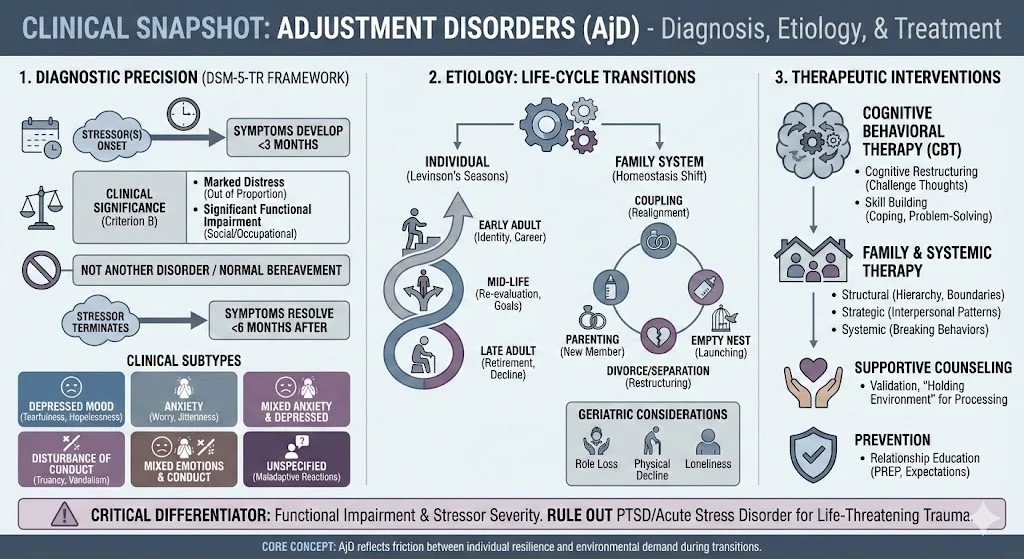
Adjustment Disorder is defined as a maladaptive emotional or behavioral reaction to an identifiable psychosocial stressor or stressors . Unlike Major Depressive Disorder or Post-Traumatic Stress Disorder, the symptomatology of AjD is inextricably linked to the timeline of the stressor; symptoms appear within three months of onset and typically resolve within six months of the stressor’s termination .
For students and clinicians, understanding AjD requires moving beyond a static symptom checklist. It demands a dynamic appreciation of “Life-Cycle Transitions,” which are the critical developmental junctures where individual coping mechanisms are most vulnerable to collapse . This article synthesizes the diagnostic framework with developmental and systemic theories to provide a comprehensive clinical overview.
Diagnostic Precision: The DSM Framework
The diagnostic criteria for Adjustment Disorders underscore the external etiology of the condition, distinguishing it from endogenous mood disorders.
Core Diagnostic Criteria
A diagnosis of Adjustment Disorder requires adherence to strict temporal and clinical parameters :
- Criterion A: Emotional or behavioral symptoms develop in response to an identifiable stressor(s) within 3 months of the onset of the stressor(s) .
- Criterion B: The clinical significance is evidenced by one or both of the following:
- Criterion C: The disturbance does not meet the criteria for another mental disorder and is not merely an exacerbation of a pre-existing mental disorder .
- Criterion D: The symptoms do not represent normal bereavement .
- Criterion E: Once the stressor or its consequences have terminated, the symptoms do not persist for more than an additional 6 months .
Clinical Subtypes
Accurate subtyping is crucial for guiding treatment planning as the presentation can vary significantly :
- With Depressed Mood: Predominance of low mood, tearfulness, and feelings of hopelessness .
- With Anxiety: Predominance of nervousness, worry, jitteriness, or separation anxiety .
- With Mixed Anxiety and Depressed Mood: A combination of depression and anxiety symptoms .
- With Disturbance of Conduct: Predominance of conduct issues, such as truancy, vandalism, reckless driving, or fighting .
- With Mixed Disturbance of Emotions and Conduct: Both emotional symptoms and conduct disturbances are present .
- Unspecified: Maladaptive reactions that do not fit the specific subtypes, often including physical complaints or social withdrawal .
Etiology: The Role of Life-Cycle Transitions
While the immediate cause of AjD is a stressor, the vulnerability to that stressor is often rooted in transitional periods. Psychologists analyze these through individual and systemic lenses.
1. The Individual Transition: Adulthood and Identity
Psychologist Daniel Levinson’s theory of adult development posits that adulthood is not a static plateau but a sequence of transitions .
- Early Adult Transition: The shift involving identity consolidation. Stressors here often involve career initiation and financial autonomy .
- Mid-Life Transition: Characterized by a re-evaluation of life goals .
- Late Adult Transition: The adjustment to retirement and physical changes .Failure to integrate these roles can lead to “Identity Crisis” or emotional turmoil, manifesting as anxiety or depression .
2. The Systemic Transition: The Family Life Cycle
From a systems theory perspective, the family unit is an organism that seeks homeostasis. Adjustment disorders often arise when the family system fails to reorganize during entry or exit points .
- Coupling/Marriage: The realignment of relationships and expectations .
- Parenting/Childbearing: The introduction of a new member requires a massive shift in resources .
- Empty Nest: The “launching” phase can trigger feelings of loss in parents .
- Divorce/Separation: A major disruption involving the loss of a member and system restructuring .
3. Transitions to Later Life (Geriatric Considerations)
The World Health Organization notes that the transition to old age brings unique physiological and psychosocial pressures .
- Role Loss: Retirement and changes in living arrangements remove primary sources of validation .
- Physical Decline: The onset of chronic illness or sensory deficits, such as hearing or vision loss, requires significant psychological adaptation .
- Bereavement & Loneliness: While bereavement itself is excluded from AjD, the consequences of loss are potent stressors that create significant risk factors for physical and mental decline .
Symptomatology and Differential Diagnosis
Clinicians must carefully differentiate Adjustment Disorders from normal adaptive stress. The key differentiator is functional impairment.
| Domain | Common Symptoms in AjD |
| Physical | Fatigue, muscle tension, insomnia, palpitations, somatic complaints like headaches or GI issues . |
| Emotional | Hopelessness, crying spells, anxiety, irritability, feelings of being overwhelmed . |
| Behavioral | Social withdrawal, avoidance of tasks, reckless behavior, substance use, truancy . |
| Cognitive | Rumination, difficulty concentrating, intrusive thoughts about the stressor . |
Critical Note: If the stressor is a life-threatening trauma, such as sexual violence or combat, the clinician must first evaluate for Acute Stress Disorder or PTSD. AjD is the appropriate diagnosis only if the criteria for these more severe disorders are not met.
Therapeutic Interventions
The primary treatment for Adjustment Disorder is psychotherapy, aimed at reducing the stressor’s impact and enhancing coping mechanisms .
1. Cognitive Behavioral Therapy (CBT)
CBT is a standard intervention for these disorders. It focuses on identifying negative thought patterns and replacing them with adaptive coping strategies .
2. Family and Systemic Therapy
Particularly relevant for stressors arising from family transitions.
- Structural Therapy: The therapist re-orders the organization of the family and enables individuals to recognize their value .
- Strategic Therapy: This approach looks at patterns of interaction to improve interpersonal relations .
- Systemic Therapy: Focuses on breaking down problematic behaviors and false beliefs held by family members .
3. Supportive Counseling
A non-directive approach that provides a safe space for emotional expression. This is often effective for uncomplicated cases where the patient simply needs validation and a “holding environment” to process the change .
4. Prevention
Premarital Relationship Enhancement Programs (PREP) and relationship education can serve as preventative measures, allowing individuals to discuss expectations before transitions occur .
Conclusion
Adjustment Disorders are prevalent yet frequently misunderstood conditions that reflect the friction between individual resilience and environmental demand. By viewing these disorders through the lens of life-cycle transitions, whether individual biological aging or systemic family shifts, clinicians can move beyond mere symptom management. Effective treatment utilizes this developmental context to not only resolve the immediate crisis but also to foster long-term adaptive growth.
References
- American Psychiatric Association. (2022). Diagnostic and statistical manual of mental disorders (5th ed., text rev.).
- Levinson, D. J. (1986). A conception of adult development. American Psychologist, 41(1), 3–13.
- Carter, B., & McGoldrick, M. (2005). The expanded family life cycle: Individual, family, and social perspectives (3rd ed.). Allyn & Bacon.
- World Health Organization. (n.d.). Mental health of older adults.
- Zubair, M. (n.d.). Adjustment Disorders [PowerPoint presentation]. Psychology Home and Online Tuitions.
