 Psychology Roots
Table of Contents
Clinical Assessment and Therapeutic Interventions in Child Sexual Abuse: A Case Formulation Approach
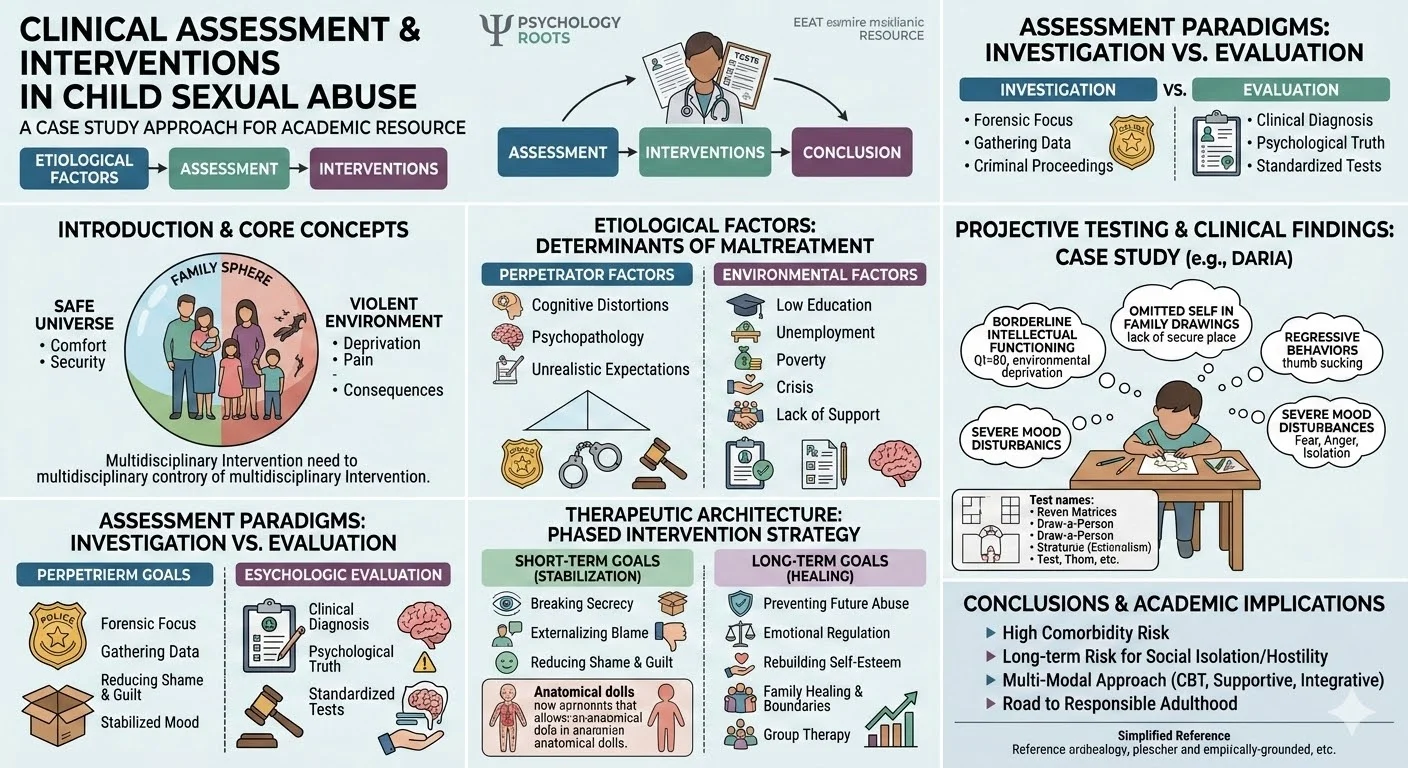
The family unit is traditionally conceptualized as the primary developmental matrix for a child, providing the stability and security necessary for normative psychological growth. However, when this foundational environment becomes a locus of deprivation and violence, the resulting trauma profoundly disrupts the developmental trajectory. In clinical practice, we often observe that addressing such profound violations requires comprehensive psychological, medical, and social interventions orchestrated by a specialized multidisciplinary team.
Etiological Factors in Child Maltreatment
The etiology of child abuse is multifaceted, encompassing both individual psychopathology and systemic environmental stressors. Research indicates that perpetrators often exhibit significant cognitive distortions, negative perceptions, and unrealistic expectations regarding child behavior, alongside elevated scores on psychopathology indices.
Beyond individual pathology, broader systemic factors heavily influence maltreatment risk. Key environmental determinants include low educational attainment, unemployment, poverty, and a profound lack of social support networks. Furthermore, acute familial crises, such as divorce, can precipitate transient periods of maltreatment where caregivers may exhibit violence or severe depressive neglect; however, effective parenting may resume once the immediate crisis resolves.
Conceptualizing Sexual Abuse and Clinical Sequelae
Child sexual abuse is clinically defined as the involvement of a minor in age-inappropriate psychosexual activities that they cannot comprehend, consent to, or that violate established social taboos. This encompasses a spectrum of coercion, manipulation, and exploitation.
Victims of such abuse endure severe physical and psychological terror. The resultant clinical sequelae frequently manifest as profound distortions in social behavior. Children may present with internalizing symptoms such as fearful withdrawal and depression, or externalizing behaviors including aggression, vindictiveness, and domineering interpersonal interactions.
The Assessment Paradigm: Investigation Versus Evaluation
In clinical psychology, it is crucial to delineate between legal investigation and psychological evaluation. The investigative phase is primarily forensic, focused on gathering data to substantiate or refute allegations of maltreatment for potential legal proceedings against perpetrators.
Conversely, the clinical evaluation aims to establish a comprehensive psychological diagnosis, determining the exact nature of the trauma and its impact on the child’s personality structure. This process utilizes standardized psychodiagnostic instruments. Typical assessment batteries include the Standard Raven Matrices, the Rey complex figure test, and projective techniques such as the Draw-a-Person, Tree, and Family tests.
Case Formulation: An 11-Year-Old Victim of Sexual Abuse
To illustrate the clinical application of these concepts, we analyze the case of Daria, an 11-year-old female placed in emergency institutional care following sexual assault by a relative. The clinical assessment revealed a complex trauma presentation compounded by severe maternal neglect.
Clinical Presentation and Psychodiagnostic Findings
- Emotional and Behavioral Functioning: The patient presented with a mixed emotional disorder characterized by marked anxiety, depressive disposition, high emotional lability, and low frustration tolerance.
- Cognitive Assessment: Testing indicated borderline intellectual functioning ($QI=80$), which was clinically formulated as secondary to severe environmental deprivation rather than an organic deficit.
- Projective Analysis: Initial projective drawings of her family omitted the patient entirely, signifying a profound lack of a secure psychological place within the family system.
- Trauma Symptoms: The patient exhibited severe mood disturbances, regressive behaviors, social isolation, and distinct feelings of fear and anger when confronted with traumatic memories.
Critical Analysis: Bridging Theory to Practice in Clinical Intervention
The therapeutic architecture for treating child sexual abuse requires a phased approach. See also: Trauma-Focused Cognitive Behavioral Therapy protocols.
Short-Term Therapeutic Objectives
Initial interventions must focus on stabilization and narrative construction. Clinicians must facilitate the patient in fully describing the abuse to identify its parameters while simultaneously addressing the intense feelings of shame and guilt. A critical milestone is breaking the rule of secrecy and externalizing the blame. Utilizing anatomically detailed dolls is a highly effective, empirically supported method to help children non-verbally communicate their experiences when language fails.
Long-Term Therapeutic Objectives
Subsequent therapeutic phases target the resolution of the core trauma and the reconstruction of the family system. Goals include stopping all victimization, facilitating emotional regulation, and rebuilding the patient’s self-esteem. Furthermore, the clinician must guide the family in establishing appropriate physical and emotional boundaries to prevent future exploitation. Group therapy is also indicated to reduce isolation and normalize the child’s affective responses through peer validation.
Conclusion
The clinical data underscores the high comorbidity of stress-related disorders with other psychopathological conditions in institutionalized victims of abuse. Early trauma significantly increases the risk for long-term social isolation and hostility. Effective intervention mandates a rigorous, multimodal approach integrating individualized psychotherapy, family counseling, and robust environmental protections to facilitate the remission of cognitive and behavioral deficits and ensure the development of a balanced adult.
References
- Constantin, M. (2008). Maltratarea copilului Între cunoaştere și intervenţie (2nd ed.). Editura Lumen.
- Ghergut, A. (2011). Evaluare şi Intervenţie psihoeducaţională: terapii educaţionale, recuperatorii şi compensatorii. Editura Polirom.
- Goran Băzărea, L. (2010). Introducere în psihologia educaţiei. Editura Fundația România de Mâine.
- Muntean, A., & Muntean, A. (2011). Violenţă, traumă, reziliență. Editura Polirom.
