 Psychology Roots
Table of Contents
The Psychology of High Performance: Analyzing Devotion, Social Dynamics, and Habit Formulation
In clinical practice and organizational psychology, we often encounter individuals seeking the “secret” to high performance and self-mastery. While popular literature frequently frames these concepts in mystical or purely motivational terms, the underlying mechanisms of success are deeply rooted in behavioral science and cognitive psychology.
The text 4 Epic Practices to Get Revelations for Exploits by John-Mabun Adesoga provides a framework derived from the biblical narrative of Daniel. While the source material is theological, the four pillars it identifies (Devotion, Team Building, Regular Practice, and Reading) map surprisingly well onto established psychological constructs: Grit, Social Identity Theory, Behavioral Activation, and Cognitive Reserve.
In this analysis, we will deconstruct these four practices through an empirical lens to explore how they function to optimize human performance and psychological well-being.
1. The Psychology of Devotion: Grit and Intrinsic Motivation
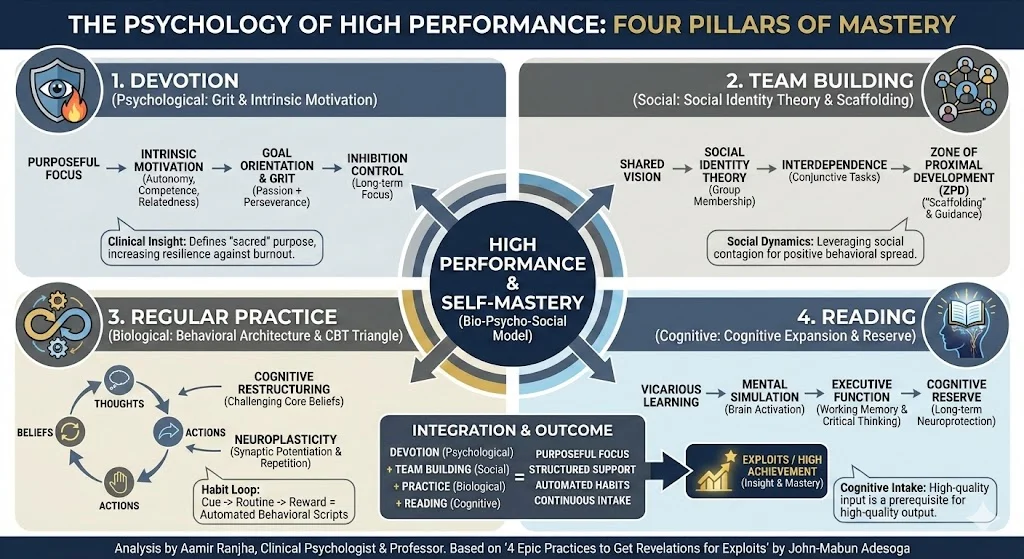
The first practice identified is “Devotion,” characterized by total consecration and focus on a specific assignment. Adesoga references Daniel’s refusal to defile himself as an act of “purposing in his heart”. Psychologically, this “purposing” is synonymous with Goal Orientation and Grit.
The Mechanism of Grit
Angela Duckworth, a pioneer in this field, defines Grit as “passion and perseverance for long-term goals.” Unlike transient motivation, grit involves a stamina that sustains effort despite adversity. When the text suggests that “extreme focus will on the long run produce an insight that will set you apart,” it describes the psychological outcome of deliberate practice. High achievers do not rely on talent alone. They rely on a consistency that borders on obsession.
- Intrinsic Motivation: The text notes that “talent is cheap; dedication is expensive”. This aligns with Self-Determination Theory (SDT), which posits that sustainable behavior is driven by intrinsic factors: specifically autonomy, competence, and relatedness.
- Selective Focus: The refusal to “defile himself” acts as a boundary setting mechanism. In cognitive psychology, this is inhibition control, a core executive function that allows individuals to suppress impulsive responses in favor of long-term goal-directed behavior.
Clinical Insight: In therapy, we often see that patients who define a “sacred” or non-negotiable purpose (Devotion) exhibit higher resilience against burnout compared to those motivated solely by external rewards.
2. Social Dynamics: The Scaffolding of Success
The second practice is “Team Building,” with the assertion that “the difference between success and failure is a great team”. Adesoga highlights the necessity of companions who share a common vision.
Social Identity Theory and Performance
Psychologist Henri Tajfel’s Social Identity Theory explains that a significant portion of our self-concept is derived from perceived membership in relevant social groups. When the text advises to “be careful and selective of the people you move with,” it touches on the phenomenon of social contagion, where behaviors, emotions, and norms spread through a network.
- Interdependence: The text argues that a team must be “interdependent” rather than just a group of independent actors. In organizational psychology, this is the shift from additive tasks (where individual efforts are summed) to conjunctive tasks (where success depends on the weakest link).
- The Zone of Proximal Development (ZPD): Adesoga describes teammates as “midwives for your insights”. This mirrors Vygotsky’s ZPD, where a learner can achieve more with the guidance of capable peers (“scaffolding”) than they could alone. A strong team provides the cognitive scaffolding necessary for “uncommon results”.
3. Behavioral Architecture: Habit and The CBT Triangle
The third practice, “Regular Practice: Habit,” emphasizes that beliefs become thoughts, thoughts become actions, and actions become habits. The text uses the example of Daniel praying three times a day as a structural habit.
The Cognitive Behavioral Connection
The progression outlined in the text (Beliefs > Thoughts > Words > Actions > Habits) is a layperson’s description of the Cognitive Behavioral Therapy (CBT) Triangle.
- Cognitive Restructuring: The text claims, “change your belief system… and the whole pattern of failure is replaced”. In CBT, we call this cognitive restructuring: identifying maladaptive core beliefs and challenging them to alter emotional and behavioral outcomes.
- Neuroplasticity and Repetition: The story of the young man plucking small plants versus a large tree illustrates synaptic potentiation. Repeated behaviors strengthen neural pathways (the “tree”), making them harder to change over time. Conversely, new habits are fragile (the “small flower”) and require protection and repetition to take root.
- The Habit Loop: Reference to Charles Duhigg validates the neurological loop of Cue, Routine, and Reward. Success is rarely a singular event but a product of automated behavioral scripts.
4. Cognitive Expansion: The Role of Reading
The final practice is “Read,” framed as a “conversation with the finest people of the past”. The text posits that reading grants “unhindered access into the lives of great souls”.
Cognitive Reserve and Executive Function
From a neuropsychological perspective, reading is one of the most effective methods for building Cognitive Reserve.
- Mental Simulation: When the text suggests you can “double people’s achievements… by taking your time to study their lives,” it speaks to the brain’s ability to simulate experiences. Reading activates the same neural regions as actually experiencing the event, allowing for “vicarious learning” (Bandura).
- Critical Thinking: The quote “Read before you think” suggests that high-quality input is a prerequisite for high-quality output. Reading enhances working memory and verbal intelligence, providing the raw material for complex problem-solving.
- Long-term Protection: Research indicates that frequent reading protects against cognitive decline in later life, acting as a buffer against neurodegeneration.
Critical Analysis
While Adesoga’s text is rooted in religious instruction, the “Four Pillar Strategies” align seamlessly with the Bio-Psycho-Social model of health.
- Devotion addresses the Psychological (internal motivation).
- Team Building addresses the Social (community support).
- Habit addresses the Biological (neurological patterning).
- Reading addresses the Cognitive (intellectual expansion).
The text’s claim that “entrance into these unusual realms will have to be by revelation” can be secularly interpreted as “insight” or “epiphany,” cognitive events that usually follow periods of intense preparation (Devotion) and incubation (Reading/Habit).
Conclusion
The transition from ordinary to “exploits” (high achievement) is not accidental. It requires a deliberate architectural approach to one’s psychology. Whether one views these practices through the lens of faith or the lens of science, the conclusion remains the same. Purposeful focus, structured social support, automated positive habits, and continuous cognitive intake are the non-negotiable prerequisites for mastery.
References
- Adesoga, J. M. (2019). 4 Epic Practices to Get Revelations for Exploits. [Source File].
- Duckworth, A. (2016). Grit: The Power of Passion and Perseverance. Scribner.
- Tajfel, H., & Turner, J. C. (1979). An integrative theory of intergroup conflict. The social psychology of intergroup relations.
- Beck, J. S. (2011). Cognitive behavior therapy: Basics and beyond (2nd ed.). Guilford Press.
- Chang, Y. H., Wu, I. C., & Hsiung, C. A. (2021). Reading activity prevents long-term decline in cognitive function in older people: evidence from a 14-year longitudinal study. International psychogeriatrics, 33(1), 63-74.
- Stern, Y. (2002). What is cognitive reserve? Theory and research application of the reserve concept. Journal of the International Neuropsychological Society, 8(3), 448-460.
