Psychology Roots
Table of Contents
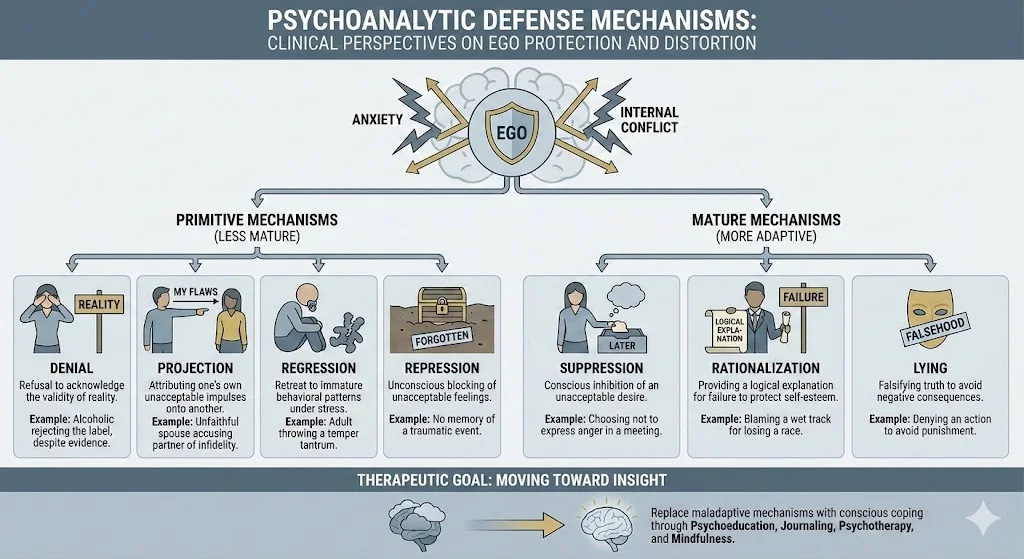
Psychoanalytic Defense Mechanisms: Clinical Perspectives on Ego Protection and Distortion
In clinical psychology and psychoanalytic theory, the human mind utilizes specific strategies to manage internal conflict and external stressors. A defense mechanism is defined as a mental maneuver, executed either consciously or unconsciously, that distorts or falsifies the reality of one’s experience . The primary function of these mechanisms is protective; they serve to shield the individual from feeling painful emotions such as shame, guilt, or anxiety .
While these mechanisms are essential for psychological homeostasis, their rigid or excessive use can lead to pathological behaviors and interpersonal dysfunction. This article explores the core defense mechanisms observed in clinical practice, distinguishing between primitive and mature strategies, and outlines methods for achieving psychological insight.
The Spectrum of Defensive Strategies
Defense mechanisms are not monolithic; they vary in maturity and their impact on an individual’s functioning. We categorize these into specific operations that manipulate reality to preserve the ego’s integrity.
1. Denial: The Refusal of Reality
Denial is often considered a primitive defense mechanism. It involves the refusal to acknowledge the validity of a reality, despite acknowledging its presence . The individual effectively opposes the force of evidence with the force of negation .
- Clinical Manifestation: A classic example is the individual with alcohol dependence who admits to enjoying drinking but adamantly rejects the label of “alcoholic” . Similarly, a smoker may dismiss substantial medical evidence linking tobacco to health pathology as “bogus” .
- Function: It creates a buffer against immediate shock or cognitive dissonance, though long-term reliance prevents necessary behavioral change.
2. Repression: The Unconscious Blockage
Repression is a foundational concept in psychoanalytic theory. It occurs when a person forces an unacceptable or threatening feeling out of awareness entirely . Unlike suppression, the individual becomes genuinely unaware of the impulse or memory .
- Clinical Manifestation: A person might be asked about their relationship with a parent and respond, “just fine,” while simultaneously exhibiting physiological signs of distress such as turning pale . The negative affect regarding the parent is so unacceptable that it is blocked from conscious awareness .
- Scope: Triggers can range from simple reprimands to traumatic events like rape .
3. Suppression: Conscious Avoidance
Suppression is distinct from repression due to the presence of conscious intent. The individual is aware of the unacceptable desire or emotion and validates its existence but intentionally inhibits its expression .
- Clinical Manifestation: An individual aware of their alcoholism might consciously decide to “go on the wagon” to prevent the behavior . Similarly, an introvert may condition themselves to act as an extrovert to fit social demands .
- Adaptive Nature: It is often considered a more mature defense as it involves volition and impulse control, such as suppressing anger in a professional setting .
4. Projection: Externalization of Internal Conflict
Projection involves attributing one’s own perceived negative attributes or unacceptable impulses onto another person . This mechanism allows the individual to ignore their own flaws by seeing them in others.
- Clinical Manifestation: An unfaithful spouse may irrationally accuse their partner of infidelity . A student who failed to study might blame the instructor for a poor grade rather than accepting personal responsibility . Additionally, one might accuse another of envy when they are actually the envious party .
5. Rationalization: The Intellectual Facade
Rationalization occurs when an individual admits to an element of the truth but denies the larger, more painful truth of the matter . It provides a logical, acceptable explanation for failure or bad behavior to protect self-esteem.
- Clinical Manifestation: A runner might claim, “I could have won the race but the track was wet” . While the track may have been wet, the larger truth, that another competitor was faster, is denied .
- Ego Protection: By attributing failure to external variables, such as claiming “the boss was a jerk” after being fired, the ego is shielded from the threat of incompetence .
6. Regression: Retreat to Immature Patterns
When adult defense mechanisms fail to manage stress, an individual may regress to behavioral patterns characteristic of an earlier developmental stage or childhood .
- Clinical Manifestation: An adult refusing to take responsibility might blame others in a childish manner, stating, “It’s not my fault, it’s her fault” . Immature behaviors such as excessive bragging or temper tantrums may also emerge .
7. Lying: Behavioral Distortion
While often categorized as a behavioral strategy rather than a traditional unconscious defense, lying functions similarly by falsifying truth to avoid punishment, rejection, or ridicule .
- Clinical Manifestation: Using phrases like “I swear I didn’t do it” or “It doesn’t mean anything” when one has failed to meet their own moral standards .
Therapeutic Interventions: Moving Toward Insight
The goal of clinical intervention is not merely to strip away defenses, which can leave a client vulnerable, but to replace maladaptive mechanisms with mature coping strategies. We identify several pathways to reduce reliance on primitive defenses:
- Psychoeducation: Reading and learning about these mechanisms can foster intellectual insight .
- Journaling: Writing about feelings and actions helps bridge the gap between unconscious impulses and conscious awareness .
- Psychotherapy: Talking to a therapist or close friend provides a safe environment to explore the root causes of anxiety .
- Mindfulness and Regulation: Practices such as meditation, prayer, and Emotional Freedom Techniques (EFT) can reduce the baseline anxiety that necessitates defense .
Conclusion
Defense mechanisms are the psychological immune system. While they protect us from immediate emotional pain, mechanisms like denial, projection, and repression can hinder growth and distort reality. By moving from unconscious repression to conscious suppression, and eventually to acceptance and insight, individuals can achieve greater psychological resilience and authenticity.