 Psychology Roots
Table of Contents
The Architecture of Anxiety: A Clinical Guide to Defense Mechanisms
In clinical practice, we often observe that the human mind is less of a fortress and more of a complex filtration system. We do not experience reality raw; we experience a version of it that has been sanitized, edited, and sometimes completely rewritten by our subconscious. These edits are what we call defense mechanisms.
While popularized by Sigmund Freud in the early 20th century, the study of defense mechanisms has evolved significantly. Modern clinical psychology views them not just as Freudian curiosities but as measurable predictors of mental health and adaptive functioning. This article explores the structural origins of these mechanisms, categorizes them through an empirical lens, and provides a framework for identifying and navigating them in therapeutic settings.
The Psychodynamic Foundation: Id, Ego, and Superego
To understand why we defend ourselves, we must understand what we are defending against. Freud proposed a tripartite model of the human personality involving three distinct aspects.
- The Id: The reservoir of primal instincts. It operates on the pleasure principle and seeks to fulfill wants, needs, and impulses immediately.
- The Superego: The moral compass. It strives for perfection and seeks to act in an idealistic, moral manner.
- The Ego: The rational mediator. It deals with reality and present events, attempting to reconcile the conflicting demands of the id and superego.
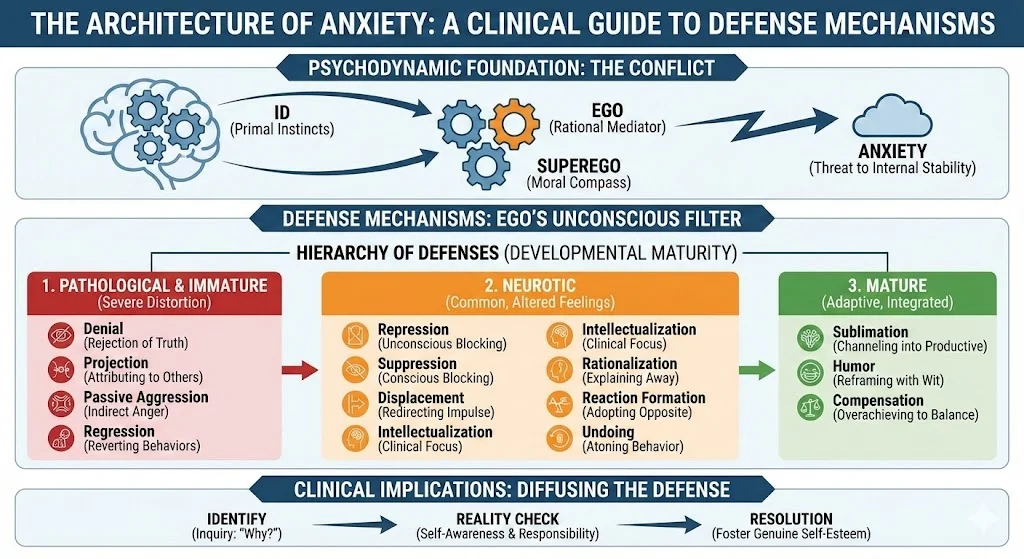
When the ego fails to reconcile these forces, specifically when it cannot manage the demands of desires, reality, and moral standards, anxiety follows. Freud conceptualized anxiety as an unpleasant inner state and a signal to the ego that internal stability is threatened. Defense mechanisms were created to shield the ego from this conflict between the id and superego. They act as the body’s sieve by filtering out an alternate reality in favor of one the mind prefers.
The Hierarchy of Defenses: From Pathological to Mature
Contemporary research categorizes defense mechanisms into a hierarchy based on their maturity and adaptive value. While the foundational list comes from Freud, modern psychology has added several mechanisms to this framework.
1. Pathological and Immature Defenses
These mechanisms are common in early development but are considered maladaptive in adults as they involve a severe distortion of reality.
- Denial: This is the open rejection of an obvious truth. By simply denying that an ailment or problem exists, the person avoids dealing with it. For example, the first step in Alcoholics Anonymous involves rejecting denial to acknowledge a drinking problem.
- Projection: This involves taking one’s own unacceptable qualities or feelings and attributing them to other people. A person who dislikes cats might project this by believing that cats do not like him, allowing him to escape acknowledging his own dislike.
- Passive Aggression: A hallmark of immature defense, this involves indirectly expressing anger. Rather than vocally expressing displeasure, the individual may remain quiet and let their feelings simmer in silence.
- Regression: Under stress, an individual may deal with unpleasant events by reverting to behavioral patterns found earlier in development. A classic example is a fired employee who sulks, or a traveler throwing a tantrum.
2. Neurotic Defenses
These are common in healthy adults but can become problematic if used rigidly. They alter an individual’s feelings or instincts but do not totally disconnect them from reality.
- Repression vs. Suppression: It is critical to distinguish these two.
- Repression is the unconscious way the self filters unwanted feelings and memories from the mind. A survivor of childhood abuse may not recall unpleasant memories until forced to talk about them.
- Suppression, conversely, is willful. It forces oneself to intentionally forget an unpleasant memory, person, or event, such as consciously forgetting an ex-lover.
- Displacement: This involves taking feelings on a subject out on another, unrelated and less threatening subject. A person may avoid arguing with a co-worker only to go home and argue with a spouse.
- Intellectualization: To avoid uncomfortable emotions, an individual thinks about events in a clinical, unfeeling way. A patient diagnosed with cancer might learn everything about the disease to remain calm and distant from the reality.
- Rationalization: This is explaining away an unacceptable behavior in a way that superficially makes sense but avoids the true explanation. A student who fails a test might blame the instructor rather than their own lack of preparation.
- Reaction Formation: This involves adopting opposite feelings, impulses, or behaviors. An individual might treat a hated enemy with the same affection they would show a spouse.
- Undoing: This involves engaging in behavior to atone or make up for an undesirable behavior. An abusive partner bringing home flowers to make up for a fight is a classic example.
3. Mature Defenses
These mechanisms are associated with high adaptive functioning. They integrate conflicting impulses in a constructive way.
- Sublimation: This involves venting unacceptable impulses in a more acceptable form. A person with extreme anger issues may take up kickboxing to release feelings safely.
- Humor: Using humor involves pointing out the funny or ironic aspects of a situation to deal with it. People often employ self-deprecating humor to cope with inadequacy.
- Compensation: This involves overachieving in one area to compensate for failures in another. A baseball player with a poor batting average may improve his defensive game to compensate.
Clinical Implications: Diffusing the Defense
In therapy, our goal is not to strip away all defenses immediately, but to foster awareness. Psychologists agree that to diffuse a defense mechanism, one must first identify the root cause of the behavior.
The most potent tool in this process is inquiry. Asking “Why?” forces the individual to identify the true reason behind their feelings. Defense mechanisms evolved to protect us when our egos were just developing and we lacked the self-esteem to protect ourselves. However, as adults, we know how to respect and take care of ourselves. We do not need to protect ourselves from threats to self-esteem in the same way.
The Reality Check: To resolve a defense mechanism, give yourself a reality check. Take full responsibility for your thoughts and actions. This increased awareness can reduce the use of defense mechanisms. Recognizing the mechanism allows you to stop yourself before the behavior manifests. Ultimately, being true to yourself increases self-esteem and the honesty of relationships.
References
- American Psychiatric Association. (2013). Diagnostic and statistical manual of mental disorders (5th ed.).
- Cramer, P. (2006). Protecting the self: Defense mechanisms in action. Guilford Press.
- Freud, A. (1937). The ego and the mechanisms of defense. Hogarth Press.
- Freud, S. (1923). The ego and the id. W. W. Norton & Company.
- Gardner, E. (n.d.). 19 Common Defense Mechanisms. Earl Gardner Ministries.
- Vaillant, G. E. (1992). Ego mechanisms of defense: A guide for clinicians and researchers. American Psychiatric Press.
