 Psychology Roots
Table of Contents
Clinical Supervision in Practice: Navigating Suicidality, GBV, and Countertransference
Clinical supervision stands as the cornerstone of effective psychological practice, serving as a critical checkpoint for counselor competence, ethical adherence, and professional development. In the therapeutic landscape, novice and seasoned practitioners alike encounter complex presentations that challenge the boundaries of standard protocol.
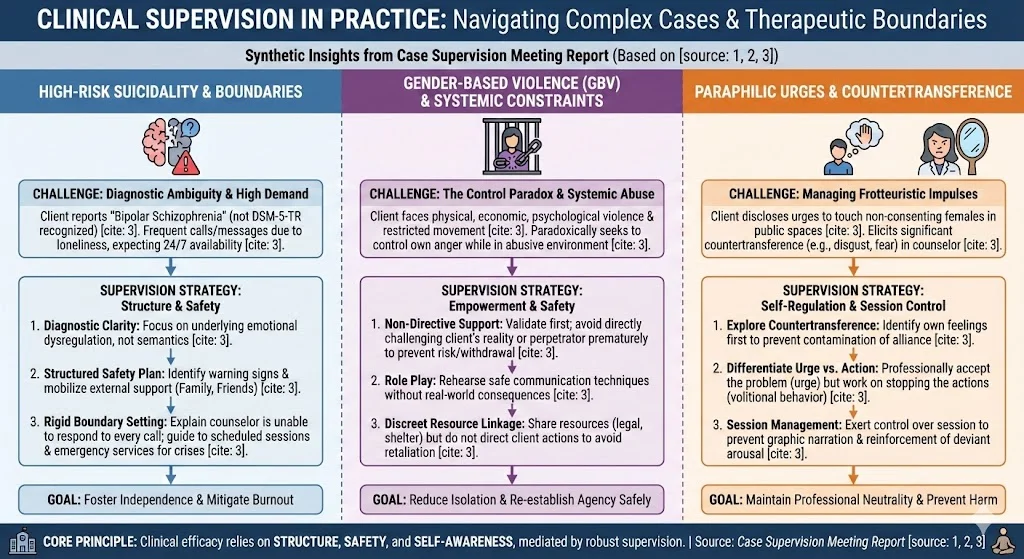
This article synthesizes insights from a recent clinical supervision case conference, addressing three distinct yet high-stakes domains: complex suicidality with diagnostic ambiguity, gender-based violence (GBV) amidst systemic constraints, and paraphilic urges involving non-consensual contact.
High-Risk Suicidality and Therapeutic Boundaries
A frequent challenge in clinical practice is the management of clients presenting with acute safety concerns coupled with high demands for clinician availability.
Diagnostic Clarity and the “Bipolar Schizophrenia” Construct
In a recent supervision cohort, a counselor presented a male client exhibiting suicidal ideation, anxiety, and a self-reported history of “bipolar schizophrenia” since age 20. It is imperative to note that “bipolar schizophrenia” is not a recognized nosological entity in the DSM-5-TR. Clinicians must differentiate between Schizoaffective Disorder, where psychotic symptoms persist in the absence of mood episodes, and Bipolar Disorder with Psychotic Features.
Mislabeling by clients often reflects a fragmented understanding of their own pathology. The supervisor correctly identified the need to focus on the underlying emotional dysregulation rather than getting lost in the client’s potentially inaccurate medical semantics.
The Support System and Safety Planning
The client in question frequently contacted the counselor outside of sessions, citing loneliness and a need for connection. This necessitates a dual approach:
- Safety Planning: Rather than ad-hoc reassurance, the clinician must establish a structured safety plan. This involves identifying warning signs, internal coping strategies, and specifically mobilizing external support systems such as family or friends to mitigate isolation.
- Boundary Setting: The supervisor emphasized that counselors cannot function as a 24/7 crisis line. It is clinically contraindicated to respond to every call, as this fosters dependency and burnout. The therapeutic frame must be rigid; counselors should explain their unavailability outside scheduled sessions and direct the client to emergency services for acute crises.
Intimate Partner Violence (IPV) and Systemic Constraints
Cases involving Gender-Based Violence (IPV/GBV) require a delicate balance between empowerment and safety, particularly when the perpetrator maintains proximity.
The Paradox of Control
A case was presented involving a female client subjected to physical, economic, and psychological violence, including extreme restriction of movement. The client expressed a desire to control her anger, despite being the victim of systemic abuse. This is a common defense mechanism where the victim attempts to regain agency by hyper-focusing on their own emotional regulation.
Non-Directive Support and Risk Assessment
The supervisor advised against directly challenging the client’s reality or the perpetrator’s actions prematurely, as this can escalate risk or lead to the client withdrawing from therapy due to “paranoia” or fear of retribution.
- Role Play: Utilizing role-play techniques can help the client rehearse safe communication without real-world consequences.
- Resource Linkage: Information regarding legal or shelter resources should be shared discreetly (“share resources but not direct”) to ensure the client does not face immediate retaliation.
- Listening as Intervention: In restrictive environments, the act of validation is a primary intervention. The goal is to reduce isolation before attempting significant behavioral change.
Paraphilic Urges and Countertransference
Working with clients who express sexual urges toward non-consenting others elicits significant countertransference, requiring robust supervision to maintain professional neutrality.
Managing Frotteuristic Impulses
A 45-year-old male client disclosed urges to touch females when in public spaces. This presentation aligns with criteria for Frotteuristic Disorder or related paraphilic coercive behaviors. The supervision guidance prioritized the counselor’s self-regulation:
- Explore Countertransference: The counselor must first identify their own feelings of disgust or fear to prevent these from contaminating the therapeutic alliance.
- Differentiating Urge from Action: Therapy must distinguish between the experience of the urge (which is automatic) and the action (which is volitional). The clinical goal is to “stop them” (the actions) while professionally accepting the problem exists.
- Session Management: If a client provides excessive, graphic details of sexual content, the counselor must exert control over the session to prevent voyeuristic dynamics or the reinforcement of deviant arousal through narration.
Conclusion
The transition from novice to expert practitioner is mediated by the quality of supervision. Whether addressing the boundary-testing behaviors of a suicidal client, navigating the safety minefield of GBV, or managing the discomfort of paraphilic disclosures, the guiding principle remains constant: clinical efficacy relies on structure, safety, and self-awareness.
References
- Ahmed, A., & Aamir, M. (2020). Case Supervision Meeting Report.
- American Psychiatric Association. (2022). Diagnostic and statistical manual of mental disorders (5th ed., text rev.).
- Case Supervision Meeting Minutes. (2020, August 20). Internal Clinical Document.
