 Psychology Roots
Table of Contents
Fundamentals and Clinical Applications of Cognitive Behavioral Therapy
Cognitive Behavioral Therapy (CBT) represents one of the most empirically supported interventions within modern clinical psychology. Initially developed by Aaron T. Beck in the 1960s, CBT operates on the fundamental premise that an individual’s cognitions directly influence their emotional responses and behavioral patterns (Beck, 1979). Rather than focusing solely on external stimuli, the cognitive model posits that the interpretation of events determines psychological distress.
In both clinical practice and academic supervision, we consistently observe that modifying dysfunctional thinking and behavior leads to significant symptom reduction. The following sections examine the core theoretical constructs of CBT, specific modalities such as Rational Emotive Behavior Therapy (REBT), and the clinical utility of cognitive restructuring.
Theoretical Foundations of Cognitive Behavioral Therapies
The Cognitive Model and Core Beliefs
The cognitive specificity hypothesis asserts that distinct psychiatric disorders are characterized by unique psychological profiles and distorted appraisals (Beck, 2005). For example, depression is typically associated with a negative view of the self, the world, and the future. Anxiety disorders often involve an overestimation of physical or psychological threats.
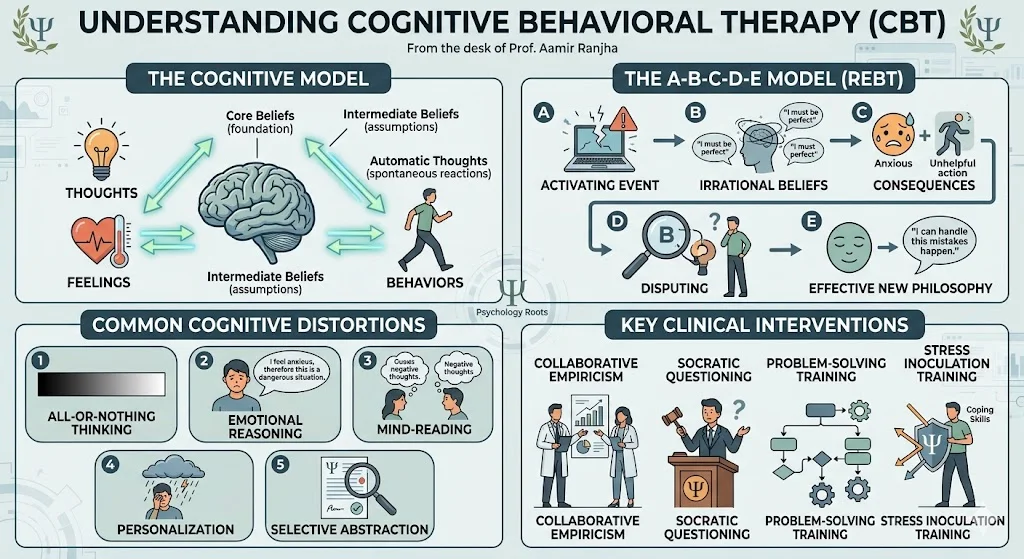
Central to this model are core beliefs. These deeply ingrained assumptions organize an individual’s understanding of themselves and the world. Core beliefs often remain dormant until activated by stressful life events. Once activated, they generate automatic thoughts, which are spontaneous, situation-specific cognitions that arise without deliberate reasoning and dictate immediate emotional reactions (Hofmann et al., 2012).
Rational Emotive Behavior Therapy
Developed by Albert Ellis, REBT is a pioneering form of cognitive-behavioral intervention that emphasizes the role of irrational beliefs in human suffering (Ellis, 1962). The core of REBT is the A-B-C-D-E-F model. In this framework, an Activating event (A) does not directly cause emotional Consequences (C). Instead, the individual’s Beliefs (B) about the event dictate the emotional outcome. The therapeutic process involves Disputing (D) these irrational beliefs, creating an Effective new philosophy (E), and establishing new Feelings (F).
Cognitive Distortions and Maladaptive Appraisals
Psychological distress is frequently maintained through systematic errors in reasoning known as cognitive distortions. Patients routinely make consistent errors in how they process information, leading to a negative bias in environmental appraisal. Recognizing these distortions is a primary objective in the early stages of cognitive therapy.
Common cognitive distortions include:
- All-or-nothing thinking: Evaluating situations in absolute, black-and-white categories.
- Emotional reasoning: Operating on the assumption that negative feelings reflect absolute reality.
- Mind-reading: Arbitrarily concluding that others are reacting negatively without empirical evidence.
- Personalization: Assuming excess responsibility for external events.
- Selective abstraction: Focusing exclusively on a negative detail while ignoring the broader context.
Clinical Techniques and Interventions
The role of the clinician in CBT is highly active, directive, and collaborative. Therapists utilize a process known as collaborative empiricism to help clients test the empirical validity of their cognitions.
Problem-Solving and Stress Inoculation Training
Problem-solving training teaches structured strategies for identifying and addressing practical life challenges. This approach is highly effective in treating both depression and anxiety. Furthermore, Donald Meichenbaum introduced Stress Inoculation Training (SIT), a specialized form of cognitive-behavioral modification (Meichenbaum, 1985). SIT involves teaching clients to utilize positive self-statements and self-instructional training to cope with anticipated stressors.
Critical Analysis: Bridging Theory to Practice
While CBT is a robust and highly efficacious treatment modality, applying it in clinical settings requires careful nuance. Research indicates that cognitive-behavioral interventions are highly successful for patients with depression and anxiety disorders (Hofmann et al., 2012). However, a limitation of the approach is its heavy reliance on the client’s cognitive capacity and willingness to actively engage in homework assignments. Durability and generalization of skills can sometimes be lacking, particularly if the underlying core beliefs are not adequately restructured.
In clinical practice, we must recognize that therapy is not merely an intellectual exercise. The therapeutic alliance remains a critical mechanism of change. The therapist must skillfully confront self-destructive beliefs without invalidating the client’s emotional experience. When clients learn to become their own therapists through sustained practice and cognitive restructuring, the risk of symptom relapse decreases significantly.
Conclusion
Cognitive Behavioral Therapy remains a cornerstone of evidence-based psychological treatment. By systematically identifying automatic thoughts, challenging cognitive distortions, and restructuring core beliefs, clinicians can facilitate profound cognitive and behavioral change. As research continues to evolve, the integration of traditional cognitive techniques with targeted behavioral interventions will further enhance treatment outcomes across diverse clinical populations.
References
- Beck, A. T. (1979). Cognitive therapy of depression. Guilford Press.
- Beck, J. S. (2005). Cognitive behavior therapy: Basics and beyond. Guilford Press.
- Ellis, A. (1962). Reason and emotion in psychotherapy. Lyle Stuart.
- Hofmann, S. G., Asnaani, A., Vonk, I. J., Sawyer, A. T., & Fang, A. (2012). The efficacy of cognitive behavioral therapy: A review of meta-analyses. Cognitive Therapy and Research, 36(5), 427-440.
- Meichenbaum, D. (1985). Stress inoculation training. Pergamon Press.
