 Psychology Roots
Table of Contents
Theoretical Frameworks and Clinical Application of Essential Counseling Competencies
The efficacy of psychological intervention is fundamentally predicated on the mastery of specific interpersonal techniques and the cultivation of a robust therapeutic alliance. While theoretical orientations provide the map for treatment, the counselor’s ability to implement core skills serves as the vehicle for behavioral and cognitive change. This article examines the multidimensional benefits of counseling and the technical proficiencies required for effective clinical practice.
The Therapeutic Value of Psychological Intervention
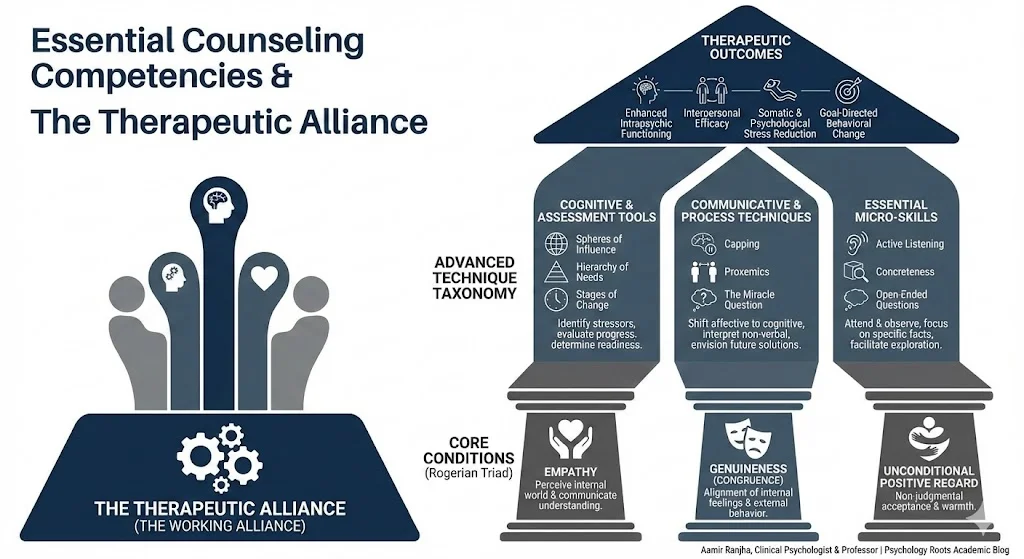
Counseling serves as a structured process designed to facilitate self-actualization and symptom reduction. Beyond mere problem-solving, the process aims to enhance the client’s internal locus of control and emotional regulation.
Key therapeutic outcomes include:
- Enhanced Intrapsychic Functioning: Clients achieve greater congruence between their self-perception and their reality, leading to increased security and comfort in daily activities.
- Interpersonal Efficacy: By understanding relational dynamics, clients foster deeper connections with family, spouses, and peers.
- Somatic and Psychological Stress Reduction: Intervention targets the physiological manifestations of emotional distress, promoting holistic health and reducing workplace or relational stress.
- Goal-Directed Behavioral Change: Counselors assist in identifying life objectives and establishing efficient pathways to achieve them.
- Self-Fulfillment: The ultimate trajectory of counseling often moves toward greater self-fulfillment and the resolution of personal fears or perceptions.
Advanced Counseling Techniques: A Taxonomy of Practice
Effective clinical work necessitates a diverse repertoire of techniques tailored to the client’s developmental stage and immediate needs. We can categorize these into assessment tools, process interventions, and cognitive restructuring strategies.
Cognitive and Assessment Tools
- Spheres of Influence: This assessment framework allows the individual to examine various life domains to determine which systems provide strength versus those that induce stress. Key spheres include immediate family, culture, employment, and external influences.
- Hierarchy of Needs: Based on Abraham Maslow’s framework, the counselor evaluates the client’s progress through physiological, safety, belonging, and self-esteem needs to determine if self-actualization is attainable.
- Stages of Change: Determining the client’s readiness for modification allows for the strategic timing of interventions based on what the client prioritizes.
- Positive Asset Search: This strength-based technique encourages clients to identify their inherent attributes to foster a resilient mindset.
Communicative and Process Techniques
- Capping: A strategic shift from affective (emotional) to cognitive processing when a client requires stabilization or emotional regulation.
- Proxemics and Observation: The study of spatial movements and non-verbal cues allows the counselor to interpret the client’s underlying mood and reactions through body orientation.
- Immediacy: Addressing the “here-and-now” dynamics within the session provides real-life learning opportunities, allowing clients to apply immediate insights to past situations.
- The Miracle Question: A solution-focused technique that encourages clients to envision a future where their primary concerns are resolved. A typical phrasing is: “What would your world look like if a miracle occurred, and how would it change things?”.
- Clarification and Paraphrasing: Counselors must frequently clarify client statements to avoid misconceptions and paraphrase content to demonstrate active processing of information.
The Core Conditions of the Helping Relationship
Research consistently indicates that the specific modality employed is often less critical to outcomes than counselor behaviors such as enthusiasm, confidence, and belief in the patient’s capacity for change. This “Working Alliance” requires active collaboration and agreement on treatment goals.
The Rogerian Triad and Beyond
- Empathy: The sophisticated ability to perceive the client’s internal world and communicate that understanding back to them to amplify meaning. Crucially, empathy is not identifying with the patient or sharing similar experiences; it is an objective, caring understanding.
- Genuineness (Congruence): The alignment of the counselor’s internal feelings with their external behavior. If a counselor feigns comfort with a difficult topic (e.g., substance abuse) while exhibiting non-verbal discomfort, it breeds mistrust.
- Unconditional Positive Regard: The provision of a non-judgmental, warm environment where the client feels accepted regardless of their disclosures. This involves conveying acceptance through both verbal and non-verbal reactions.
Essential Micro-Skills
- Active Listening: This is bifurcated into “attending” (physical orientation and undivided attention) and “observing” (capturing verbal and non-verbal data). Research estimates that approximately 80% of communication is non-verbal.
- Concreteness: This skill keeps communication focused on specific facts and feelings, avoiding vague generalizations. It assists clients in identifying specific problems and clarifying terms.
- Interpretation: An advanced skill where the counselor provides new meaning or explanations for behaviors, helping the client view problems through a novel framework.
- Open-Ended Questions: These are designed to facilitate exploration rather than interrogating the client for “yes/no” data. The goal is to encourage details regarding “how,” “why,” and “what”.
Critical Analysis: The Nuance of Self-Disclosure and Confrontation
In clinical supervision, I often observe students struggling with the balance of Self-Disclosure. While it can humanize the therapist, it should only be employed when there is a pressing clinical need that cannot be met otherwise. It must always benefit the client, not unburden the counselor.
Similarly, Confrontation is frequently misunderstood. It is not an adversarial stance between therapist and client, but rather a facilitation of the client’s self-examination. The pace of this self-confrontation must be negotiated carefully to maintain the alliance.
Conclusion
The practice of counseling is an intricate synthesis of art and science. From the strategic use of Silence/Focusing to allow clients to process emotion , to the structural organization of sessions to build trust, every interaction is purposeful. Mastery of these competencies—rooted in the core conditions of empathy, genuineness, and respect—empowers the clinician to move beyond mere advice-giving and toward facilitating profound psychological change.
References
- Counseling Skills and Techniques. (n.d.). [Source Document].
- Maslow, A. H. (1943). A theory of human motivation. Psychological Review, 50(4), 370–396.
- Rogers, C. R. (1957). The necessary and sufficient conditions of therapeutic personality change. Journal of Consulting Psychology, 21(2), 95–103.
- Egan, G. (2013). The Skilled Helper: A Problem-Management and Opportunity-Development Approach to Helping. Cengage Learning.
