 Psychology Roots
Table of Contents
Dyslexia: A Neurodevelopmental Perspective on Specific Learning Disorders
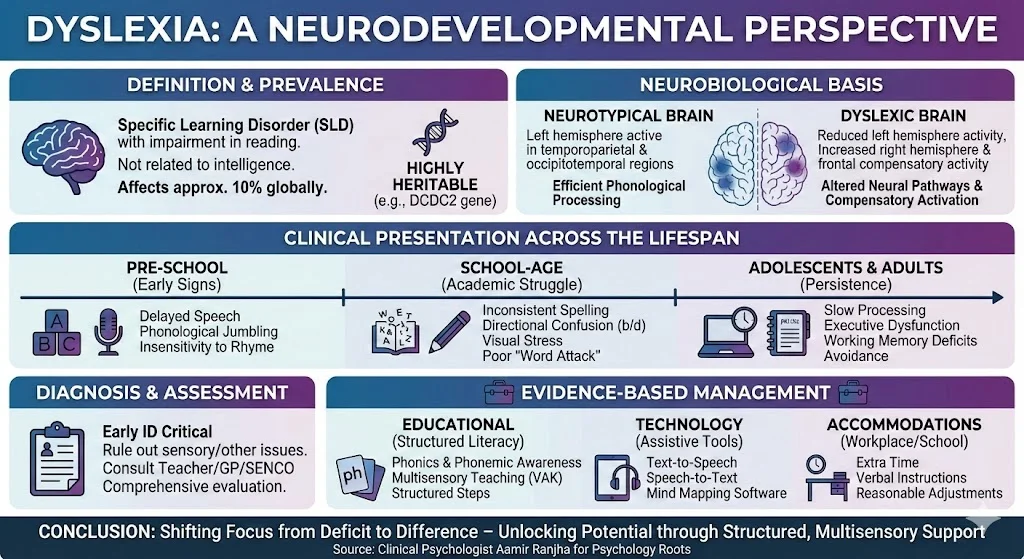
Dyslexia is frequently misunderstood as merely a reading problem or a sign of low intelligence. In clinical practice and academic research, we define it as a specific learning difficulty that affects abilities such as reading, writing, and spelling. Contrary to common misconceptions, dyslexia is unrelated to a person’s general level of intelligence. It represents a variation in how the brain processes information rather than a lack of ability.
Epidemiological data estimates that up to 1 in every 10 people in the UK has some degree of dyslexia. While it is a lifelong condition that can present daily challenges, individuals can achieve significant success with appropriate support. This article explores the etiology, clinical presentation, and management of dyslexia through a rigorous psychological lens.
The Neurobiological Basis of Dyslexia
To understand dyslexia, we must look beyond behavior to the brain’s architecture. Dyslexia is highly heritable and often runs in families. Research suggests that certain inherited genes may act together to affect how parts of the brain develop during early life.
Dyslexia is fundamentally characterized by a difficulty in recognizing the different sounds that make up words and relating these sounds to letters. This deficit lies in phonological awareness, which is the ability to recognize and manipulate smaller units of sound, or phonemes.
Clinical Presentation Across the Lifespan
The signs of dyslexia differ from person to person. As clinicians, we look for a unique pattern of strengths and weaknesses in each individual.
1. Pre-School: The Early Warning Signs
Symptoms can sometimes be detected before a child starts school. Red flags in early development include:
- Delayed Speech: Speech development may be slower compared to other children of the same age.
- Phonological Retrieval Issues: Children may have speech problems, such as jumbling phrases (e.g., saying “hecilopter” instead of “helicopter”) or being unable to remember the right word to use.
- Insensitivity to Rhyme: There is often little understanding or appreciation of rhyming words or nursery rhymes.
- Lack of Interest in Letters: A child may show difficulty with, or little interest in, learning the alphabet.
2. School-Age Children: The Academic Struggle
Signs usually become apparent when a child begins to focus on learning to read and write. Key indicators include:
- Inconsistent Spelling: Spelling may be unpredictable and inconsistent.
- Directional Confusion: Children may put letters the wrong way round, such as writing “b” instead of “d”.
- Visual Disturbances: Some children describe letters as seeming to move or blur when reading.
- Poor Word Attack Skills: Young children often lack the ability to make sense of unfamiliar words by looking for smaller, known collections of letters.
- Sequencing Deficits: It is common to find it hard to carry out a sequence of directions or learn sequences like the days of the week.
3. Adolescents and Adults: Persistence and Compensation
In adulthood, the reading deficit often evolves into broader organizational challenges. Adults may exhibit:
- Organizational Difficulties: Individuals often struggle with planning, organization, and meeting deadlines.
- Memory Deficits: There may be a struggle to remember things such as a PIN or telephone number.
- Avoidance Behaviors: Adults may try to avoid reading and writing whenever possible.
- Written Expression Issues: Even knowledgeable individuals may have problems expressing that knowledge in writing.
Clinical Note: Despite these challenges, people with dyslexia often possess strong skills in other areas, such as creative thinking and problem solving.
Diagnosis and Assessment
Early diagnosis is critical; the earlier a child is diagnosed, the more effective interventions are likely to be. However, identification is difficult as signs are not always obvious.
If you are concerned about a child’s progress, the first step is to speak with their teacher. It is also vital to rule out other health problems with a GP, such as vision problems, hearing issues (e.g., glue ear), or other conditions like ADHD. If no underlying health issues explain the difficulty, the child may not be responding well to standard teaching methods.
Evidence-Based Management and Interventions
Management of dyslexia focuses on remediation and accommodation. While dyslexia is lifelong, specialist educational interventions can significantly help.
1. Educational Interventions
Most interventions focus on phonics, a technique that improves the ability to identify and process the sounds that make up words. Effective interventions often involve:
- Structured Learning: Teaching should be highly structured, developing in small steps with regular practice.
- Multisensory Teaching: This involves using several senses at the same time. For example, a child might see the letter “a”, say its name, and write it in the air simultaneously.
- Phonological Training: Teaching children to recognize sounds in spoken words and combine letters to create words.
2. Parental Support
Parents play a significant role in improving confidence. Helpful strategies include:
- Overlearning: Reading a favorite book repeatedly to reinforce understanding and familiarity.
- Shared Reading: Reading together and discussing what is happening in the story.
- Silent Reading: Allowing the child to read alone to encourage independence.
3. Assistive Technology and Workplace Adjustments
Technology serves as a vital bridge for older children and adults:
- Speech-to-Text: Speech recognition software can translate spoken words into written text, which is useful given that verbal skills are often stronger than writing skills.
- Text-to-Speech: Computers can read text aloud, reducing the burden of reading.
- Mind Mapping: Creating visual diagrams with images and keywords can be more effective than writing lists for planning.
Employers are required to make reasonable adjustments for employees with dyslexia. These may include allowing extra time for tasks, providing instructions verbally, or supplying assistive technology.
Conclusion
Dyslexia is a complex neurodevelopmental condition that affects a significant portion of the population. While it presents challenges with reading, writing, and organization, it does not define a person’s intelligence or potential for success. By understanding the signs and implementing structured, multisensory interventions, we can support individuals in overcoming these hurdles.
References
- American Psychiatric Association. (2022). Diagnostic and statistical manual of mental disorders (5th ed., text rev.).
- Peterson, R. L., & Pennington, B. F. (2015). Developmental dyslexia. The Lancet, 379(9830), 1997-2007.
- Snowling, M. J. (2013). Early identification and interventions for dyslexia: a contemporary view. Journal of Research in Special Educational Needs, 13(1), 7-14.
