 Psychology Roots
Table of Contents
Applied Behavior Analysis in Autism Intervention: Integrating Discrete Trial Training and Naturalistic Strategies
In the landscape of autism intervention, Applied Behavior Analysis (ABA) remains the most empirically supported framework for skill acquisition and behavior modification. However, the field has evolved significantly from early, rigid protocols. Today, clinical best practice dictates a sophisticated integration of structured methodologies, such as Discrete Trial Training (DTT), with flexible, learner-centric approaches known as Naturalistic Teaching.
This article provides a comprehensive analysis of these teaching methodologies, examining their mechanical underpinnings, indications for use, and the critical transition from acquisition to generalization in Early Intensive Behavioral Intervention (EIBI).
The Science of Behavior: Core Principles of ABA
At its core, ABA is a natural science devoted to investigating environmental factors that influence behavior. It is not merely a set of techniques but a systematic approach to understanding the functional relationship between an individual and their environment.
For children with disabilities, the primary goals of ABA are twofold: to decrease inappropriate behaviors and to increase socially appropriate behaviors. Research consistently demonstrates that early intervention, ideally commencing before age five, yields the most robust outcomes. A dose-response relationship exists, where comprehensive programs (often spanning 30+ hours per week) are correlated with significant gains in IQ, adaptive behavior, and functional communication.
Discrete Trial Training (DTT): Structure and Acquisition
Discrete Trial Training (DTT) is often the entry point for early learners who require a highly structured environment to master foundational skills. It breaks complex behaviors down into small, measurable units, teaching them through simplified, repeated trials.
The Four-Term Contingency
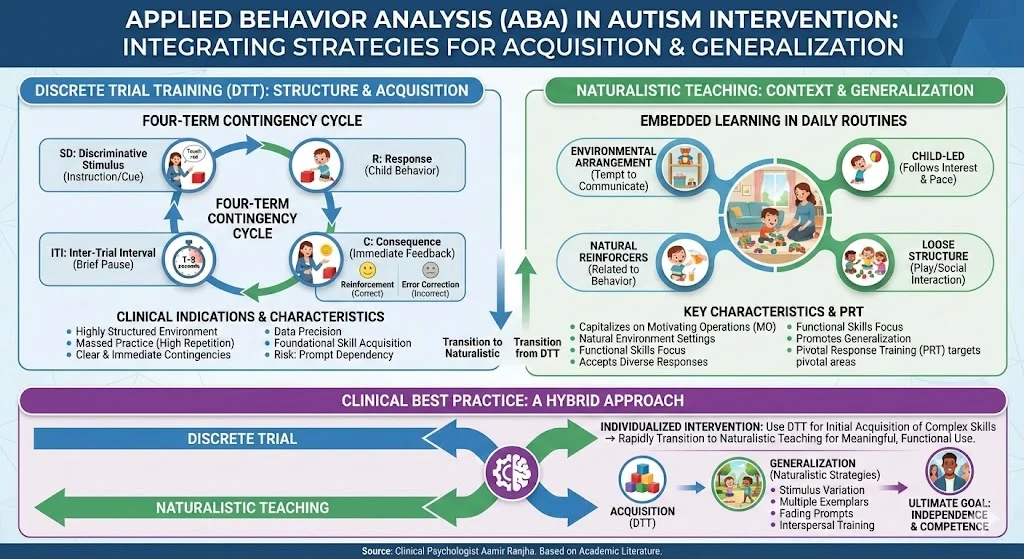
DTT operates on a precise behavioral loop, often described as the four-term contingency:
- Discriminative Stimulus (SD): The instruction or cue, which can be verbal or non-verbal (such as an object or picture). This signals that reinforcement is available for a specific response.
- Response (R): The child’s behavior, which may be correct, incorrect, or absent.
- Consequence (C): Immediate feedback. Correct responses receive reinforcement, while incorrect responses trigger error correction or extinction.
- Inter-Trial Interval (ITI): A brief pause before the next trial begins, allowing for distinct separation between learning opportunities.
Clinical Indications for DTT
DTT is particularly effective for establishing a “good learner” repertoire in children who struggle with attention or discrimination. By stripping the environment of distractions and using contrived reinforcers, clinicians can ensure high rates of responding. It allows for:
- Massed Practice: Rapid repetition of a specific skill, providing numerous opportunities to practice.
- Clear Contingencies: The cause-and-effect relationship between behavior and consequence is explicit and immediate.
- Data Precision: The structured nature of DTT makes data collection on acquisition rates straightforward and reliable.
However, the rigidity of DTT can lead to challenges with generalization, as it often uses stimuli and reinforcers not present in the natural environment.
The Evolution toward Naturalistic Teaching
To address the limitations of DTT, particularly regarding generalization, contemporary ABA emphasizes Naturalistic Teaching. This approach embeds learning trials into the child’s natural environment and daily routines.
Key Characteristics of Naturalistic Teaching
Unlike DTT, which is often therapist-led, naturalistic teaching emphasizes following the child’s interest, lead, or pace. It capitalizes on the child’s Motivating Operations (MO): momentary states that alter the value of a reinforcer, such as deprivation or satiation.
- Environmental Arrangement: The clinician arranges the setting to tempt the child to communicate, often using stimuli from the child’s natural environment.
- Natural Reinforcers: The reinforcer is directly related to the behavior. If a child requests an item, they receive that item rather than an unrelated reward.
- Loose Structure: Trials occur during play or social interaction, mimicking the flow of natural conversation and accepting diverse responses.
Pivotal Response Training (PRT)
A prominent naturalistic model is Pivotal Response Training. PRT targets “pivotal” areas of development rather than individual behaviors. It is structured enough to teach complex play skills yet flexible enough to allow creativity. Research indicates that children who are developmentally ready can learn to engage in spontaneous, creative play similar to language-age matched peers via PRT.
Bridging the Gap: Generalization and Maintenance
A common critique of traditional ABA is the “train and hope” methodology. Effective intervention requires active planning for generalization: the ability to perform a skill across different people, settings, and stimuli.
Strategies for Generalization
- Stimulus Variation: Clinicians must expand the stimulus class by using different stimuli and instructions, rather than relying on a single cue.
- Multiple Exemplars: Teaching sufficient examples of a concept ensures the child understands the category broadly.
- Fading Prompts: Systematic prompt fading is crucial to prevent prompt dependency. The goal is to transfer stimulus control from the therapist’s prompt to the natural environmental cue.
- Interspersal Training: Mixing maintenance tasks (mastered skills) with acquisition tasks (new skills) builds behavioral momentum and keeps the learner engaged.
Critical Analysis: The Necessity of a Hybrid Approach
In clinical practice, the dichotomy between DTT and Naturalistic Teaching is often a false one. The most effective intervention plans are individualized, employing DTT to introduce new, complex skills that require high repetition, and rapidly transitioning to Naturalistic Teaching to ensure those skills are functional and generalized.
Furthermore, ethical considerations in modern ABA demand that we prioritize the learner’s experience. Naturalistic approaches, by virtue of following the child’s lead, inherently respect the learner’s autonomy and reduce the likelihood of problem behaviors often associated with high demands.
Recent meta-analyses suggest that while DTT is superior for specific rote skills, naturalistic interventions produce better outcomes for social communication and adaptive behavior. Therefore, a competent behavior analyst must be fluent in both methodologies, modulating the instructional style based on the learner’s immediate needs and developmental trajectory.
Conclusion
The effective application of ABA requires more than the rote implementation of procedures; it requires clinical judgment and a deep understanding of behavioral principles. While Discrete Trial Training offers the structure necessary for initial skill acquisition, Naturalistic Teaching provides the context required for those skills to become meaningful. By synthesizing these approaches and focusing on early, intensive, and generalized intervention, clinicians can profoundly alter the developmental trajectory of children with autism, fostering not just compliance, but true independence and competence.
References
- Easter Seals Southeast Wisconsin. (n.d.). ABA & Teaching Methods [PDF]. Autism Speaks.
- Eldevik, S., Titlestad, K. B., Aarlie, H., & Tønnessen, R. (2024). Community implementation of early behavioral intervention: Higher intensity yields better outcomes. European Journal of Behavior Analysis, 21(1), 1-18.
- Koegel, L. K., Koegel, R. L., Ashbaugh, K., & Bradshaw, J. (2019). The importance of early identification and intervention for children with autism spectrum disorders. International Journal of Speech-Language Pathology, 21(2), 119-128.
- Leaf, J. B., Cihon, J. H., Ferguson, J. L., & Milne, C. M. (2022). Applied behavior analysis and autism: An introduction. Journal of Autism and Developmental Disorders, 52(1), 1-12.
- Valenti, M., Cerbo, R., Masedu, F., De Caris, M., & Sorge, G. (2023). Social communicative abilities and theory of mind in children with ASD: A systematic review of ABA interventions. Behavioral Sciences, 13(6), 814.
