 Psychology Roots
Table of Contents
Anxiety Disorders: Classification, Symptomatology, and Diagnostic Criteria
In clinical practice, differentiating between normative emotional responses and pathological states is a foundational diagnostic skill. Fear can be described as a natural emotion and is a response an individual shows when perceives or thought about threatening event. It serves an adaptive function by orienting the individual to environmental threatening stimuli. Conversely, anxiety is a natural prospect for future threat.
Anxiety disorders are group of disorders in which clients or patients have characteristics such as intemperate fear and anxiety and behavioural problems. These mental issues also cause physical problems like unnecessary autonomic arousal, flight of ideas, perceiving threatening stimulus without its actual presence all the time, muscle tension, and vigilance when one think about future. Fear and anxiety when act together and becomes overwhelming then becomes mental problem which are named as anxiety disorder.
Classification and Typology of Anxiety Disorders
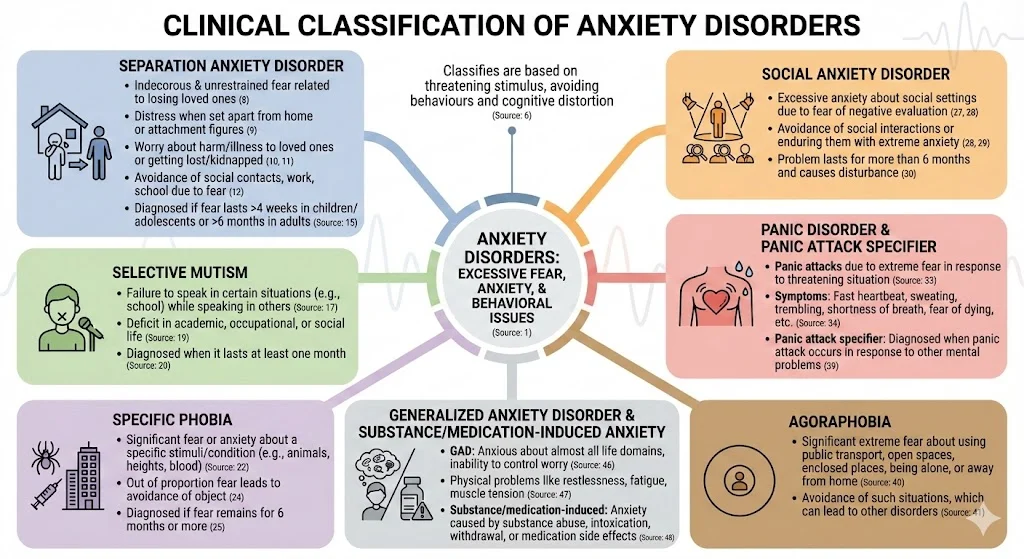
Anxiety disorders are of many types and each one is different from the other and this difference is based on threatening stimulus or condition, avoiding behaviours and cognitive distortion. Furthermore, the anxiety disorders are further classified according to the age of onset. The Diagnostic and Statistical Manual of Mental Disorders outlines several distinct presentations.
Separation Anxiety Disorder
Disorder in which there is Indecorous and unrestrained fear or anxiety related to losing loved ones (those with whom we have strong emotional attachment) is referred to as a separation anxiety disorder.
- The clients with these disorders pass through significant distress when they are set apart from home and other attachment figures.
- Such people become panic when they thought about losing their closed one and always remain worried about possible illness, injuries, traumatic event or death which may cause harm to their loved ones.
- They remained anxious about situations that never ever happened like if they got kidnapped, get lost, have accident, or become ill which may cause them to live apart from their attachment figure.
- In this situation individuals tend to remain at home, avoid social contacts, not go to work, and school just due to fear of separation.
- Such people also have complained such as headache, stomach pain, nausea, vomiting, fever when they are not with their loved one.
- If this fear remains for at-least four weeks in children and adolescents and more than 6 months in adults then psychologists, psychiatrist or other mental health specialists diagnose separation disorder to the client.
Selective Mutism
Historically referred to in some contexts alongside social phobia, selective mutism presents unique clinical challenges. It is a type of anxiety disorder in which client fails to speak in certain situation such as at school, peer group etc while speaks out in other situations.
- This disorder causes deficit in clients academic or occupational life and clients face problems in social setting while communicating with others.
- Mental health professional diagnoses this disorder when it remained for at-least one month.
- If child is not speaking in certain situation, one cannot say that he has lack of knowledge or have an autism disorder or other psychotic disorder.
Specific Phobia and Social Anxiety Disorder
A disorder in which there is significant fear or anxiety about a specific stimuli, condition or stimuli such as animal (snake, cockroach, line, mouse), Hight, blood, injection, water or fire. In this situation person tries to avoid that object because of its out of proportion fear. If this fear related to specific object or situation remains for 6 months o more then mental health professionals diagnose it as specific phobia.
Social anxiety disorder represents a broader interpersonal challenge. A type of anxiety disorder in which a person has excessive anxiety about social setting because he thought that people with inspect her, make him guilty or betrayed him.
- Individuals with this problem have people will negatively evaluate them due to their anxiousness.
- This problem lasts for more than 6 months and causes disturbance in day-to-day life.
- If the fear or anxiety is only in speaking and performing tasks in social interaction, then psychologists specify it in their diagnosis.
Panic Disorder and Agoraphobia
In this disorder a person has panic attack. Panic attacks is a condition caused due to extreme fear in response to threatening situation.
- Due to this fear the individuals heart starts pounding, heartbeat becomes fast, sweating, trembling, shortness of breath, coughing, pain in chest, nausea, staggering, heat sensations, numbness in hands, loss of contact with reality, fear of unvolunteered movements fear of dying and detachment from one self are the symptoms caused in panic attack.
- These symptoms vary from culture to culture.
- The psychologist or mental health professional cannot diagnose this condition as drug intoxication effect, hyperthyroidism, or cardiopulmonary disorder.
Agoraphobia is often conceptualized alongside panic etiology. It is defined as significant extreme fear about using public transportation, being in open spaces like parks, being in confined places like lift, standing alone or in number of people, and being apart from the home. In this situation individuals avoid such situation which induces extreme fear in them which can leads to depressive disorders or substance abuse disorder.
Generalized Anxiety Disorder (GAD)
The disorder in which a person feels anxious about almost all domains of life such as education and occupation etc and person feels himself unable to control the worry.
- This disorder also cause physical problems like restlessness, feels oneself apprehensive or edgy, feel fatigue all the time without any work, lack of attention and concentration, agitation, muscle tension and lack of sleep.
Substance or Medication-Induced Anxiety
The type of anxiety disorder in which anxiety is caused due to substance abuse, substance intoxication or withdrawal or as a side effect of any prescribed medication. Thorough pharmacological screening is essential prior to establishing a primary psychiatric diagnosis.
Critical Analysis and Clinical Implications
From a clinical teaching perspective, the assessment of anxiety disorders requires rigorous differential diagnosis. Clinicians must systematically evaluate whether avoidance behaviors stem from specific triggers, social evaluation fears, or the fear of subsequent panic attacks. Research consistently demonstrates that cognitive distortions play a central role in maintaining these maladaptive patterns.
For further contextualization, readers are encouraged to review related literature on Cognitive Behavioral Therapy efficacy, which remains the gold standard for treating the cognitive and somatic symptoms outlined above. Recognizing somatic manifestations, such as those seen in separation anxiety or panic disorder, prevents misattribution to purely physiological medical conditions.
Conclusion
Anxiety disorders encompass a heterogeneous cluster of conditions characterized by excessive fear, future-oriented apprehension, and significant behavioral avoidance. Accurate categorization based on the specific nature of the threatening stimulus and the duration of symptoms is imperative for effective clinical intervention and prognostic accuracy.
References
American Psychiatric Association. (2022). Diagnostic and statistical manual of mental disorders (5th ed., text rev.). https://doi.org/10.1176/appi.books.9780890425787
