 Psychology Roots
Table of Contents
What Is a School Psychologist? Roles, Training & Impact
In the popular imagination, the school psychologist is often reduced to a single function: the “tester.” A child struggles in class, disappears into an office for a few hours of cognitive assessments, and returns with a report. However, this view fundamentally misrepresents a dynamic and clinically sophisticated profession.
Today’s school psychologists are not merely gatekeepers of special education; they are the primary mental health architects within the educational ecosystem. Operating at the intersection of psychology and pedagogy, they employ evidence-based interventions to resolve the academic, social, behavioral, and emotional barriers that impede student success.
Research consistently demonstrates that the presence of school-based mental health professionals is associated with lower suspension rates, improved academic achievement (particularly in math and reading), and better student attendance. In this article, we will deconstruct the modern role of the school psychologist, exploring their training, their systemic impact, and the clinical methodologies they use to transform schools into environments of resilience.
Core Competencies and Rigorous Training
The title “School Psychologist” is a protected professional designation that requires specialized graduate training distinct from school counselors or clinical psychologists.
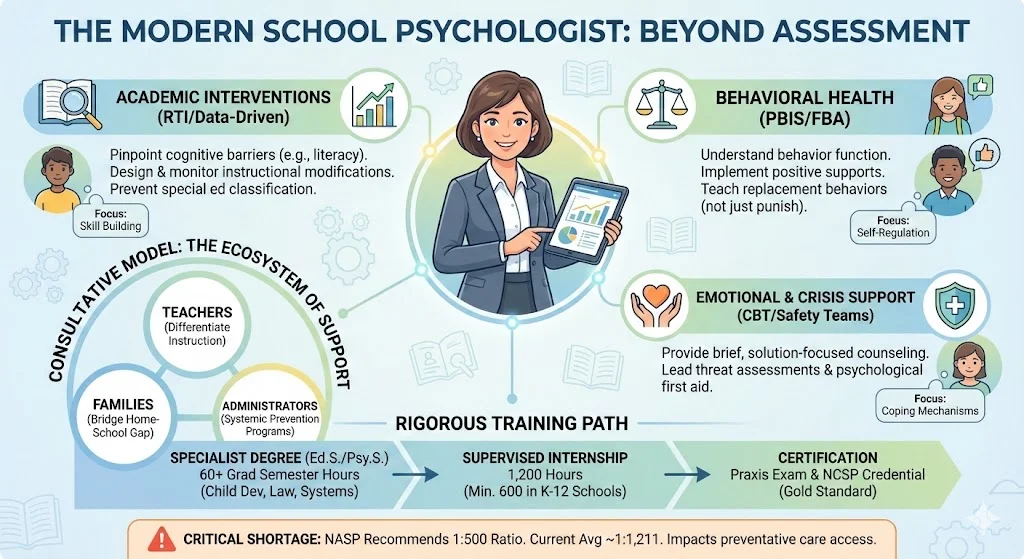
The entry-level standard for the profession is not a master’s degree, but rather a Specialist-level degree (Ed.S. or Psy.S.). This rigorous training typically encompasses:
- 60+ Graduate Semester Hours: Covering child development, psychometrics, school law, and systems theory.
- Supervised Internship: A minimum of 1,200 hours, with at least 600 hours completed in a K-12 school setting.
- Certification: Professionals must pass the Praxis School Psychologist exam and often pursue the Nationally Certified School Psychologist (NCSP) credential, the gold standard issued by the National Association of School Psychologists (NASP).
This training equips them to view a child’s difficulties not just as internal deficits, but as mismatches between the student’s needs and their environment.
The Ecosystem of Support: From Individual to System
School psychologists operate within a Multi-Tiered System of Supports (MTSS), providing services that range from individual therapy to school-wide climate improvement.
1. Academic Interventions (The “Tommy” Case)
When a student like “Tommy” struggles with literacy, the school psychologist moves beyond simple observation. They utilize Response to Intervention (RTI) data to pinpoint the specific cognitive breakdown—whether it is phonological awareness, processing speed, or working memory.
- Action: Instead of waiting for the student to fail, they design instructional modifications and monitor progress weekly.
- Outcome: Research shows that data-driven academic interventions can prevent the need for special education classification in up to 70% of at-risk readers.
2. Behavioral Health & Modification (The “David” Case)
For students exhibiting aggression or truancy, punitive measures like suspension are often ineffective. School psychologists conduct Functional Behavioral Assessments (FBAs) to understand the function of the behavior (e.g., escaping a difficult task or seeking peer attention).
- Action: They implement Positive Behavioral Interventions and Supports (PBIS), teaching replacement behaviors rather than simply punishing negative ones.
- Clinical Vignette: For a student like “David,” who acts out to avoid failure, the psychologist might implement a “token economy” system that rewards task completion and self-regulation.
3. Emotional & Crisis Support (The “Carla” Case)
Anxiety and family trauma are silent barriers to learning. School psychologists are trained in Cognitive Behavioral Therapy (CBT) adapted for school settings.
- Action: For “Carla,” whose academic withdrawal stems from parental divorce, the psychologist provides brief, solution-focused counseling to build coping mechanisms.
- Crisis Response: They also lead school safety teams, conducting threat assessments and providing “psychological first aid” after tragic events like student deaths or community violence.
Collaboration: The Consultative Model
A school psychologist rarely works in isolation. A significant portion of their role involves consultation—an indirect service delivery model where they empower adults to support students.
- With Teachers: They help educators differentiate instruction and manage classroom behavior, reducing teacher burnout and improving classroom climate.
- With Families: They bridge the gap between home and school, teaching parenting skills and connecting families with community mental health resources.
- With Administrators: They analyze school-wide data (e.g., bullying reports, office referrals) to identify systemic issues and implement prevention programs.
Critical Analysis: The Shortage Crisis
Despite their proven value, the profession faces a critical shortage. NASP recommends a ratio of 1 school psychologist for every 500 students. However, current national averages hover around 1:1,211, with some districts exceeding 1:5,000.
This scarcity forces many psychologists into a “test-and-place” triage role, limiting their ability to provide the preventative mental health care that research supports. Advocacy for lower ratios is not just a professional issue; it is a matter of equity for students who rely on schools as their primary source of mental health access.
Conclusion
The modern school psychologist is a data scientist, a clinician, and an advocate wrapped in one. By shifting the focus from “what is wrong with this child?” to “how can we support this child’s ecosystem?”, they fundamentally alter the trajectory of students’ lives.
For students like Tommy, Carla, and David, the school psychologist is often the difference between dropping out and breaking through. As education continues to grapple with the mental health crisis among youth, the role of these professionals has never been more essential.
Would you like me to develop a specific case study (e.g., a detailed FBA plan for a disruptive student) to illustrate these concepts further?
References
- UMass Global. (n.d.). What Does a School Psychologist Do?
- Parallel Learning. (n.d.). School Psychologists: Roles and Responsibilities.
- Research.com. (2025). 2026 School Psychology Careers: Guide to Career Paths, Options & Salary.
- School Mental Health. (n.d.). Evidence-based, Best-practices Educational Interventions.
- NIH. (2022). Bringing Evidence-Based Interventions into the Schools.
- Brain Tech Clinic. (n.d.). The Role of Evidence-Based Interventions in School Psychology.
- PMC. (2022). Sustaining BEST in CLASS: Teacher-Reported Evidence-Based Practice.
- PMC. (2013). The Critical Role of School Psychology in the School Mental Health Movement.
- ResearchGate. (2025). Impact of a School-Based Mental Health Program on Academic Outcomes.
- PMC. (2021). The Effect of School Psychologists and Social Workers on School Achievement.
- Psychology.org. (2025). How to Become a School Psychologist: A Step-By-Step Guide.
- ProCare Therapy. (2024). School Psychologist License Guide.
