 Psychology Roots
Table of Contents
Teacher Expectations & Student Competence: The Role of Autonomy Support
For decades, educational psychology has grappled with the “Pygmalion Effect”, the phenomenon where a teacher’s expectations significantly influence a student’s academic trajectory. We know that when a teacher expects a student to excel, that student often does. Conversely, low expectations can stifle potential. However, a critical question remains: Are students helpless recipients of these expectations, or does the classroom climate determine their vulnerability?
A seminal study by Trouilloud, Sarrazin, Bressoux, and Bois (2006) provides a compelling answer. It suggests that the motivational climate, specifically, whether it is autonomy-supportive or controlling, acts as a powerful moderator. In my years of clinical observations and academic supervision, I have found that environments fostering self-determination can effectively “immunize” students against the negative impact of low teacher expectations.
This article dissects the mechanics of this relationship, integrating the 2006 findings with broader Self-Determination Theory (SDT) to offer actionable insights for educators and psychologists.
The Pygmalion Effect in the Classroom
The concept of Teacher Expectation Effects (TEE) posits that a teacher’s belief about a student’s ability leads to differential treatment, which the student eventually internalizes. This becomes a self-fulfilling prophecy (Jussim & Harber, 2005).
- The Cycle: A teacher believes a student is “gifted.” The teacher provides more challenging material, warmer feedback, and more patience. The student perceives themselves as competent, exerts more effort, and ultimately achieves higher results, confirming the teacher’s initial belief.
- The Risk: The inverse is equally potent. Low expectations often lead to criticism, less autonomy, and simpler tasks, causing the student to doubt their competence.
However, TEE is not a universal law; it is probabilistic. Recent meta-analyses suggest TEE accounts for a moderate portion of student variance (Hattie, 2023), implying that other factors—moderators—can amplify or dampen these effects.
The Moderator: Autonomy-Supportive Climate
The Trouilloud et al. (2006) study, conducted within Physical Education (PE) classes, introduced a crucial variable: Autonomy Support.
According to Self-Determination Theory (SDT), an autonomy-supportive climate is one where the authority figure (teacher):
- Acknowledges the student’s perspective.
- Provides meaningful choices.
- Encourages self-initiation.
- Minimizes the use of coercive pressure or rewards (Reeve, 2002).
In contrast, a Controlling Climate relies on directives, threats, and rigid evaluations, forcing students to think and act in specific ways.
Key Findings from the Longitudinal Analysis
Trouilloud and colleagues followed 421 students and 22 teachers over a full academic year. Their multilevel analysis yielded three groundbreaking insights:
- Confirmation of TEE: Teachers’ early-year expectations significantly predicted students’ perceived competence at the end of the year, even after controlling for prior ability.
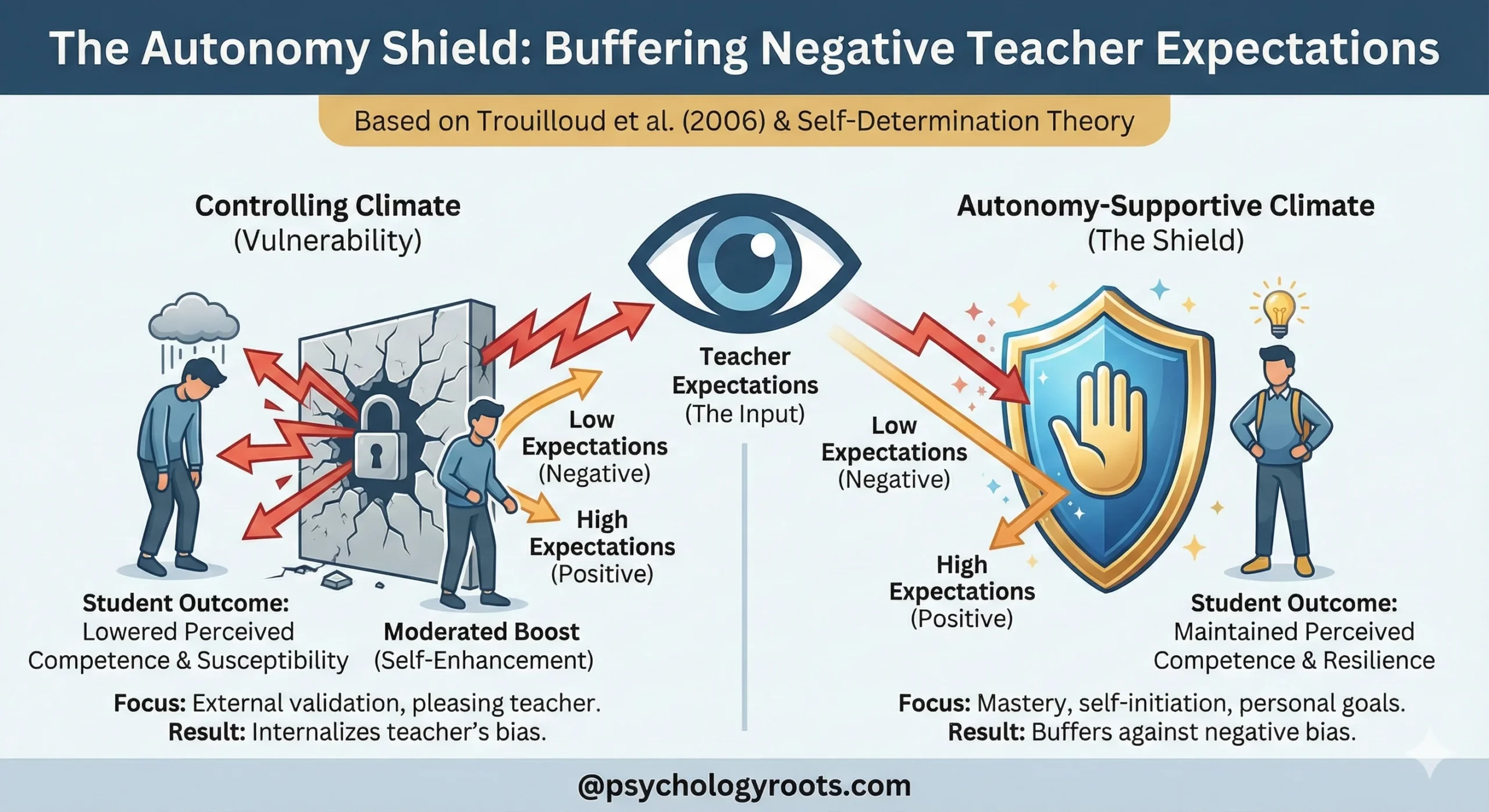
- The “Curvilinear” Effect: High expectations were more powerful in boosting competence than low expectations were in damaging it. This aligns with Self-Enhancement Theory—students are motivated to accept positive feedback that boosts self-esteem while filtering out negative cues (Sedikides, 1993).
- The Buffering Effect (Crucial Finding): The relationship between teacher expectations and student competence was strongest in controlling classrooms.
- In Low Autonomy environments, students were highly susceptible to teacher expectations. If the teacher thought they were “bad,” they felt incompetent.
- In High Autonomy environments, the link between teacher expectations and student self-perception vanished. The autonomy-supportive climate effectively “buffered” the students, allowing them to maintain perceived competence regardless of what the teacher thought.
Why Does Autonomy Support Protect Students?
The mechanism behind this buffering effect lies in the locus of causality.
1. Susceptibility in Controlling Environments
In a controlling classroom, students develop an extrinsic motivational orientation. They learn that success depends on satisfying the teacher’s demands. Their sense of self-worth becomes contingent on external feedback. Consequently, they become hyper-vigilant to the teacher’s cues (voice tone, criticism, praise). If a controlling teacher holds low expectations, the student has no internal resource to counter that narrative and accepts the label of “incompetent” (Guay et al., 2001).
2. Resilience in Autonomy-Supportive Environments
In an autonomy-supportive classroom, students are encouraged to internalize their learning goals. They focus on mastery and self-improvement rather than external validation. When a student feels they are the “origin” of their behavior (internal locus of causality), they rely less on the teacher’s implicit biases. Even if a teacher holds low expectations, the autonomy-oriented student perceives feedback as information to improve, rather than a judgment of their fixed worth.
Clinical Note: We observe this in therapy frequently. Individuals with high self-determination are less likely to internalize negative projections from authority figures, viewing them instead as external data points rather than truths about their identity.
Implications for Educational Practice
The implications of this research are profound for pedagogical reform. We cannot simply ask teachers to “have high expectations” for everyone, as unconscious biases are difficult to eradicate. However, we can restructure the classroom climate.
Strategies for an Autonomy-Supportive “Shield”
- Provide Choice: Allow students to select difficulty levels or methods of task completion. This shifts the focus from “pleasing the teacher” to “mastering the challenge.”
- Rationales over Rules: Explain why a task is important. Understanding the value of an activity fosters internalization.
- Empathy for Resistance: When students struggle, acknowledge their feelings (e.g., “I know this drill is tiring”) rather than criticizing their effort.
- Minimise Controlling Language: Reduce the use of “should,” “must,” and “have to.” Use inviting language like “you might find it helpful to…”
By adopting these behaviors, teachers can ensure that even if they inadvertently harbor low expectations for certain students, those students remain resilient and motivated.
Conclusion
The relationship between a teacher and student is dynamic, not deterministic. While the Pygmalion Effect highlights the power of belief, the work of Trouilloud et al. (2006) highlights the power of climate. A controlling environment weaponizes expectations, making students vulnerable to bias. An autonomy-supportive environment disarms this weapon, empowering students to define their own competence.
For educators and psychologists, the mandate is clear: To protect student well-being, we must move beyond merely managing behaviors to cultivating environments where autonomy can thrive.
References
- Deci, E. L., & Ryan, R. M. (2002). Handbook of self-determination research. University of Rochester Press.
- Guay, F., Boggiano, A. K., & Vallerand, R. J. (2001). Autonomy support, intrinsic motivation, and perceived competence: Conceptual and empirical linkages. Personality and Social Psychology Bulletin, 27(6), 643-650.
- Hattie, J. (2023). Visible Learning: The Sequel. Routledge.
- Jussim, L., & Harber, K. D. (2005). Teacher expectations and self-fulfilling prophecies: Knowns and unknowns, resolved and unresolved controversies. Personality and Social Psychology Review, 9(2), 131-155.
- Reeve, J. (2002). Self-determination theory applied to educational settings. In E. L. Deci & R. M. Ryan (Eds.), Handbook of self-determination research (pp. 184-203). University of Rochester Press.
- Sedikides, C. (1993). Assessment, enhancement, and verification determinants of the self-evaluation process. Journal of Personality and Social Psychology, 65(2), 317–338.
- Trouilloud, D., Sarrazin, P., Bressoux, P., & Bois, J. (2006). Relation between teachers’ early expectations and students’ later perceived competence in physical education classes: Autonomy-supportive climate as a moderator. Journal of Educational Psychology, 98(1), 75–86.
- Wang, S., Rubie-Davies, C. M., & Meissel, K. (2018). A systematic review of the teacher expectation literature over the past 30 years. Educational Research and Evaluation, 24(3-5), 124-179.
