 Psychology Roots
Table of Contents
Foundations of Developmental Psychology: Methodological Approaches and Influencing Factors
Developmental psychology constitutes a foundational pillar of psychological science. It examines the profound transformations that occur across the human lifespan. From the imitative reflexes of a newborn to the cognitive shifts experienced in late adulthood, the discipline seeks to understand how and why human beings change over time. As clinical practitioners and researchers, we must view these developmental trajectories through a rigorous empirical lens. This article delineates the fundamental issues, biological and environmental determinants, and methodological frameworks that define contemporary developmental science.
Core Debates in Developmental Psychology
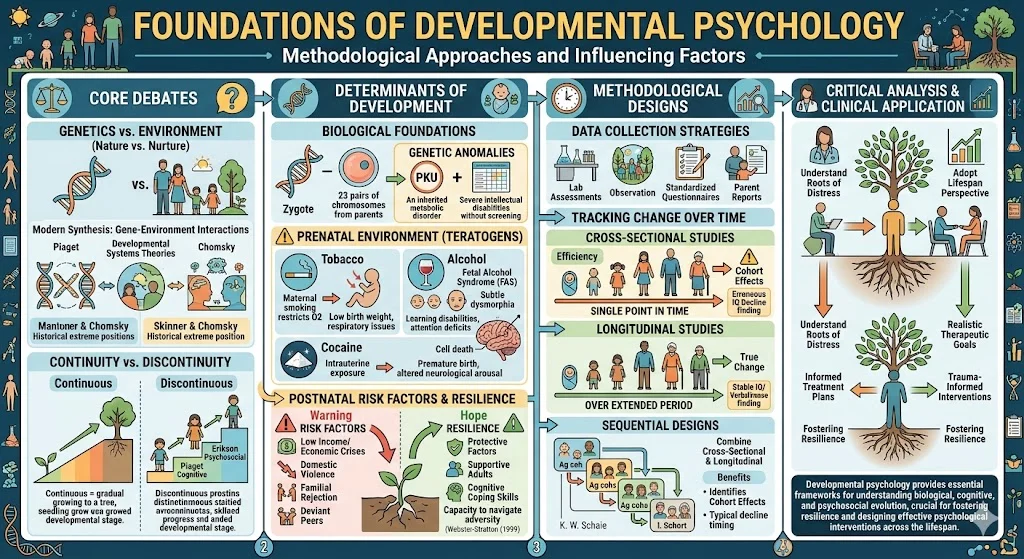
The study of human development is historically anchored in several central theoretical debates. These paradigms dictate how researchers interpret behavioral, cognitive, and emotional changes across the lifespan.
The Interaction of Genetics and Environment
The historical dichotomy of nature versus nurture has evolved into a nuanced understanding of gene-environment interactions. Early theoretical perspectives often adopted extreme positions. For instance, radical behaviorists like B. F. Skinner posited that human abilities are predominantly the result of environmental conditioning and reinforcement. Conversely, nativists like Noam Chomsky argued for innate, biologically predetermined structures, particularly concerning language acquisition. Modern developmental psychologists align closer to Jean Piaget and contemporary developmental systems theories, which propose that both inherited genetic blueprints and environmental contexts interact reciprocally to shape developmental outcomes.
Continuity versus Discontinuity
Another fundamental debate concerns the trajectory of change. Continuous development views change as a gradual, cumulative process, much like the growth of a tree. Discontinuous development posits that humans progress through distinct, qualitative stages, such as Piagetian stages of cognitive development or Eriksonian psychosocial stages. Empirical evidence suggests that development encompasses both mechanisms, depending on the specific cognitive or physical domain under investigation.
Biological and Environmental Determinants of Development
Understanding typical and atypical development requires a thorough analysis of the biological vulnerabilities and environmental risk factors that influence the growing organism.
Genetic Foundations and Anomalies
Human development begins with the zygote, containing 23 pairs of chromosomes comprising genetic material randomly selected equally from the mother and the father. These genes orchestrate cellular division and systemic specialization. However, genetic anomalies can profoundly disrupt developmental pathways. A prime clinical example is Phenylketonuria (PKU), an inherited metabolic disorder. Without early genetic screening and strict dietary intervention, the accumulation of phenylalanine leads to severe intellectual disabilities. This highlights the critical intervention window where environmental modifications can mitigate genetic vulnerabilities.
Teratogenic Influences
The prenatal environment is highly susceptible to external chemical agents known as teratogens. The impact of these substances depends on the dosage, timing of exposure, and genetic susceptibility of the fetus.
- Tobacco: Maternal smoking restricts oxygen supply to the fetus and reduces fetal movement. It is consistently associated with low birth weight and compromised respiratory outcomes.
- Alcohol: Prenatal alcohol exposure can result in the death of developing brain cells. Excessive consumption leads to Fetal Alcohol Syndrome (FAS), characterized by facial dysmorphia, severe learning disabilities, and enduring attention deficits.
- Cocaine: Intrauterine cocaine exposure is linked to premature birth, altered neurological arousal, and subsequent deficits in sustained attention and emotional regulation.
Environmental Risk Factors and Resilience
Beyond the prenatal environment, postnatal psychosocial factors exert immense pressure on developmental trajectories. Webster-Stratton (1999) identified several critical risk factors that compromise child development. These include low family income, economic crises, domestic violence, familial rejection, and association with deviant peer groups.
Despite these risks, clinical psychology places significant emphasis on resilience. Resilience refers to the capacity of individuals to navigate and overcome profound adversity. Effective intervention programs designed to bolster protective factors, such as supportive non-parental adult relationships and cognitive coping skills, are vital in redirecting high-risk youths toward adaptive developmental outcomes.
Methodological Designs in Developmental Research
To study the progression of human development accurately, researchers must employ specialized research designs. Standard experimental designs, which involve random assignment and variable manipulation, are often precluded by ethical constraints. Therefore, developmental scientists rely heavily on non-experimental or quasi-experimental methods to track change over time.
Cross-Sectional and Longitudinal Approaches
- Cross-Sectional Studies: This design involves comparing different age groups at a single point in time. While highly efficient, cross-sectional designs can be confounded by cohort effects. For example, early cross-sectional studies erroneously suggested a steep decline in intelligence (IQ) beginning in early adulthood.
- Longitudinal Studies: By tracking the same individuals over an extended period, longitudinal designs isolate true developmental change. These studies revealed that verbal intelligence often increases or remains stable well into late adulthood.
- Sequential Designs: To overcome the limitations of both aforementioned methods, researchers like K. W. Schaie utilized sequential designs. By combining cross-sectional and longitudinal approaches, sequential studies demonstrated that cognitive decline in areas like processing speed typically occurs in the late sixties, though significant individual variability exists.
Data Collection Strategies
Methodological rigor also relies on diverse data collection techniques. Researchers utilize laboratory-based assessments, naturalistic observations in homes and schools, standardized questionnaires, and detailed parental reports. Each method possesses distinct advantages and vulnerabilities regarding ecological validity and observer bias.
Critical Analysis: Bridging Theory and Clinical Practice
In clinical practice, we often observe that psychological distress in adulthood has profound roots in early developmental disruptions. The integration of developmental psychology into clinical frameworks allows practitioners to adopt a lifespan perspective. Understanding that a child presenting with behavioral issues may be reacting to systemic family stressors, rather than exhibiting a primary psychopathology, drastically alters the treatment plan. Furthermore, acknowledging the neurobiological impact of teratogens or early neglect helps clinicians set realistic therapeutic goals and apply trauma-informed interventions. Academic knowledge must continuously inform clinical application to ensure that psychological interventions are empirically supported and developmentally appropriate.
Conclusion
Developmental psychology offers an indispensable framework for understanding the biological, cognitive, and psychosocial evolution of the human being. By navigating complex debates regarding genetics and environment, recognizing the profound impact of risk factors, and employing rigorous research methodologies, the field continues to advance our understanding of human growth. For clinicians and researchers alike, maintaining a developmental perspective is crucial for fostering resilience and designing effective psychological interventions across the lifespan.
References
- Berk, L. E. (2017). Development through the lifespan (7th ed.). Pearson.
- Schaie, K. W. (1989). The hazards of cognitive aging. The Gerontologist, 29(4), 484-493. https://doi.org/10.1093/geront/29.4.484
- Webster-Stratton, C. (1999). How to promote children’s social and emotional competence. Sage Publications.
