 Psychology Roots
Table of Contents
Transitioning to APA 7th Edition
The evolution of academic standards reflects the maturation of our scientific disciplines. For professionals and students in clinical psychology, adherence to the Publication Manual of the American Psychological Association (APA) is not merely a stylistic preference; it is a foundational requirement for rigorous empirical communication.
The transition from the 6th to the 7th edition of the APA manual introduces critical modifications designed to enhance readability, promote inclusivity, and simplify the citation of digital sources. In my tenure supervising postgraduate research, I have observed that mastering these mechanical guidelines significantly elevates the clarity and authority of a manuscript. This article delineates the primary adjustments required for immediate implementation in academic writing.
Streamlining Citations and the Reference List
The 7th edition prioritizes conciseness in the main text while demanding greater comprehensiveness in the reference list.
In-Text Citations for Multiple Authors
Previously, navigating the rules for sources with three to five authors required listing all authors upon the first citation. The updated protocol simplifies this process.
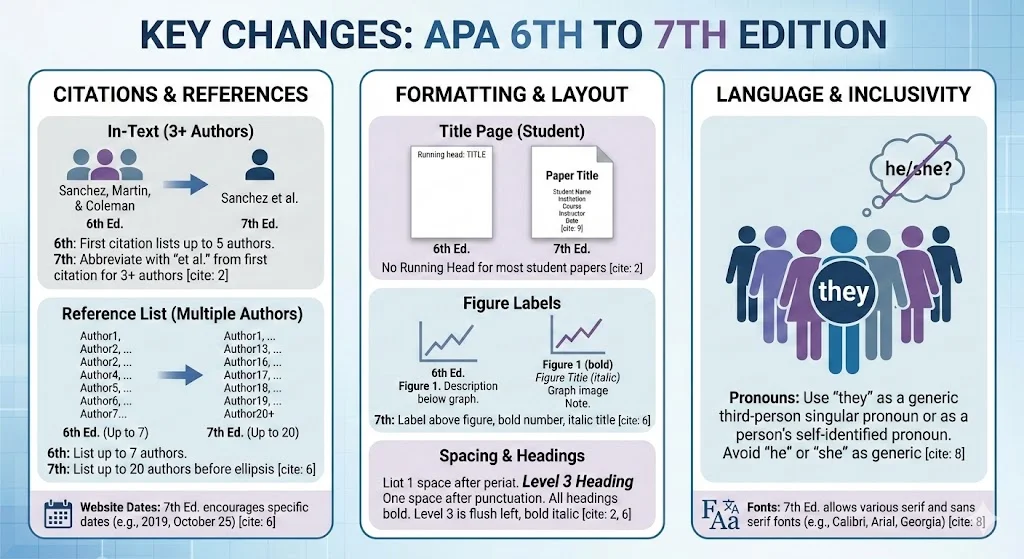
- For any source with three or more authors, you must abbreviate the citation from the very first use by providing the first author’s name followed by “et al.”.
- For example, a parenthetical citation will appear as (Sanchez et al., 2019), and a narrative citation will appear as Sanchez et al. (2019) .
Reference List Expansion
While in-text citations have been abbreviated, the reference list now requires more robust author documentation.
- Researchers must include all author names and initials for works with up to 20 authors.
- If a publication has more than 20 authors, you must write out the first 19 names, insert an ellipsis, and then provide the final author’s name.
- Furthermore, periodical reference citations must always include the issue number if it is available, regardless of whether the journal utilizes continuous pagination.
Digital and Online Sources
Digital referencing has been modernized to reflect current internet architecture.
- When referencing a website, provide the most specific date possible, such as 2019, October 25.
- The title of the specific webpage must be italicized.
- To avoid redundancy, omit the publisher’s name if the author and the website publisher are identical.
- A retrieval date is only required when the contents of a page are dynamic, unarchived, or designed to be updated regularly.
Structural and Formatting Adjustments
Readability and accessibility are central themes in the 7th edition, directly impacting how manuscripts are visually structured.
Font Flexibility and Spacing
The rigid requirement for 12-point Times New Roman has been lifted. Students and researchers may now utilize a variety of accessible fonts.
- Approved sans serif fonts include 11-point Calibri, 11-point Arial, and 10-point Lucida Sans Unicode.
- Approved serif fonts include 12-point Times New Roman, 11-point Georgia, and 10-point Computer Modern.
- Regardless of the chosen font, consistency must be maintained throughout the entire manuscript.
- Additionally, only a single space is required after all punctuation marks, including periods at the end of a sentence.
Title Pages and Running Heads
The formatting of the title page now differentiates strictly between professional and student papers.
- For student assignments, the paper title must be bold, in title case, and centered three to five line breaks from the top of the page.
- The student title page requires the student’s name, department, institution, course, instructor, and date, separated by single line breaks.
- Notably, the running head is no longer required for student papers, including undergraduate assignments, annotated bibliographies, and essays. Dissertations and theses, however, remain exceptions and may require running heads depending on institutional guidelines.
Heading Levels and Figure Labels
Hierarchical organization has been visually standardized.
- All heading levels are now bold.
- Level 3 headings, which were previously indented, are now positioned flush left, bold, italicized, and in title case.
- The presentation of figures has been aligned with the formatting of tables. The word “Figure” and its corresponding Arabic numeral must appear bold and flush left above the image.
- A brief figure title, formatted in italicized title case, must be placed immediately below the figure number.
Advancing Inclusive Language
Perhaps the most culturally significant update is the formal endorsement of the singular “they.”
- Writers are instructed to use a person’s self-identified pronoun, including the singular “they”.
- The singular “they” is also the designated generic third-person pronoun when an individual’s gender is unknown or irrelevant to the context.
- Writers must not use “he” or “she” alone as generic pronouns, nor should they use combinations like “he or she” unless those are confirmed as the subject’s preferred pronouns.
Critical Analysis
In clinical practice and academic research, precision is paramount. The modifications in the APA 7th edition are not arbitrary; they reflect a conscious shift toward accessibility, inclusivity, and digital literacy. By removing the running head for students and expanding font options, the APA acknowledges the varying technological environments of modern learners. The explicit guidelines regarding pronouns demonstrate a necessary evolution in psychological writing, ensuring our literature respects the identities of the populations we study and serve.
Conclusion
Transitioning to the APA 7th edition requires deliberate unlearning of deeply ingrained habits, particularly regarding in-text citations and document spacing. However, these changes ultimately facilitate a more streamlined writing process. By adopting these updated standards, researchers and students ensure their work remains professional, accessible, and aligned with the current empirical landscape.
References
American Psychological Association. Publication Manual of the American Psychological Association–7th ed. Washington, DC: American Psychological Association; 2020.
