 Psychology Roots
Table of Contents
Cognitive-Behavioral Mechanisms in Anger Management: A Clinical Framework for Mitigating Reactive Violence
In clinical practice and forensic psychology, distinguishing between the emotional experience of anger and the behavioral manifestation of aggression is critical for effective intervention. A common misconception equates anger, hostility, and aggression; however, these constructs represent distinct psychological experiences.
Anger operates as a fundamental human emotion that spans from mild frustration to severe rage. Hostility functions as a negative cognitive framework regarding the external environment. Aggression is defined as a specific behavior executed with the intent to cause harm to individuals or damage to property. The primary objective of structured anger management protocols is to equip individuals with control skills to prevent future violent behavior.
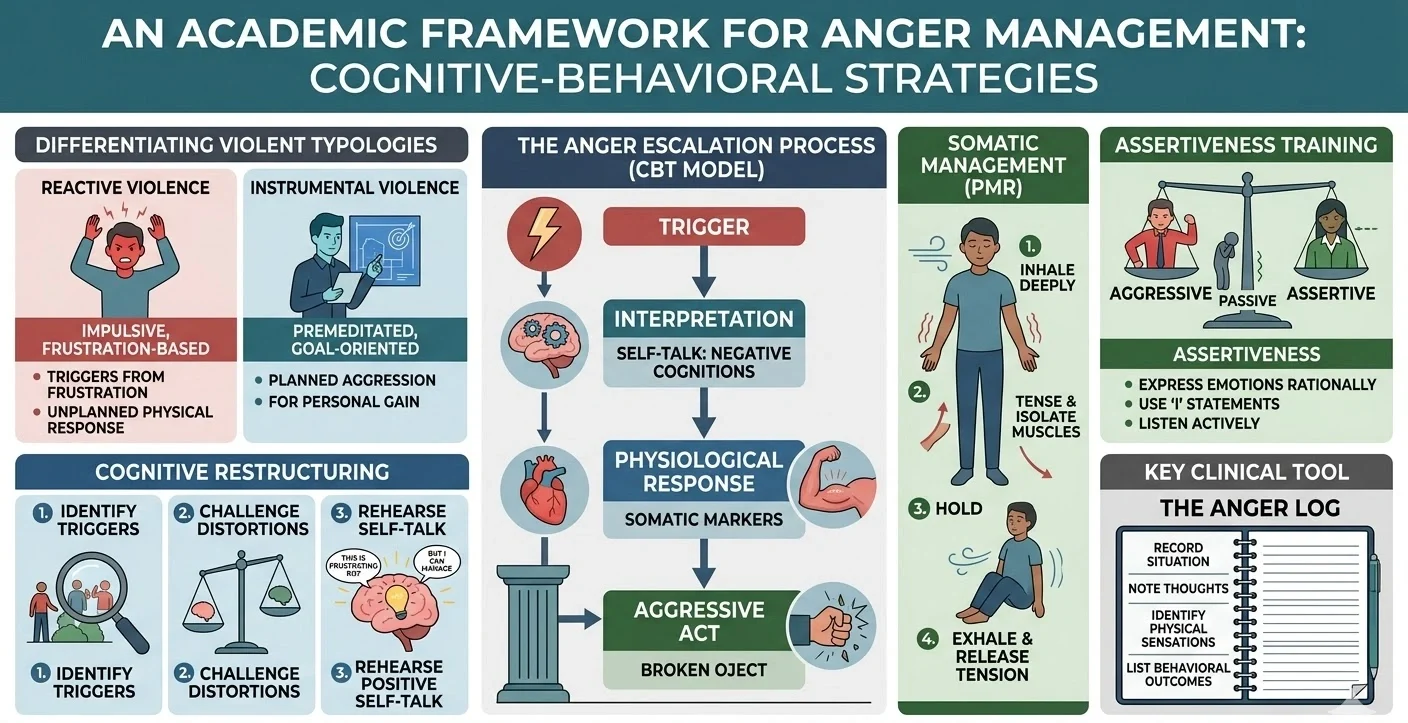
Differentiating Typologies of Violence
A comprehensive clinical assessment must differentiate between the underlying motivations for violent behavior. Interventions targeting anger are contraindicated for all typologies of violence.
- Reactive violence is characterized by an impulsive and angry physical response to frustration.
- This subtype is often precipitated by stimuli mistakenly perceived as personal insults.
- Instrumental violence involves intentionally harming another individual to secure a specific personal gain.
- Instrumental aggression is typically premeditated and goal-oriented.
Individuals exhibiting instrumental violence require interventions focused on criminal attitudes rather than traditional anger management, as their behavior is cognitively driven rather than emotion-driven. The strategies discussed herein are specifically designed for individuals demonstrating reactive violence.
Etiology of Anger: Internal and External Triggers
The onset of an anger episode is catalyzed by specific environmental or psychological stimuli, operationally defined as triggers. Recognizing these precipitating factors is a foundational step in developing adaptive coping mechanisms.
- External triggers originate from outside sources and the physical environment.
- Common external stimuli include interpersonal annoyances, instances of abuse, and perceived injustices.
- Internal triggers emerge from within the individual.
- These internal variables encompass specific thoughts, core beliefs, and accompanying emotional states.
Cognitive Restructuring and Self-Talk
Cognitive appraisal plays a crucial role in the escalation of anger. The manner in which an individual interprets a situation directly dictates their emotional and behavioral response. During high arousal states, cognitive processes can deteriorate, leading individuals to draw incorrect conclusions.
Automatic internal dialogue, or self-talk, often dictates these rapid escalations. Hostile self-talk operates automatically, frequently bypassing conscious awareness, which facilitates the rapid transition from anger to aggression. Clinical intervention requires a systematic approach to challenge and replace these cognitive distortions.
- Identify the specific trigger or situation initiating the negative mood.
- Articulate the automatic thoughts and expectations directed at others.
- Label and quantify the intensity of the resulting emotional states.
- Subject the negative thoughts to empirical scrutiny by demanding evidentiary support.
- Formulate and mentally rehearse positive, realistic self-statements to counteract future cognitive distortions.
Physiological Arousal and Somatic Management
Anger is not exclusively a cognitive or emotional phenomenon; it elicits profound physiological arousal. Recognizing somatic markers enables individuals to identify early stages of anger prior to behavioral acting out.
- Frequent physiological indicators include acute muscle tension and rapid cardiac acceleration.
- Secondary symptoms may manifest as profuse sweating, nausea, and changes in vocal tone.
To counteract this autonomic nervous system activation, clinicians prescribe progressive muscle relaxation. This technique requires the individual to deliberately inhale deeply, isolate and tense specific muscle groups, hold the tension, and subsequently exhale while releasing the muscular contraction. Sequential application across the entire body facilitates a reduction in physiological arousal and anger intensity.
Conflict Resolution and Assertiveness Training
Interpersonal conflict frequently arises when individuals perceive a violation of their personal rights. Modulating behavioral responses to these inevitable conflicts is a core competency in anger management.
- Passiveness involves suppressing anger and yielding to external demands.
- This approach fails to resolve the underlying problem and generates internalized resentment.
- Aggressiveness results in explosive reactions designed to inflict harm.
- This maladaptive strategy damages relationships and frequently leads to profound legal or psychosocial consequences.
- Assertiveness constitutes the optimal communication paradigm.
- Assertive communication involves expressing emotions rationally without resorting to aggression or demanding compliance.
Effective assertiveness requires congruent nonverbal communication, such as maintaining appropriate eye contact and an upright posture while minimizing exaggerated gestures. Furthermore, active listening mitigates misunderstandings. Techniques include providing direct attention, utilizing nonverbal feedback mechanisms, and withholding judgment until the speaker concludes their statement.
Clinical Application: The Anger Log
Behavioral modification necessitates rigorous self-monitoring. Clinicians utilize tools such as the Anger Log to help individuals systematically document their triggers. By recording the environmental context, physiological sensations, and behavioral outcomes of anger episodes, individuals can analyze their response patterns. This empirical data collection is vital for formulating alternative, prosocial responses to future provocations.
Critical Analysis: Empathy and Maintenance
Theoretical mastery of cognitive-behavioral techniques is insufficient without practical application. Retaining historical grievances impedes therapeutic progress. Consequently, cultivating empathy and practicing interpersonal forgiveness are necessary clinical objectives. By actively adopting the perspective of others, individuals can deconstruct hostile attributions and reduce subsequent aggressive impulses. Ultimately, the efficacy of these interventions relies upon continuous rehearsal in low-arousal environments to ensure skill generalization during acute crises.
Conclusion
The successful amelioration of reactive violence requires a multidimensional approach. Clinicians must educate individuals on the fundamental distinctions between emotional anger, hostile cognition, and aggressive behavior. By systematically mapping internal and external triggers, utilizing tools like the Anger Log, and aggressively challenging automatic negative thoughts, individuals can intercept the sequence of violence. Integration of physiological relaxation protocols and assertiveness training provides a robust framework for long-term behavioral regulation.
References
American Psychological Association. (2020). Publication manual of the American Psychological Association (7th ed.). https://doi.org/10.1037/0000165-000
Serin, R. C., McQuaid, S., & DeWolf, A. (2015). Anger management client handbook series. Carleton University, Criminal Justice Decision Making Laboratory & Ontario Ministry of Community Safety and Correctional Services.
